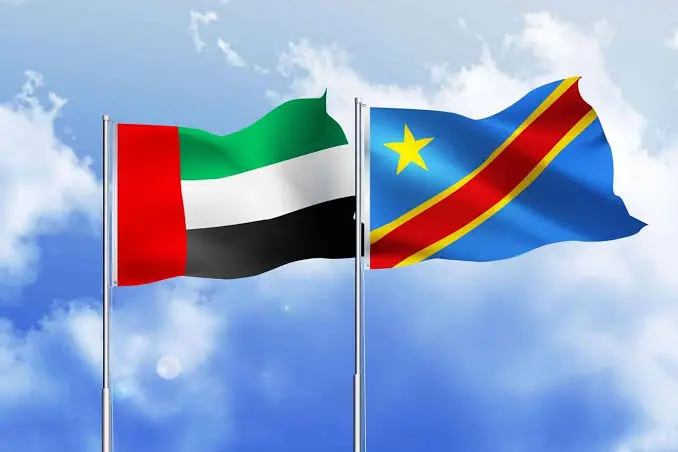
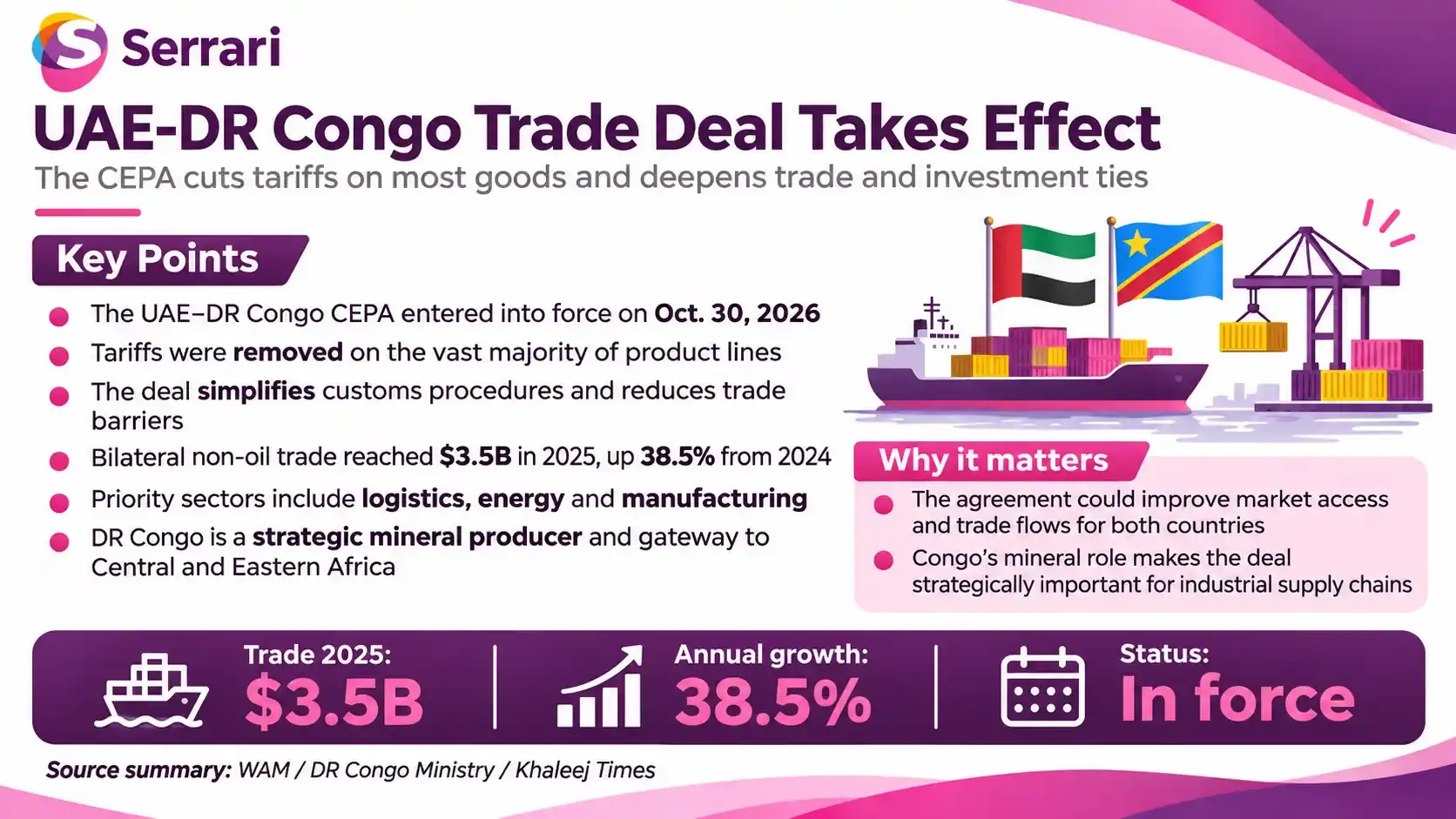
The United Arab Emirates’ Comprehensive Economic Partnership Agreement (CEPA) with the Democratic Republic of Congo (DRC) entered into force on October 30, 2026, removing tariffs on the vast majority of product lines and creating a new framework for trade and investment. The agreement builds on $3.5 billion in bilateral non-oil trade recorded in 2025, up 38.5% from the previous year. Both governments expect the pact to support trade in industrial goods and minerals while encouraging investment in logistics, energy and manufacturing.
Key Overview
- Effective date: October 30, 2026, when the UAE–DRC trade agreement became operational.
- Tariffs: Duties eliminated on the vast majority of product lines, alongside measures to simplify customs procedures.
- Trade: Bilateral non-oil trade reached $3.5 billion in 2025, a 38.5% annual increase before the deal took effect.
- Strategic sectors: Logistics, energy, manufacturing, machinery, vehicles and mineral supply chains.
- UAE trade strategy: The country reports 40 concluded CEPAs, of which 20 are in force, including the DRC agreement.
Trade Agreement Removes Tariffs and Eases Customs Barriers
The October 30 implementation announcement confirmed that the CEPA had entered into force, moving the bilateral relationship from an agreed framework to one that businesses can use for eligible trade.
The pact eliminates tariffs across most product categories, aligns customs procedures and seeks to reduce unnecessary administrative barriers. However, this does not mean every product automatically enters duty-free: businesses must check the relevant tariff schedules, origin rules and documentation before claiming preferences.
The DRC’s published agreement summary describes a broader framework covering goods, services, investment and economic cooperation. Its ambition extends beyond cheaper imports to attracting capital, strengthening technology transfer and supporting industrial development.
Bilateral Trade Reaches $3.5 Billion Before Implementation
UAE–DRC non-oil trade reached $3.5 billion in 2025, growing 38.5% from 2024, according to details of the bilateral trade relationship. That expansion preceded the October 2026 entry into force, so it cannot be attributed to tariff cuts introduced under the new agreement.
The DRC is a market for UAE exports including vehicles, machinery, electronics and construction materials. Meanwhile, the UAE acts as an international trading and logistics hub for Congolese exports such as metals, agricultural goods, cotton and food products.
Lower trade barriers could help companies diversify suppliers and buyers. Whether trade increases significantly will depend on logistics costs, regulatory compliance, business investment and the speed with which exporters adopt preferential arrangements.
Context is everything. Stay ahead of shifting trends with today’s market updates, and uncover emerging opportunities using the Serrari Group Market Index and Marketplace. Then, take control of your own financial future by exploring our Money & Life Reset Transformation Blueprint ™ to build stronger habits, create better systems, and design a path toward lasting wealth.
Congo’s Minerals Give the Deal Strategic Importance
The DRC is a major producer of minerals used in batteries, electrical systems and industrial equipment. It accounts for more than 70% of global cobalt output, according to the figures cited in the official trade announcement, and is a leading African copper producer. The country also supplies gold, tin, tantalum and tungsten.
Its position bordering nine countries makes it a potential entry point for commercial activity across Central and Eastern Africa. The UAE announcement put DRC gross domestic product at approximately $122.28 billion, with growth of 5.2%. Those are the figures used in the announcement; economic estimates can vary by source and update.
The mineral connection is particularly relevant as manufacturers and investors seek more diversified sources of raw materials for electric vehicles, electronics and energy infrastructure. Still, stronger trade flows alone do not guarantee that more processing or value addition will occur within the DRC.
Investment Opportunities and Next Steps
The agreement identifies logistics, energy and manufacturing as priorities for bilateral investment. UAE Minister of Foreign Trade Thani bin Ahmed Al Zeyoudi said implementation would offer businesses a stronger route into African markets and support private-sector partnerships.
The CEPA also advances the UAE’s wider trade-diversification programme. The government says it has concluded agreements with 40 countries, with 20 now in force. For the DRC, the key test will be whether improved market access supports export growth, domestic processing and productive investment rather than simply increasing the movement of unprocessed commodities.
Sources: Emirates News Agency / DR Congo Ministry of External Trade / Khaleej Times
Your financial future isn’t something you wait for—it’s something you build.
The real question is: when do you begin?
Move beyond simply staying informed.
Navigate the markets with clarity—track trends through the Serrari Group Market Index, uncover opportunities in the Serrari Marketplace, and build practical knowledge with our Curated Wealth Builder Platform.
Stay connected to what truly matters.
Get daily insights on macro trends and financial movements across Kenya, Africa, and global markets—delivered through the Serrari Newsletter.
Growth opens doors.
Advance your career through professional programs including ACCA, HESI A2, ATI TEAS 7 , HESI EXIT , NCLEX – RN and NCLEX – PN, Financial Literacy!🌟—designed to move you forward with confidence.
See where money is flowing—clearly and in real time.
Track Money Market Funds, Treasury Bills, Treasury Bonds, Green Bonds, and Fixed Deposits, alongside global and African indexes, key economic indicators, and the evolving Crypto and stablecoin landscape—all within Serrari’s Market Index.