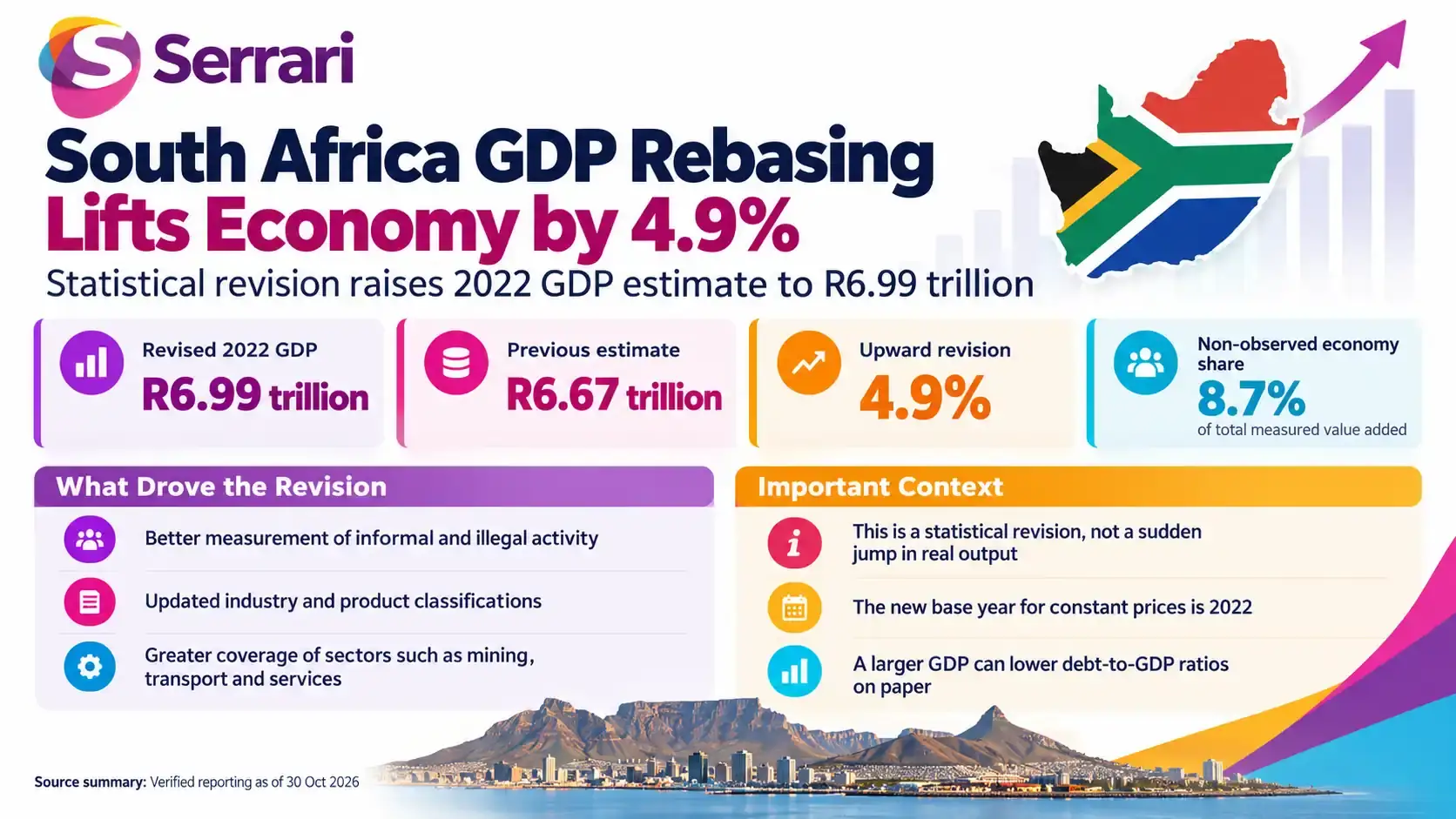
South Africa’s economy is 4.9% larger than previously estimated following a comprehensive revision of gross domestic product (GDP) data. Statistics South Africa announced on October 29, 2026, that the country’s 2022 GDP had been revised to R6.99 trillion from R6.67 trillion. The adjustment reflects improved economic measurement, including better coverage of informal and illegal activities, rather than a sudden increase in economic production.
Key Overview
- 4.9% upward revision: South Africa’s 2022 GDP increased from R6.67 trillion to R6.99 trillion.
- R324 billion: Additional economic activity identified in the revised 2022 estimates.
- R8.04 trillion: Revised nominal GDP for 2025, compared with the previous R7.64 trillion estimate.
- 12.5%: Upward revision in the mining industry’s measured output, the largest percentage adjustment among sectors.
- 8.7%: Share of total measured value added attributed to the non-observed economy in 2022.
- New base year: The reference year for constant-price GDP calculations shifts from 2015 to 2022.
GDP Revision Adds R324 Billion to South Africa’s Economy
The latest GDP benchmarking exercise increased South Africa’s measured economic output for 2022 by approximately R324 billion, bringing the total to R6.99 trillion.
The revision follows the statistical agency’s decision to update its economic measurement framework, incorporating more comprehensive information on business activity, household expenditure and previously undercounted industries.
The adjustment also extends beyond the 2022 reference year. According to the revised national accounts, South Africa’s nominal GDP for 2025 increased by 5.3%, from R7.642 trillion to R8.044 trillion.
These figures do not indicate that the economy suddenly expanded by the revised amounts. Instead, the changes reflect a more complete measurement of activities that were already taking place.
Mining and Financial Services Record Major Adjustments
Mining experienced the largest percentage revision, with its measured economic output increasing by 12.5%. The adjustment was primarily attributed to improved coverage of illegal mining operations, which had previously been inadequately represented in official statistics.
Finance, real estate and business services recorded the second-largest percentage increase at 9.1%. The revision largely reflects changes in how the estimated rental value of owner-occupied housing is calculated.
In absolute terms, the finance industry contributed approximately R127 billion to the increase in 2022 GDP. Mining and trade each added around R61 billion.
The revisions change the relative importance of industries within the economy, influencing how policymakers and investors interpret sector contributions, productivity and economic structure.
Context is everything. Stay ahead of shifting trends with today’s market updates, and uncover emerging opportunities using the Serrari Group Market Index and Marketplace. Then, take control of your own financial future by exploring our Money & Life Reset Transformation Blueprint ™ to build stronger habits, create better systems, and design a path toward lasting wealth.
Informal and Illegal Economic Activities Receive Greater Recognition
A significant element of the updated GDP methodology is the inclusion and improved measurement of activities outside conventional business reporting systems.
These include informal trading, illegal mining, illegal gambling, e-hailing services and other economic activities that are difficult to capture through traditional surveys and administrative records.
The non-observed economy accounted for approximately R551 billion, or 8.7% of total measured value added in 2022. This figure represents its estimated share of economic activity, not an additional 8.7% increase in national GDP.
The trade industry contributed the largest portion of non-observed activity, followed by transport and communication, and manufacturing.
Measuring these activities does not legitimise illegal operations. Rather, national accounting standards seek to capture economic production regardless of whether it occurs within formally registered businesses.
Why South Africa Changed Its GDP Base Year
The statistical agency changed its reference year from 2015 to 2022 to reflect structural developments in the economy more accurately.
GDP rebasing typically occurs every five years. However, authorities avoided using 2020 because economic activity during the COVID-19 pandemic was unusually disrupted.
Benchmarking also incorporates new surveys, administrative information and updated classifications to improve the reliability of historical economic estimates.
The revisions can affect economic indicators such as debt-to-GDP ratios, tax revenue relative to GDP and sectoral productivity measures.
What the Revision Means for Government Debt and Economic Growth
A larger GDP denominator can reduce reported public debt as a percentage of economic output without changing the amount the government owes.
An economic assessment of the revisions suggests that South Africa’s gross debt ratio for the current fiscal year could decline from an estimated 78.2% to approximately 74.5% following the statistical adjustment.
However, the revision does not generate additional government revenue, reduce interest payments or resolve underlying fiscal pressures.
For investors and policymakers, the updated figures provide a clearer assessment of South Africa’s economic scale. The longer-term challenge remains translating that economic capacity into stronger real growth, formal employment and sustainable public finances.
Sources: Statistics South Africa / Reuters / SABC News / Business Day / FAnews
Your financial future isn’t something you wait for—it’s something you build.
The real question is: when do you begin?
Move beyond simply staying informed.
Navigate the markets with clarity—track trends through the Serrari Group Market Index, uncover opportunities in the Serrari Marketplace, and build practical knowledge with our Curated Wealth Builder Platform.
Stay connected to what truly matters.
Get daily insights on macro trends and financial movements across Kenya, Africa, and global markets—delivered through the Serrari Newsletter.
Growth opens doors.
Advance your career through professional programs including ACCA, HESI A2, ATI TEAS 7 , HESI EXIT , NCLEX – RN and NCLEX – PN, Financial Literacy!🌟—designed to move you forward with confidence.
See where money is flowing—clearly and in real time.
Track Money Market Funds, Treasury Bills, Treasury Bonds, Green Bonds, and Fixed Deposits, alongside global and African indexes, key economic indicators, and the evolving Crypto and stablecoin landscape—all within Serrari’s Market Index.