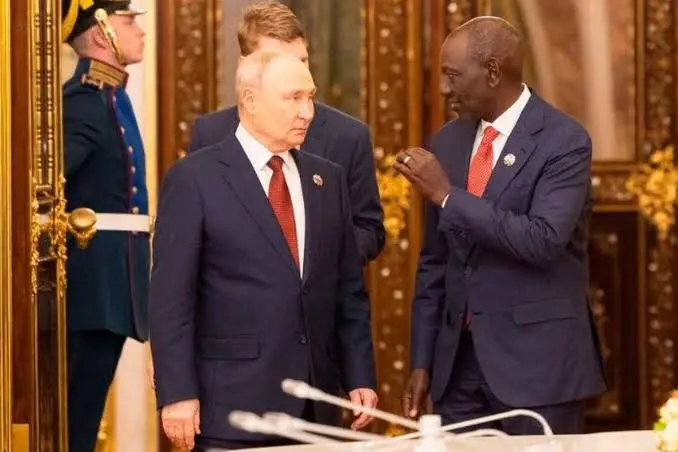
Kenya is seeking easier access to Russian commodities and more investment in domestic manufacturing following President William Ruto’s visit to Moscow for the third Russia–Africa Summit in late October 2026. Ruto argued that a peaceful resolution to Russia’s war in Ukraine could improve trade logistics and the movement of goods into African markets. He also urged Russian businesses to invest in Kenyan production facilities rather than focus solely on selling commodities.
Key Overview
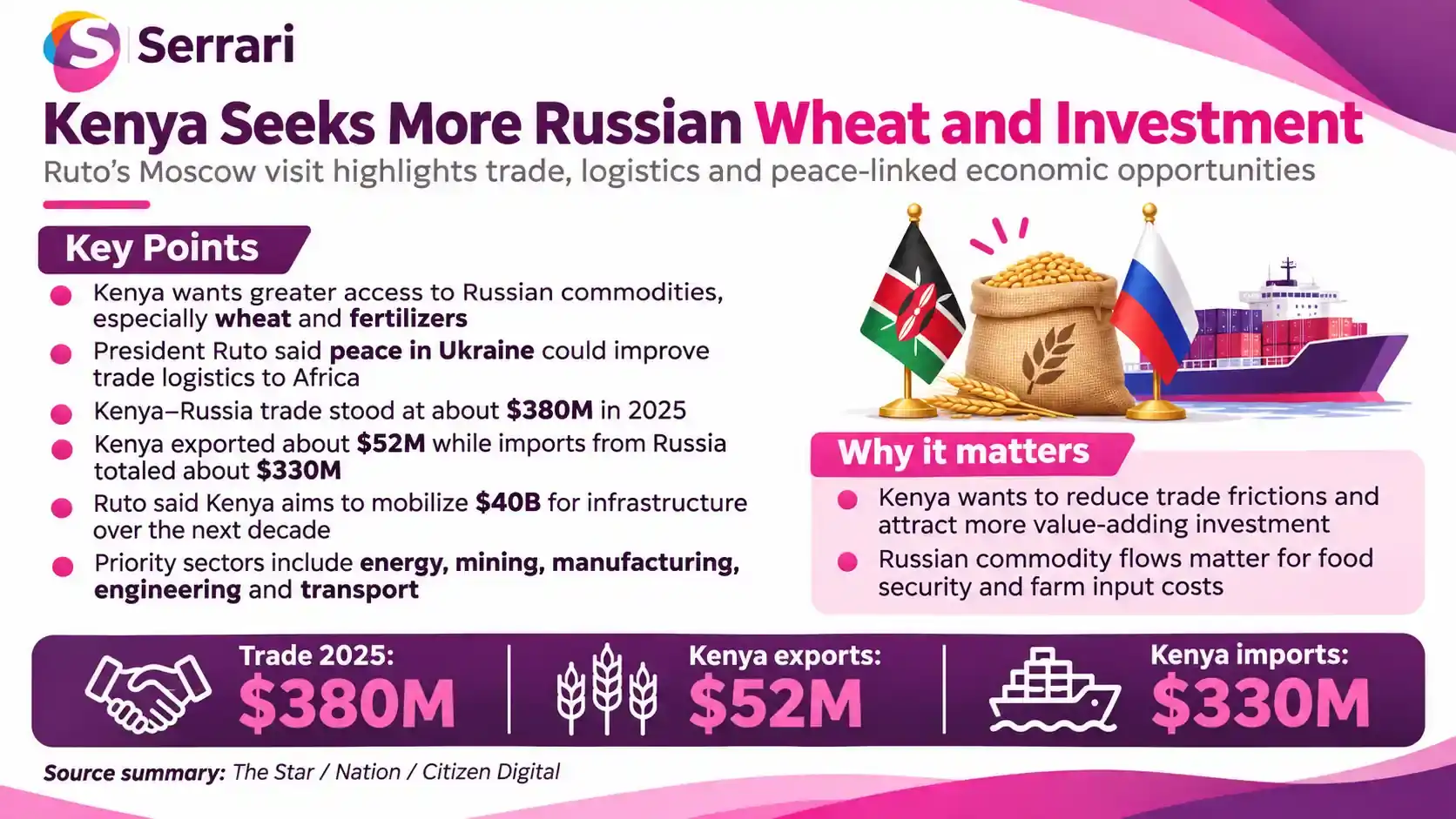
- Bilateral trade: Kenya and Russia recorded approximately $380 million in trade in 2025, according to figures presented by Ruto.
- Trade imbalance: Kenyan exports stood at about $52 million, against $330 million in imports from Russia.
- Priority commodities: Wheat and fertilisers remain important to Kenya’s food supply and agricultural production.
- Investment appeal: Ruto outlined plans to mobilise approximately $40 billion (Sh5.2 trillion) for infrastructure over the next decade.
- Peace and diplomacy: Kenya reiterated its support for sovereignty, territorial integrity and peaceful dispute settlement.
Kenya Seeks More Reliable Wheat and Fertiliser Supplies
Speaking at the Russia–Africa summit in Moscow, Ruto said progress toward ending the Russia–Ukraine war could ease constraints on trade routes and open opportunities to move commodities into African markets. His remarks linked diplomacy to practical concerns over food imports, shipping and commercial costs.
Russia supplies Kenya with wheat and fertilisers, alongside iron and steel products. Disruptions to trade and transport can feed into food prices and agricultural production costs, although the effects depend on global prices, exchange rates, freight charges and alternative suppliers. A peace agreement could reduce some of those pressures, but no immediate improvement in shipments or prices was announced.
Trade Gap Highlights Kenya’s Export Challenge
At the October 28 Kenya–Russia business roundtable, Ruto put bilateral trade at approximately $380 million in 2025. Kenyan exports, principally tea, coffee, flowers, fruit and vegetables, amounted to roughly $52 million; Russian goods entering Kenya were valued at around $330 million.
Those rounded figures imply an import surplus of about $278 million in Russia’s favour. The president also estimated existing Russian investment in Kenya at $22 million, describing it as modest compared with the potential for cooperation. These are figures cited in his remarks, rather than a newly announced trade agreement or investment commitment.
Kenya wants to widen direct market access for its agricultural products while improving processing and logistics. Expanding exports would help narrow the trade gap, but success will depend on commercial demand, transport links, regulatory requirements and the competitiveness of Kenyan producers.
Context is everything. Stay ahead of shifting trends with today’s market updates, and uncover emerging opportunities using the Serrari Group Market Index and Marketplace. Then, take control of your own financial future by exploring our Money & Life Reset Transformation Blueprint ™ to build stronger habits, create better systems, and design a path toward lasting wealth.
Ruto Pitches $40 Billion Infrastructure Pipeline
Ruto invited Russian companies to explore energy, mineral processing, fertiliser manufacturing, engineering, transport and other industrial opportunities. He presented a ten-year infrastructure financing ambition of approximately $40 billion, equivalent to Sh5.2 trillion at the exchange rate used in the announcement.
The proposal is a financing target, not $40 billion already committed by Russia. Ruto’s central argument was that foreign capital should establish factories, transfer expertise and create Kenyan jobs, rather than merely increase imports or purchases of raw materials.
At the broader summit discussions, he urged African economies to retain more value from their resources through manufacturing and regional supply chains. That approach aligns with Kenya’s effort to use its position in East Africa to attract investors seeking access to wider continental markets.
Digital Trade and Peace Diplomacy Also Feature
Ruto also met Robert Mirzoyan, chief executive of Russian online retailer Wildberries, to explore possible e-commerce investment. No investment amount or implementation timetable was publicly established for those discussions.
On the war in Ukraine, Ruto stressed that sovereignty, territorial integrity and peaceful settlement of disputes should apply consistently. Kenya’s economic outreach to Moscow therefore came alongside a diplomatic message rather than an endorsement of the invasion.
The practical test of the visit will be whether discussions lead to signed investments, better export access, improved commodity logistics and factories operating in Kenya. For now, the trade and infrastructure figures mainly show the size of the opportunity and the gap between ambition and delivered projects.
Sources: The Star / Daily Nation / Citizen Digital / The Standard / Tukio
Your financial future isn’t something you wait for—it’s something you build.
The real question is: when do you begin?
Move beyond simply staying informed.
Navigate the markets with clarity—track trends through the Serrari Group Market Index, uncover opportunities in the Serrari Marketplace, and build practical knowledge with our Curated Wealth Builder Platform.
Stay connected to what truly matters.
Get daily insights on macro trends and financial movements across Kenya, Africa, and global markets—delivered through the Serrari Newsletter.
Growth opens doors.
Advance your career through professional programs including ACCA, HESI A2, ATI TEAS 7 , HESI EXIT , NCLEX – RN and NCLEX – PN, Financial Literacy!🌟—designed to move you forward with confidence.
See where money is flowing—clearly and in real time.
Track Money Market Funds, Treasury Bills, Treasury Bonds, Green Bonds, and Fixed Deposits, alongside global and African indexes, key economic indicators, and the evolving Crypto and stablecoin landscape—all within Serrari’s Market Index.