French government bond yields edged lower on October 20, 2026, but remained close to levels last seen in 2002. Investors continued to demand a substantial premium to hold French debt rather than German government bonds as nationwide protests, difficult budget negotiations and persistent inflation pressures weighed on confidence. The modest decline in yields offered limited relief after a sharp sell-off the previous day.
Key Overview
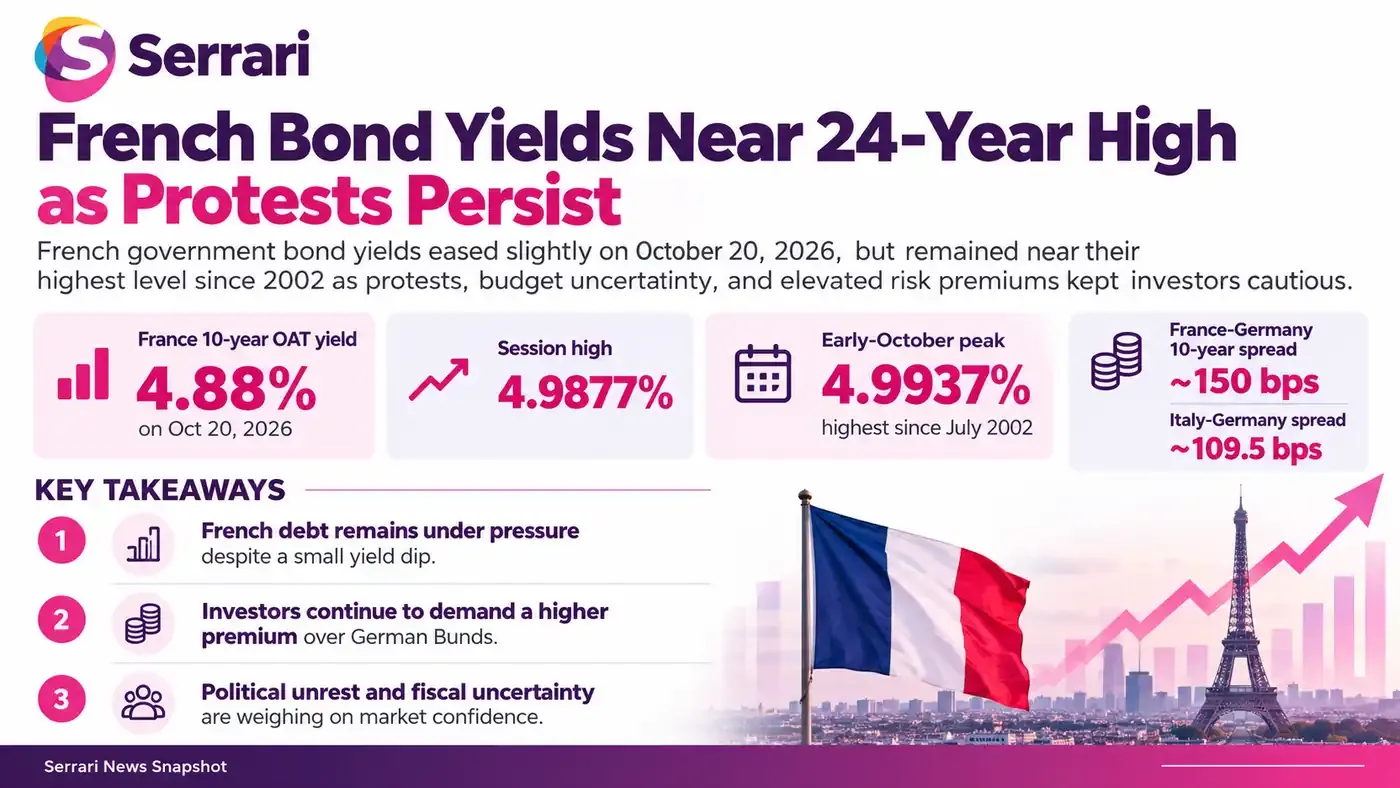
- France’s 10-year government bond yield fell three basis points to 4.88% during the October 20 session, after reaching 4.9877% earlier in the day.
- The yield remained near its early-October peak of 4.9937%, the highest level since July 2002.
- The gap between French and German 10-year yields widened to roughly 150 basis points, signalling continued investor concern about French debt.
- Protests, debate over the 2027 budget and expectations of further European Central Bank rate increases continued to unsettle European bond markets.
French Bonds Remain Under Pressure Despite Yield Decline
France’s benchmark 10-year bonds, known as Obligations Assimilables du Trésor (OATs), yielded 4.88% in afternoon trading on October 20, down three basis points from the previous session. A basis point equals 0.01 percentage points.
Although yields declined during the session, the intraday high of 4.9877% came close to the 4.9937% peak recorded earlier in October. That earlier reading was the highest since July 2002. Bond prices generally move in the opposite direction to yields, so the recent rise in yields reflects falling prices for French government debt.
The French-German yield spread widened by approximately 2.5 basis points to 150 basis points, or 1.50 percentage points. The spread had reached 158.67 basis points earlier in October, its widest since November 2011. Italy’s comparable spread narrowed to around 109.5 basis points on October 20, suggesting greater pressure on French bonds than on Italian debt during the session.
Protests and the 2027 Budget Raise Fiscal Concerns
The bond-market volatility followed unrest in France, with protest groups planning additional demonstrations after clashes over the weekend. Discontent over living costs and public services has increased uncertainty about the government’s ability to implement politically sensitive spending reductions and tax measures.
The fiscal backdrop is already demanding. Official figures show that France’s public debt reached 115.6% of GDP at the end of 2025, while its annual deficit was 5.1% of GDP. The 2027 draft budget sets a 5.0% deficit target, but meeting that objective depends on parliamentary approval and the implementation of planned measures.
Political uncertainty is also building ahead of the 2027 presidential election. Polling cited in recent market reporting has placed Marine Le Pen and Jean-Luc Mélenchon ahead of several rivals, increasing attention on how the next administration might manage public borrowing. However, polling leads do not determine an election result or establish what fiscal policies will ultimately pass.
An October 19 assessment of French bond spreads warned that protests could make fiscal consolidation harder for any future government. The core concern for investors is whether France can credibly narrow its deficit while facing public resistance to reforms.
Context is everything. Stay ahead of shifting trends with today’s market updates, and uncover emerging opportunities using the Serrari Group Market Index and Marketplace. Then, take control of your own financial future by exploring our Money & Life Reset Transformation Blueprint ™ to build stronger habits, create better systems, and design a path toward lasting wealth.
German Bond Yields Fall as ECB Rate Risks Persist
German government bonds also gained support during the October 20 session. Germany’s 10-year yield declined seven basis points to 3.385%, while its more interest-rate-sensitive two-year yield fell five basis points to 3.045%.
However, lower daily yields do not mean the inflation threat has disappeared. Elevated energy prices continue to influence expectations for European Central Bank policy. An October assessment of eurozone monetary policy anticipated at least one further quarter-point rate increase in 2026 to address inflation pressures.
Higher policy rates can increase borrowing costs across the eurozone, while France’s additional political and fiscal risks may keep its borrowing costs elevated relative to Germany’s. This distinction matters because a widening spread points to concerns specific to French government debt, not simply a general rise in European interest rates.
What Investors Should Watch Next
Key developments include further demonstrations, progress on the 2027 budget, upcoming sovereign credit-rating decisions and changes in European energy prices. A sustained narrowing of the French-German yield spread would suggest improving confidence, while renewed widening could signal greater concern over France’s fiscal outlook.
The October 20 yield decline therefore represents a short-term easing in market pressure, not a resolution of the underlying risks. France’s ability to build political support for a credible deficit-reduction plan remains central to the outlook for its government bonds.
Sources
Reuters / ING Think / INSEE / Agence France Trésor
Your financial future isn’t something you wait for—it’s something you build.
The real question is: when do you begin?
Move beyond simply staying informed.
Navigate the markets with clarity—track trends through the Serrari Group Market Index, uncover opportunities in the Serrari Marketplace, and build practical knowledge with our Curated Wealth Builder Platform.
Stay connected to what truly matters.
Get daily insights on macro trends and financial movements across Kenya, Africa, and global markets—delivered through the Serrari Newsletter.
Growth opens doors.
Advance your career through professional programs including ACCA, HESI A2, ATI TEAS 7 , HESI EXIT , NCLEX – RN and NCLEX – PN, Financial Literacy!🌟—designed to move you forward with confidence.
See where money is flowing—clearly and in real time.
Track Money Market Funds, Treasury Bills, Treasury Bonds, Green Bonds, and Fixed Deposits, alongside global and African indexes, key economic indicators, and the evolving Crypto and stablecoin landscape—all within Serrari’s Market Index.