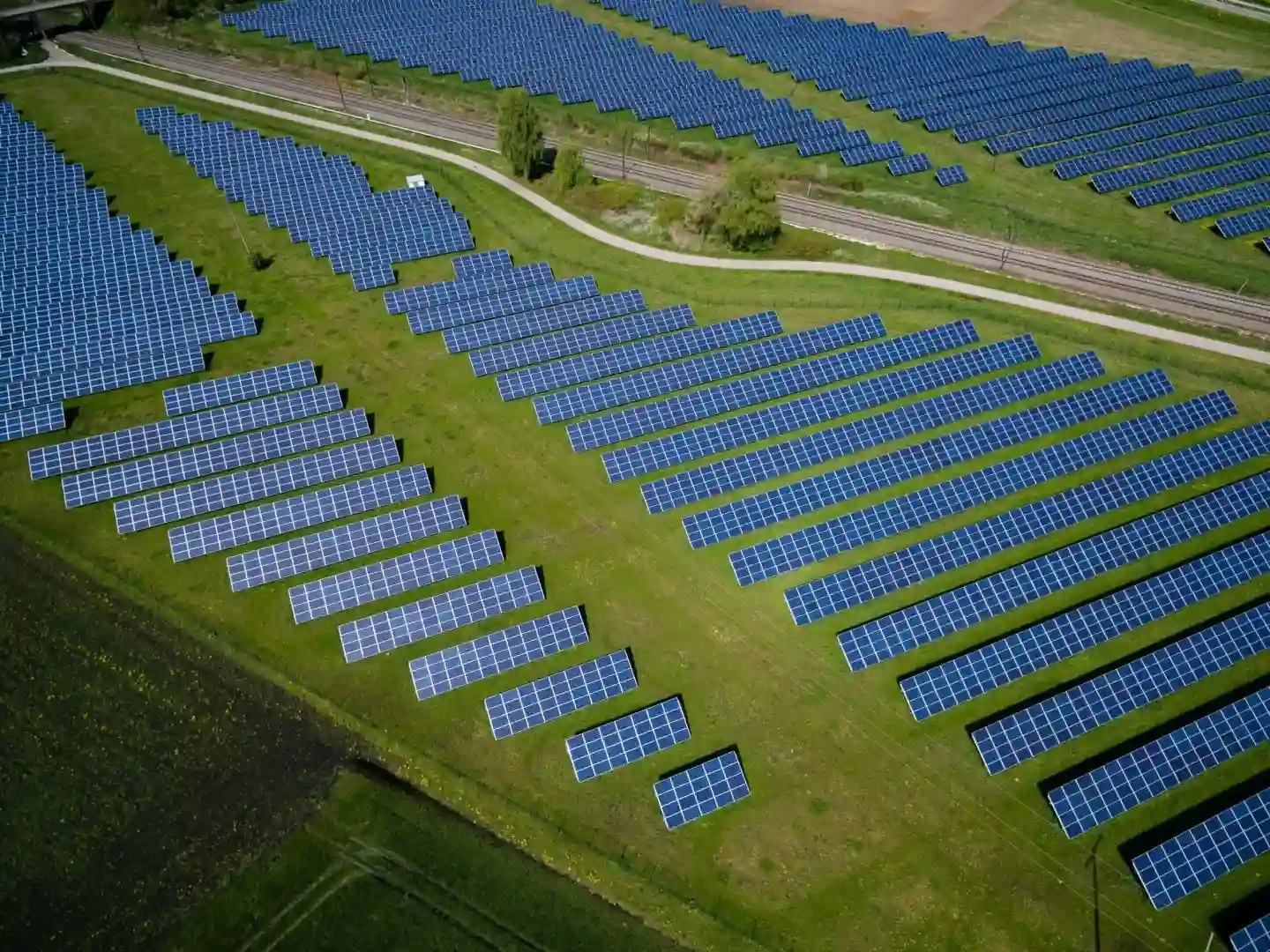
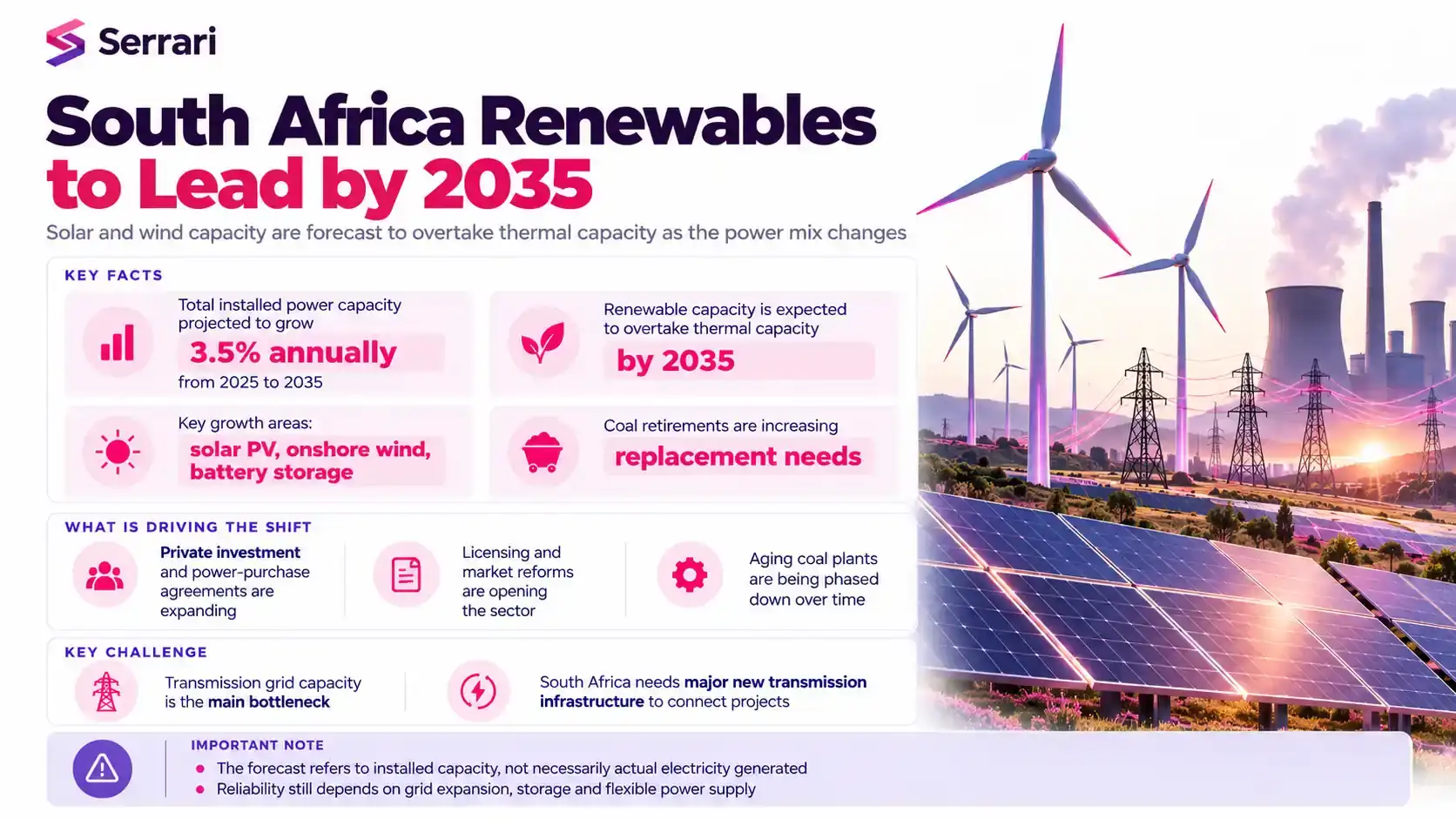
South Africa’s installed renewable power capacity is projected to overtake thermal capacity by 2035, driven by new solar and wind projects, private investment and the retirement of ageing coal plants. A new electricity-market forecast estimates that the country’s total installed power capacity will grow by 3.5% annually between 2025 and 2035. The forecast signals a major shift in the electricity system, although expanding the transmission grid remains a critical obstacle.
Key Overview
- 2035 projection: Renewable generating capacity is forecast to exceed thermal capacity, not necessarily thermal electricity output.
- Capacity growth: Total installed electricity capacity is projected to increase at a 3.5% compound annual rate from 2025 to 2035.
- Main drivers: Solar, onshore wind, corporate electricity contracts and the retirement of older coal units.
- Grid challenge: South Africa’s electricity plans call for approximately 14,500 kilometres of new transmission lines by 2034.
- Policy reforms: Competitive electricity trading is being developed, alongside proposed investment in battery storage and flexible gas generation.
Solar and Wind Investment Reshapes the Power Market
South Africa is gradually moving away from a system dominated by coal-fired power stations and a single state utility. Private electricity producers are increasingly developing solar and wind projects for mines, manufacturers, retailers and municipalities, alongside projects supplying the wider grid.
The 2035 power-market analysis identifies corporate power-purchase agreements and electricity wheeling as important drivers. Wheeling lets a buyer purchase electricity from a generator at another location using the existing network, subject to applicable charges and agreements.
The shift should be measured carefully. Installed capacity is the maximum rated output of power plants, while electricity generation measures the energy actually produced. Because solar and wind output varies with weather and daylight, renewables can lead in installed capacity while coal and other dispatchable plants still supply substantial electricity.
Context is everything. Stay ahead of shifting trends with today’s market updates, and uncover emerging opportunities using the Serrari Group Market Index and Marketplace. Then, take control of your own financial future by exploring our Money & Life Reset Transformation Blueprint ™ to build stronger habits, create better systems, and design a path toward lasting wealth.
Transmission Bottlenecks Threaten Project Timelines
Grid access, rather than a lack of renewable proposals, is emerging as the biggest constraint. Some of the country’s strongest solar and wind resources are located far from major electricity users, while existing transmission corridors have limited room for new projects.
South Africa’s transmission infrastructure investment assessment calls for around 14,500 kilometres of new high-voltage lines by 2034 and estimates the programme could require approximately R440 billion. Building the lines, securing land access and expanding substations will determine how quickly proposed capacity can start producing electricity.
The government has also opened transmission development to private participation, seeking additional finance and construction capacity to accelerate grid expansion.
Coal Retirements Create Demand for Reliable Replacement Power
Coal remains central to South Africa’s electricity supply, but older power stations are approaching retirement. The country’s 2025 electricity planning framework anticipates coal capacity declining from approximately 42 gigawatts in 2024 to 28 gigawatts by 2034, while renewable capacity increases.
Replacing coal requires more than installing solar panels and wind turbines. Battery storage, flexible power plants and stronger transmission links are needed to balance periods when wind or solar production falls and to maintain dependable supply for homes and industry.
On October 7, the government outlined a proposed first procurement phase prioritising 4,600 megawatts of battery storage and 5,000 megawatts of gas-to-power. New wind and solar procurement under that process is expected to follow in a later phase. These figures are proposed allocations, not newly operating capacity.
Electricity Reforms Open More Opportunities for Investors
The electricity-market reform law, which took effect in January 2025, established a framework for competitive electricity trading and an independent transmission system operator. The National Transmission Company South Africa currently operates as an Eskom subsidiary, while work continues to establish a fully separate operator.
The government’s July 2026 restructuring update also identified municipal arrears and market governance as issues that must be addressed to support a competitive system.
The 2035 renewable-capacity crossover remains a forecast, not a guaranteed outcome. Delivering it will depend on timely grid construction, viable private financing, reliable backup supply and reforms that allow new projects to connect and sell power.
Sources: GlobalData / Development Bank of Southern Africa / South African Government / International Energy Agency
Your financial future isn’t something you wait for—it’s something you build.
The real question is: when do you begin?
Move beyond simply staying informed.
Navigate the markets with clarity—track trends through the Serrari Group Market Index, uncover opportunities in the Serrari Marketplace, and build practical knowledge with our Curated Wealth Builder Platform.
Stay connected to what truly matters.
Get daily insights on macro trends and financial movements across Kenya, Africa, and global markets—delivered through the Serrari Newsletter.
Growth opens doors.
Advance your career through professional programs including ACCA, HESI A2, ATI TEAS 7 , HESI EXIT , NCLEX – RN and NCLEX – PN, Financial Literacy!🌟—designed to move you forward with confidence.
See where money is flowing—clearly and in real time.
Track Money Market Funds, Treasury Bills, Treasury Bonds, Green Bonds, and Fixed Deposits, alongside global and African indexes, key economic indicators, and the evolving Crypto and stablecoin landscape—all within Serrari’s Market Index.