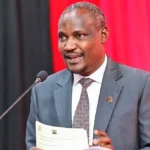
The global economy has weathered repeated shocks better than expected, but its resilience is becoming increasingly uneven, International Monetary Fund (IMF) Managing Director Kristalina Georgieva warned during the October 2026 annual meetings in Bangkok. In her October 14 policy briefing, she cautioned that depleted financial buffers, persistent inflation and high debt could undermine the recovery, especially in low-income and conflict-affected countries.
Key Overview
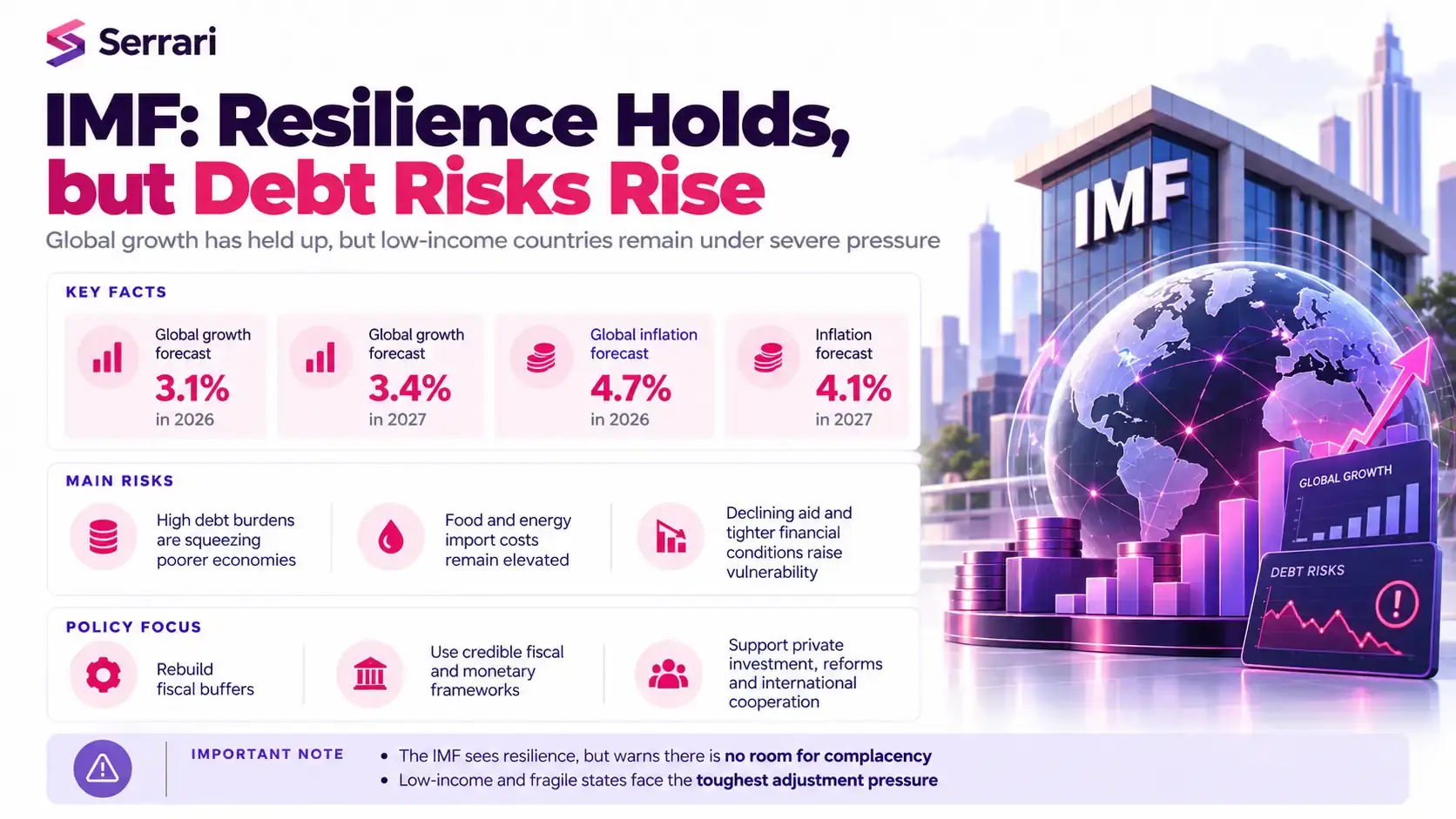
- Global growth: Forecast at 3.1% in 2026 and 3.4% in 2027.
- Inflation: Expected to reach 4.7% in 2026, before easing to 4.1% in 2027.
- Uneven recovery: Economies benefiting from artificial intelligence investment are outperforming many energy-importing and poorer countries.
- Debt pressure: Average debt-service costs for developing countries have risen to about 14% of government revenue, compared with 6% a decade ago.
- IMF priorities: Restore fiscal buffers, protect vulnerable households, support private investment and strengthen concessional financing.
Global Growth Holds Up, but the Recovery Is Uneven
The IMF’s October 2026 economic projections put world growth at 3.1% this year, followed by 3.4% next year. These forecasts suggest the global economy remains capable of expanding despite conflicts, trade uncertainty and higher living costs.
However, the averages conceal large differences. Economies closely connected to AI-related investment and technology supply chains are benefiting from stronger demand, while countries dependent on imported energy and food face higher costs. Georgieva described growth as being pulled between the negative shock from Middle East energy disruptions and the positive momentum of the technology boom.
The Fund also expects global inflation to rise to 4.7% in 2026 before moderating to 4.1% in 2027, leaving central banks with difficult choices between price stability and economic activity.
Context is everything. Stay ahead of shifting trends with today’s market updates, and uncover emerging opportunities using the Serrari Group Market Index and Marketplace. Then, take control of your own financial future by exploring our Money & Life Reset Transformation Blueprint ™ to build stronger habits, create better systems, and design a path toward lasting wealth.
Debt Repayments Squeeze Developing-Country Budgets
Low-income developing countries and fragile states face the sharpest risks. Rising food and fuel import bills are coinciding with tighter financing conditions, reduced development assistance and limited government reserves.
Georgieva warned that average debt-service costs have increased to roughly 14% of government revenue, from 6% a decade earlier. This means a larger share of public income is being directed toward creditors rather than services and investment.
For African governments already managing substantial debt obligations, the pressure can restrict spending on health, education, infrastructure and social protection. Higher borrowing costs can also discourage private investment and complicate refinancing when existing debts mature.
The warning is not that all developing countries face the same level of distress, but that weaker financial buffers leave the most vulnerable economies less able to absorb another shock.
IMF Calls for Stronger Fiscal and Monetary Policies
Georgieva urged governments to rebuild fiscal space through credible budgets, stronger revenue collection and better public financial management. In her remarks on fiscal policy priorities, she also emphasised protecting households rather than broadly suppressing prices.
The Fund’s analysis of cost-of-living crises similarly favours temporary, targeted income assistance over costly blanket price controls. The approach seeks to protect vulnerable families while limiting pressure on public finances.
Longer-term reforms are equally important. Stronger institutions, investment in infrastructure and skills, better governance and increased access to technology can help attract private capital and spread the benefits of economic growth more widely.
Concessional Financing and Global Cooperation Remain Critical
Georgieva called on IMF member countries to honour commitments supporting the Poverty Reduction and Growth Trust (PRGT), which provides concessional financing to eligible low-income economies. The Fund’s 2026 assessment of its financing trusts highlights the importance of maintaining sufficient resources as countries face continuing economic shocks.
The Fund is also updating its surveillance, lending arrangements and technical assistance to help members manage external financing pressures and strengthen their economic institutions.
The central message from Bangkok is that stronger-than-expected global growth offers some reassurance, but cannot substitute for rebuilding financial buffers. Without credible domestic reforms and international support, the gap between economies benefiting from new technology and those struggling with debt and import costs could widen further.
Sources: International Monetary Fund / Reuters
Your financial future isn’t something you wait for—it’s something you build.
The real question is: when do you begin?
Move beyond simply staying informed.
Navigate the markets with clarity—track trends through the Serrari Group Market Index, uncover opportunities in the Serrari Marketplace, and build practical knowledge with our Curated Wealth Builder Platform.
Stay connected to what truly matters.
Get daily insights on macro trends and financial movements across Kenya, Africa, and global markets—delivered through the Serrari Newsletter.
Growth opens doors.
Advance your career through professional programs including ACCA, HESI A2, ATI TEAS 7 , HESI EXIT , NCLEX – RN and NCLEX – PN, Financial Literacy!🌟—designed to move you forward with confidence.
See where money is flowing—clearly and in real time.
Track Money Market Funds, Treasury Bills, Treasury Bonds, Green Bonds, and Fixed Deposits, alongside global and African indexes, key economic indicators, and the evolving Crypto and stablecoin landscape—all within Serrari’s Market Index.