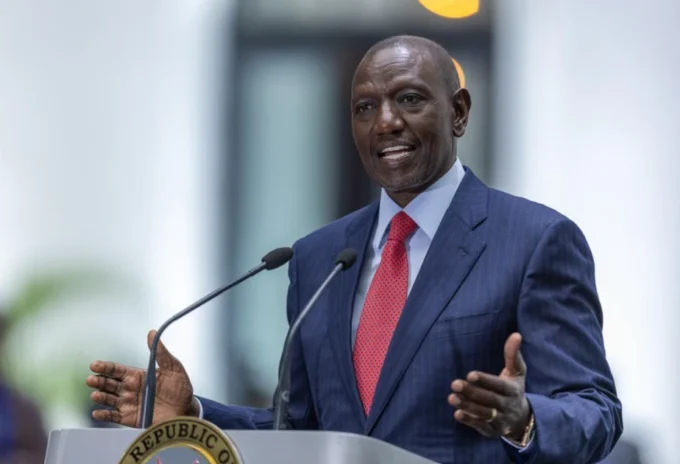
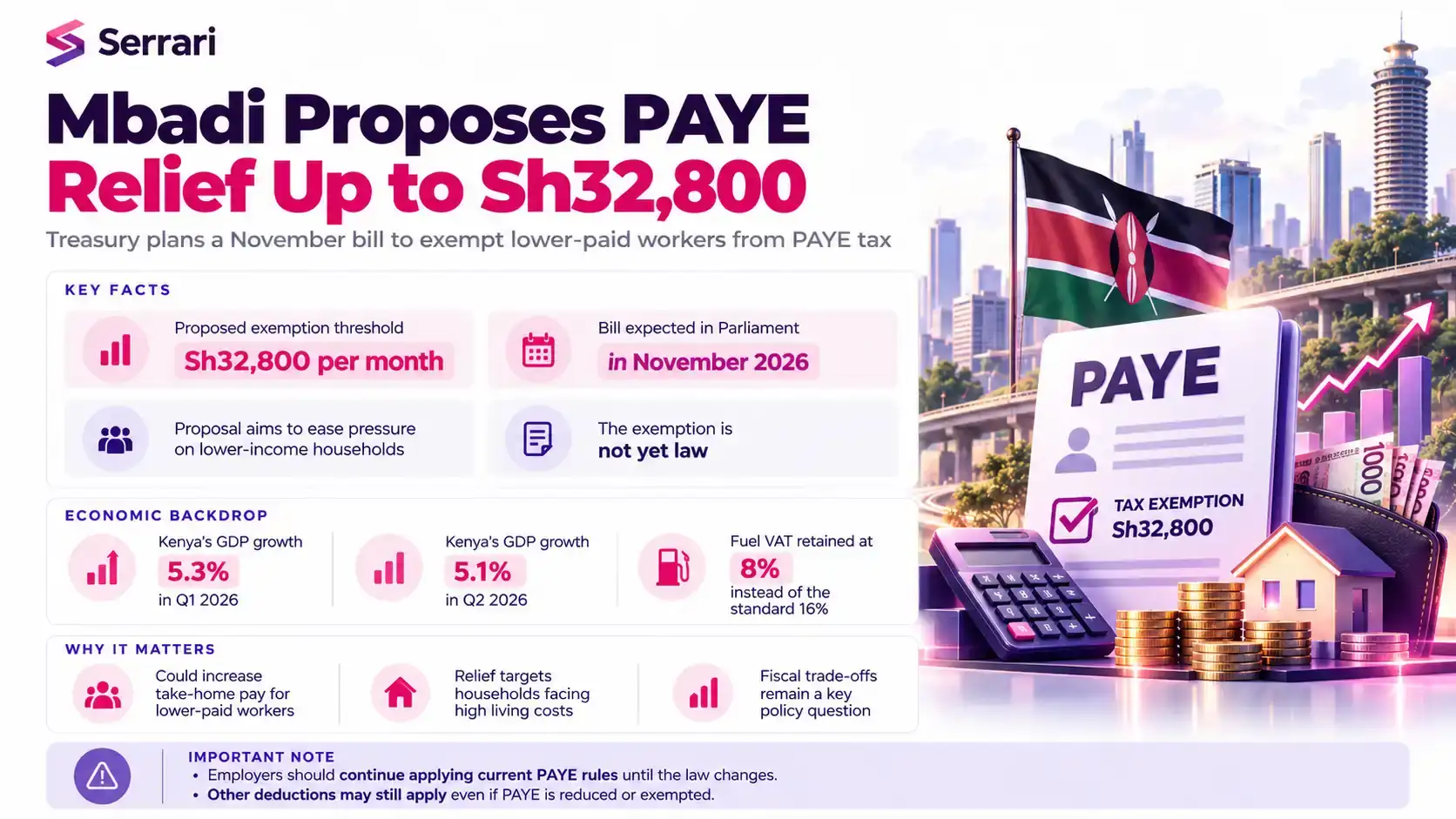
Kenya’s National Treasury plans to exempt employees earning Sh32,800 or less per month from Pay As You Earn (PAYE) income tax, in a proposed change intended to increase take-home pay for lower-income workers. Treasury Cabinet Secretary John Mbadi announced the plan at the Eldoret National Polytechnic on October 16, saying the government expects to present the amendment to Parliament in November. The exemption is not yet law, and the start date and detailed eligibility rules have not been confirmed.
Key Overview
- Proposed PAYE threshold: Workers earning up to Sh32,800 monthly would be exempt from PAYE if the plan becomes law.
- Legislative timetable: Treasury intends to introduce the amendment in November 2026.
- Existing rules: The first Sh24,000 of monthly taxable income is taxed at 10%, offset by Sh2,400 in personal relief for eligible residents.
- Other deductions: An exemption from PAYE would not automatically eliminate housing, health insurance or pension contributions.
- Economic backdrop: Kenya’s economy expanded by 5.3% in Q1 2026 and 5.1% in Q2 2026, according to official data.
What the Proposed Sh32,800 PAYE Exemption Means
Mbadi unveiled the proposal during the Mashujaa Day 2026 Economy (Finance) Thematic Week, held under the theme An Economy for the People. The measure would allow qualifying salaried employees to retain income that would otherwise be deducted as PAYE, potentially helping with food, transport, rent and other living expenses.
The Sh32,800 threshold replaces an earlier proposed Sh30,000 figure, rather than an exemption already in force. Treasury previously set aside the Sh30,000 proposal amid concerns that it could reduce annual tax collections by about Sh30 billion. The government has not yet published a comparable revenue-cost estimate for the higher threshold.
The final bill will need to clarify how qualifying pay is defined and whether people earning more than Sh32,800 would receive any additional relief. Those details should not be assumed before the legislation is published.
How Kenya’s Current PAYE Rates Work
Under the existing monthly PAYE tax bands, the first Sh24,000 of taxable employment income attracts a 10% rate, the next Sh8,333 is taxed at 25%, and subsequent income falls into higher bands. Eligible resident employees receive Sh2,400 monthly personal tax relief, which offsets the tax on the first Sh24,000 of taxable income.
Importantly, gross salary and taxable pay are not necessarily the same. Certain statutory contributions and other allowable deductions are considered before calculating PAYE. That means the tax saving for someone earning Sh32,800 cannot reliably be inferred from their gross salary alone.
Even if the proposed exemption is approved, PAYE relief would not necessarily mean an employee takes home the entire salary. Contributions to the Social Health Insurance Fund, National Social Security Fund and Affordable Housing Levy are governed by separate rules.
Context is everything. Stay ahead of shifting trends with today’s market updates, and uncover emerging opportunities using the Serrari Group Market Index and Marketplace. Then, take control of your own financial future by exploring our Money & Life Reset Transformation Blueprint ™ to build stronger habits, create better systems, and design a path toward lasting wealth.
Economic Growth Has Not Removed Household Pressure
Mbadi said the government is targeting economic growth of approximately 5% to support job creation, particularly for young Kenyans. The latest first-quarter national accounts show GDP growth of 5.3%, while the second-quarter figures put growth at 5.1%. The first-quarter figure corrects the 5.1% reported for both quarters in some accounts of the speech.
The Treasury chief acknowledged that higher transport costs, food prices and pressure on household budgets remain challenges even as headline economic indicators improve.
Fuel VAT Relief Adds to the Tax Policy Trade-Off
The PAYE proposal comes alongside measures to limit the effect of international energy prices. Parliament approved another 90 days of reduced fuel VAT, preserving the 8% rate instead of the standard 16%, and the measure was signed into law on October 16.
Mbadi estimated that the fuel VAT reduction had already resulted in approximately Sh54 billion in foregone revenue over six months, illustrating the fiscal cost of measures designed to ease living expenses. The PAYE amendment will likewise need to be assessed against the government’s revenue and spending requirements.
What Happens Before Workers Receive Tax Relief?
For now, employers must continue applying the existing PAYE rules. The proposed November bill must be published, considered and passed by Parliament, and take legal effect before payroll deductions can change.
The debate will focus on whether the measure delivers meaningful relief to lower-paid workers while allowing the government to fund public services and meet its financial obligations. Until a final law specifies the effective date and calculation method, Sh32,800 remains a proposed exemption threshold, not an implemented payroll rule.
Sources: Kenya News Agency / The Star / Kenya Revenue Authority / Kenya National Bureau of Statistics / Parliament of Kenya
Your financial future isn’t something you wait for—it’s something you build.
The real question is: when do you begin?
Move beyond simply staying informed.
Navigate the markets with clarity—track trends through the Serrari Group Market Index, uncover opportunities in the Serrari Marketplace, and build practical knowledge with our Curated Wealth Builder Platform.
Stay connected to what truly matters.
Get daily insights on macro trends and financial movements across Kenya, Africa, and global markets—delivered through the Serrari Newsletter.
Growth opens doors.
Advance your career through professional programs including ACCA, HESI A2, ATI TEAS 7 , HESI EXIT , NCLEX – RN and NCLEX – PN, Financial Literacy!🌟—designed to move you forward with confidence.
See where money is flowing—clearly and in real time.
Track Money Market Funds, Treasury Bills, Treasury Bonds, Green Bonds, and Fixed Deposits, alongside global and African indexes, key economic indicators, and the evolving Crypto and stablecoin landscape—all within Serrari’s Market Index.