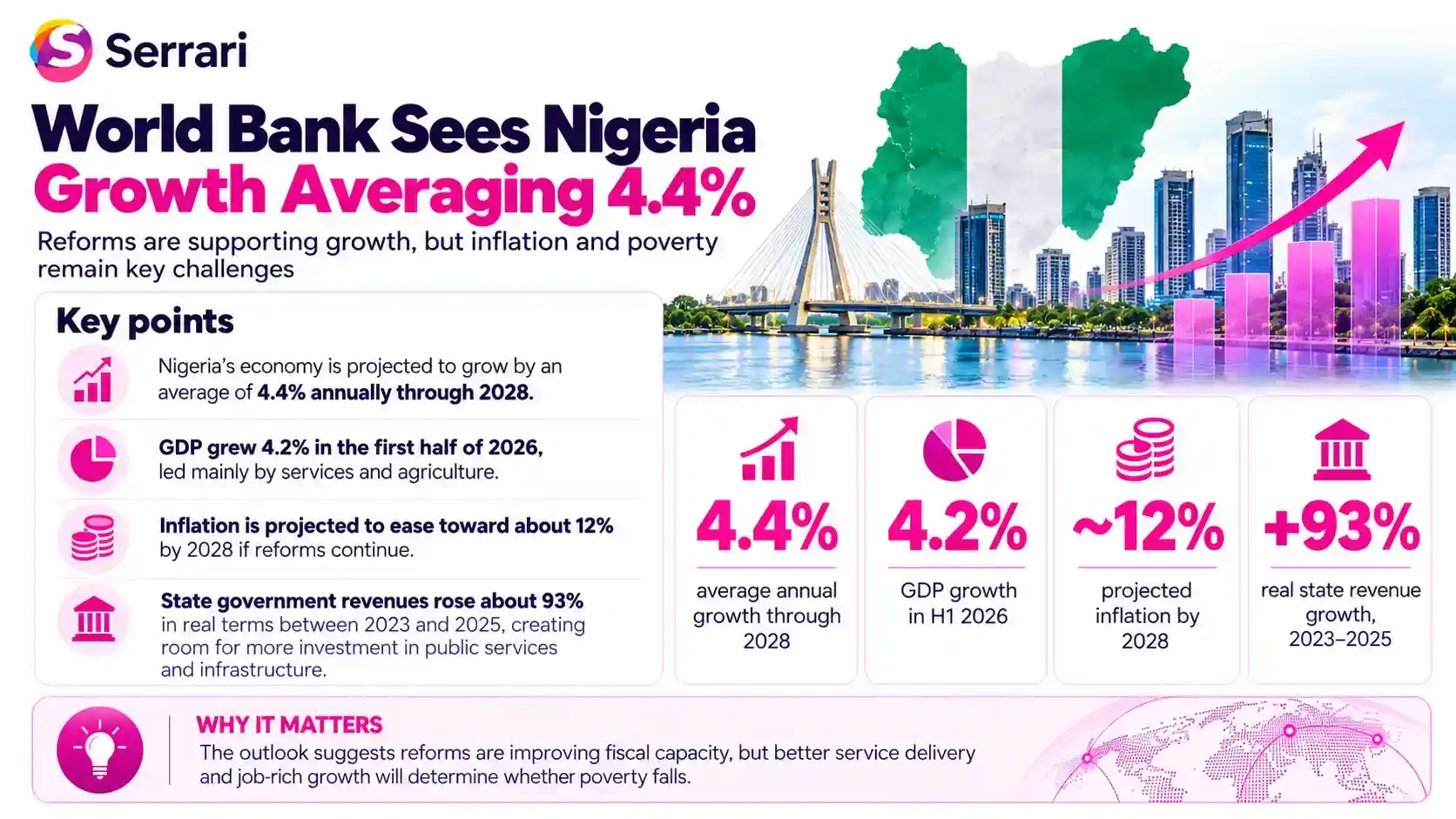
Nigeria’s economy is projected to expand by an average of 4.4% annually between 2026 and 2028, supported by economic reforms, stronger government revenues and improving activity across services and agriculture.
According to the October 2026 Nigeria Development Update, the country’s economy grew 4.2% during the first half of 2026, compared with 3.9% in the corresponding period of 2025.
The report also projects inflation declining toward 12% by 2028, although elevated food and energy prices continue to constrain household purchasing power.
Nigeria’s reforms have significantly strengthened public finances, with aggregate state government revenues increasing approximately 93% in real terms between 2023 and 2025. However, translating these gains into lower poverty and better living standards remains a central challenge.
Key Overview
- Economic growth: Nigeria’s real GDP is projected to expand by an average of 4.4% annually from 2026 through 2028.
- Improving performance: GDP grew 4.2% during the first half of 2026, supported primarily by services and agriculture.
- Inflation outlook: Consumer price inflation is expected to gradually decline toward 12% by 2028.
- State government revenues: Aggregate state revenues increased approximately 93% in real terms between 2023 and 2025.
- Infrastructure spending: States have increased capital expenditure, particularly in transportation, housing and agriculture.
- Poverty reduction: Sustained economic growth, job creation and improvements in public services will be essential to reducing poverty.
Nigeria’s Economic Growth Accelerates in 2026
Nigeria’s economic recovery has continued strengthening following reforms introduced to improve fiscal stability, foreign exchange market operations and government revenue collection.
The latest economic assessment indicates that GDP expanded 4.2% during the first six months of 2026, exceeding the 3.9% recorded during the same period in 2025 and 3.5% in 2024.
Growth was largely driven by services, with agriculture making a stronger contribution as economic activity expanded across several industries.
The projected annual average of 4.4% through 2028 suggests that Nigeria could maintain economic growth above its population growth rate.
This matters because sustained growth in real economic output per person can create opportunities for higher incomes and improved living standards.
However, stronger GDP figures alone do not guarantee widespread prosperity. Economic benefits must translate into productive employment, increased household purchasing power and improved access to essential services.
Government Reforms Drive 93% Increase in State Revenues
Nigeria’s fiscal reforms have significantly changed the financial resources available to state governments.
The removal of petrol subsidies, changes to the foreign exchange system and improvements in revenue administration have increased government receipts.
According to the analysis of state government finances, aggregate state revenues increased approximately 93% in real terms between 2023 and 2025, while expenditure rose about 92%.
Gross federation revenues increased 69% in real terms over the same period.
Higher revenue allocations, improved value-added tax collections and the settlement of longstanding federal obligations contributed to the increase in state resources.
States have used the additional funding to expand public investment and strengthen their fiscal positions.
Capital expenditure increased from 46% of total state spending in 2023 to 61% in 2025, reflecting greater emphasis on infrastructure development.
Transportation infrastructure received substantial investment alongside housing, agriculture and other economic development projects.
Education and Healthcare Spending Remain Critical Challenges
Despite growing public revenues, spending patterns reveal continuing weaknesses in human capital investment.
The state expenditure findings show that education’s share of total expenditure declined from 14.9% in 2021 to 12.1% in 2025.
Healthcare spending remained relatively stable at approximately 7%, while social protection increased from 1.4% to 4.4%.
Although spending on education and healthcare increased in absolute terms, these sectors received a smaller share of the expanding public expenditure envelope than economic infrastructure.
This creates challenges for improving educational outcomes, healthcare access and workforce productivity.
Greater investment in schools, hospitals, clean water and social assistance could help households benefit more directly from Nigeria’s improving fiscal position.
The report therefore emphasises spending efficiency, accountability and effective service delivery rather than relying exclusively on higher government expenditure.
Context is everything. Stay ahead of shifting trends with today’s market updates, and uncover emerging opportunities using the Serrari Group Market Index and Marketplace. Then, take control of your own financial future by exploring our Money & Life Reset Transformation Blueprint ™ to build stronger habits, create better systems, and design a path toward lasting wealth.
Inflation Expected to Ease Toward 12% by 2028
Nigeria has made progress in reducing inflation following a period of significant price increases.
According to the October economic outlook, headline inflation declined from 27.6% in January 2025 to 15.2% in December 2025.
However, higher fuel prices associated with the Middle East conflict and seasonal food supply pressures have slowed further disinflation.
Inflation is projected to gradually decline toward 12% by 2028, provided macroeconomic stability is maintained and external pressures ease.
Lower inflation would reduce the pace at which household living costs increase, potentially improving purchasing power where incomes grow sufficiently.
Nevertheless, declining inflation does not mean consumer prices will return to earlier levels. It indicates that prices are expected to rise more slowly.
For households facing elevated food, transportation and energy expenses, sustained income growth will remain essential.
External Reserves and Oil Revenues Strengthen
Nigeria’s external financial position has also benefited from higher international oil prices and foreign investment inflows.
The latest external sector figures show that the current account surplus increased to $12 billion, equivalent to 7.1% of GDP, during the first half of 2026.
This compares with $8.6 billion, or 6.7% of GDP, during the corresponding period in 2025.
Gross external reserves exceeded $54 billion in September 2026, supported partly by foreign portfolio investment.
Higher oil prices have strengthened export receipts and government revenue, although existing oil-backed financing agreements have limited some fiscal gains.
Meanwhile, elevated fuel costs have increased pressure on consumers, illustrating the mixed impact of higher global energy prices on the Nigerian economy.
What Nigeria Must Do to Sustain Economic Growth
Nigeria’s projected 4.4% average growth through 2028 presents an opportunity to build on recent macroeconomic reforms.
However, achieving lasting improvements in living standards will require stronger private investment, job creation, infrastructure development and public service delivery.
The government has identified private-sector-led growth and employment generation as important economic priorities.
For investors, stronger fiscal revenues, improving external reserves and moderating inflation could support a more stable business environment.
Nevertheless, infrastructure limitations, elevated living costs, external economic shocks and public spending inefficiencies remain significant risks.
Nigeria’s medium-term economic success will ultimately depend on converting stronger government finances and GDP growth into higher productivity, better employment opportunities and measurable reductions in poverty.
Sources
World Bank / Reuters / CNBC Africa
Your financial future isn’t something you wait for—it’s something you build.
The real question is: when do you begin?
Move beyond simply staying informed.
Navigate the markets with clarity—track trends through the Serrari Group Market Index, uncover opportunities in the Serrari Marketplace, and build practical knowledge with our Curated Wealth Builder Platform.
Stay connected to what truly matters.
Get daily insights on macro trends and financial movements across Kenya, Africa, and global markets—delivered through the Serrari Newsletter.
Growth opens doors.
Advance your career through professional programs including ACCA, HESI A2, ATI TEAS 7 , HESI EXIT , NCLEX – RN and NCLEX – PN, Financial Literacy!🌟—designed to move you forward with confidence.
See where money is flowing—clearly and in real time.
Track Money Market Funds, Treasury Bills, Treasury Bonds, Green Bonds, and Fixed Deposits, alongside global and African indexes, key economic indicators, and the evolving Crypto and stablecoin landscape—all within Serrari’s Market Index.