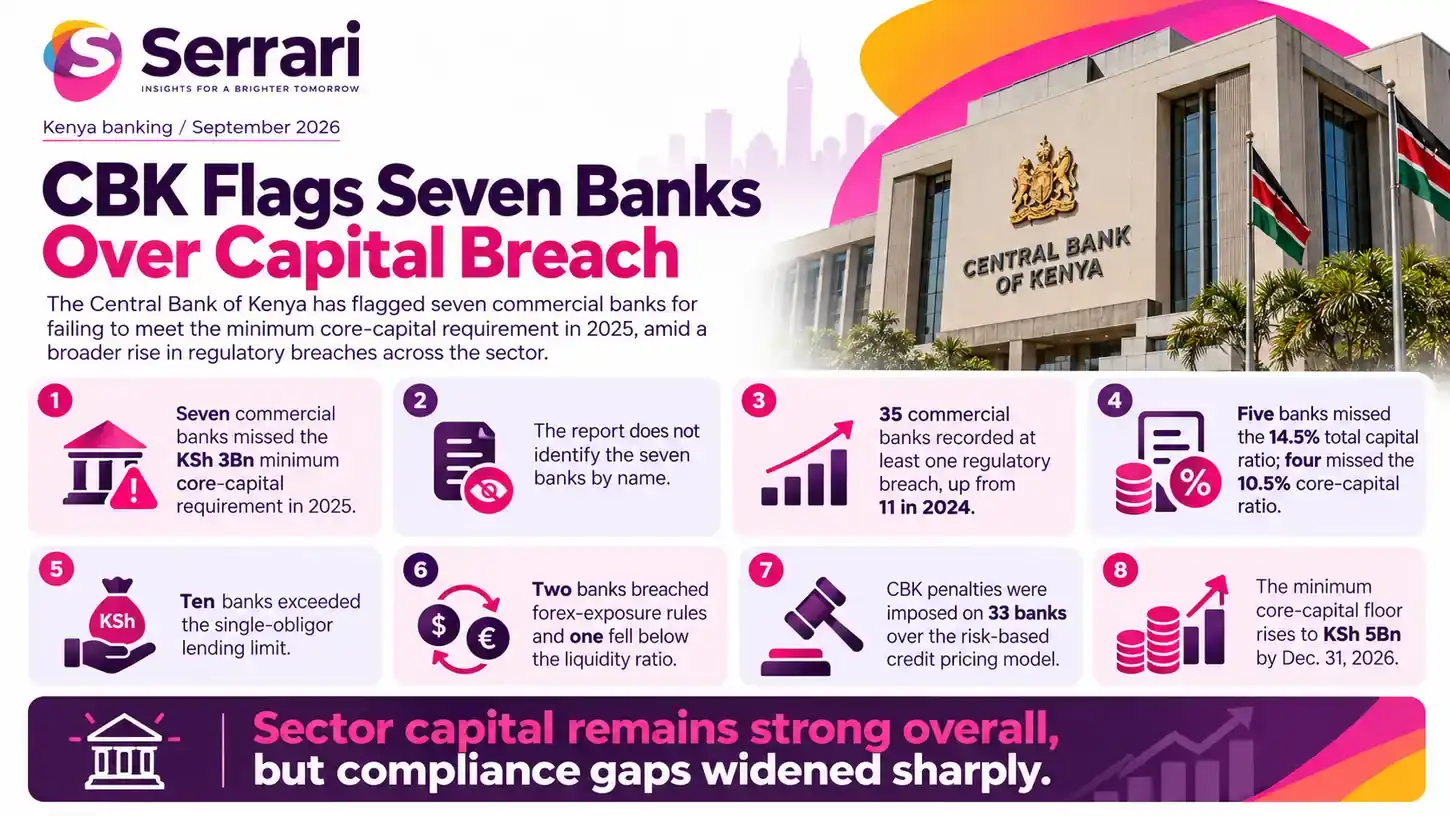
Seven Kenyan commercial banks failed to maintain the statutory KSh 3 billion minimum core capital by the end of 2025, placing them in breach of the Banking Act as the country’s higher capital requirements began taking effect.
The finding forms part of a much wider compliance problem. The regulator recorded breaches at 35 commercial banks as of December 31, 2025, compared with 11 a year earlier, with problems spanning credit pricing, lending concentration, capital adequacy, liquidity, foreign-exchange exposure and corporate governance.
Despite those institution-level breaches, the banking system as a whole remained well capitalised, with its total capital-to-risk-weighted-assets ratio reaching 20.7%, comfortably above the 14.5% minimum.
Key Overview
- Seven banks failed to maintain the KSh 3 billion minimum core capital required at the end of 2025.
- The official report does not identify the seven institutions by name in its compliance section.
- 35 commercial banks recorded at least one regulatory breach, compared with 11 in 2024.
- Five banks missed the 14.5% total capital-to-risk-weighted-assets ratio and four missed the 10.5% core-capital ratio.
- Ten banks exceeded the 25% single-obligor lending limit.
- Two banks breached the foreign-exchange exposure ceiling and one fell below the minimum liquidity ratio.
- Credit-pricing inspections resulted in penalties for 33 banks, while only three were fully compliant with the model assessed.
- The statutory core-capital floor rises again to KSh 5 billion by December 31, 2026.
Seven Banks Miss the New Capital Floor
The 2025 supervision findings show that seven commercial banks violated Section 7(1) of the Banking Act because they did not maintain at least KSh 3 billion in core capital as of December 31.
The higher threshold was the first major step in Kenya’s phased increase in minimum bank capital. The statutory schedule raised the minimum from KSh 1 billion at the end of 2024 to KSh 3 billion in 2025, KSh 5 billion in 2026 and ultimately KSh 10 billion by the end of 2029.
The regulator’s compliance section does not name the seven banks. Earlier market reports identified several smaller lenders that needed additional capital before the 2025 deadline, but those earlier lists should not be treated as an official identification of the institutions that ultimately breached the year-end requirement.
The higher capital floor is intended to strengthen banks’ ability to absorb losses and support larger balance sheets, but it also increases pressure on smaller institutions to raise equity, secure parent-company support, merge or otherwise restructure their capital positions.
Capital Ratios Show Additional Pressure
The absolute KSh 3 billion requirement was not the only capital rule breached.
Five commercial banks failed to meet the minimum 14.5% total capital-to-risk-weighted-assets ratio, while four were below the required 10.5% core capital-to-risk-weighted-assets ratio. Three banks also missed the minimum 8% core-capital-to-deposits ratio.
These institution-specific breaches occurred even as the overall sector strengthened. The industry’s total capital ratio increased to 20.7% in December 2025 from 19.6% a year earlier, while the core-capital ratio rose to 18.2% from 17.3%.
Total banking-sector assets also expanded to KSh 8.35 trillion, from KSh 7.57 trillion in 2024, while customer deposits increased to KSh 6.12 trillion.
Context is everything. Stay ahead of shifting trends with today’s market updates, and uncover emerging opportunities using the Serrari Group Market Index and Marketplace. Then, take control of your own financial future by exploring our Money & Life Reset Transformation Blueprint ™ to build stronger habits, create better systems, and design a path toward lasting wealth.
Lending Limits and Liquidity Rules Were Also Breached
Concentration risk emerged as another significant area of non-compliance.
Ten commercial banks exceeded the single-obligor limit, which restricts exposure to one borrower to 25% of core capital. Two banks breached the 20% limit for a single insider borrower, while one exceeded the 100% ceiling for total insider borrowing.
Two institutions invested more than 20% of core capital in land and buildings, while three breached the rule limiting aggregate large credit exposures to five times core capital.
Foreign-exchange and liquidity controls also produced breaches. Two banks exceeded the permitted foreign-exchange exposure of 10% of core capital, while one failed to maintain the statutory 20% minimum liquidity ratio.
At the industry level, however, average liquidity remained much stronger at 59.3%.
Credit-Pricing Inspections Trigger Penalties
The regulator also conducted targeted inspections of all commercial banks’ implementation of the Risk-Based Credit Pricing Model introduced in 2019.
Those inspections resulted in penalties against 33 banks, with administrative action taken against two others. Only three banks were assessed as fully compliant with the framework.
During 2025, the framework itself was revised. The new pricing model uses the Kenya Overnight Interbank Average Rate, or KESONIA, as the common reference rate for variable-rate loans, with the Central Bank Rate available where KESONIA is impractical.
The revised framework took effect for new variable-rate loans from September 1, 2025 and was extended to existing variable-rate facilities after a six-month transition ending February 28, 2026.
The breadth of the 2025 violations shows that Kenya’s banking system can remain strong in aggregate while individual institutions still face significant regulatory weaknesses. With the minimum core-capital requirement rising to KSh 5 billion at the end of 2026, capital raising and regulatory compliance are likely to remain major priorities for smaller banks.
Sources
Central Bank of Kenya / Kenya Law / Bizna Kenya / Business Daily Africa
Your financial future isn’t something you wait for—it’s something you build.
The real question is: when do you begin?
Move beyond simply staying informed.
Navigate the markets with clarity—track trends through the Serrari Group Market Index, uncover opportunities in the Serrari Marketplace, and build practical knowledge with our Curated Wealth Builder Platform.
Stay connected to what truly matters.
Get daily insights on macro trends and financial movements across Kenya, Africa, and global markets—delivered through the Serrari Newsletter.
Growth opens doors.
Advance your career through professional programs including ACCA, HESI A2, ATI TEAS 7 , HESI EXIT , NCLEX – RN and NCLEX – PN, Financial Literacy!🌟—designed to move you forward with confidence.
See where money is flowing—clearly and in real time.
Track Money Market Funds, Treasury Bills, Treasury Bonds, Green Bonds, and Fixed Deposits, alongside global and African indexes, key economic indicators, and the evolving Crypto and stablecoin landscape—all within Serrari’s Market Index.