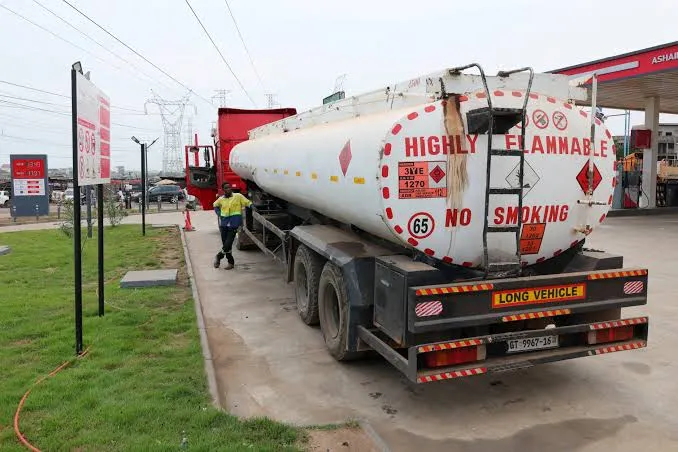
Ghana’s state-owned fuel distributor BOST Energies has reduced diesel and petrol exports to Burkina Faso and Mali since August 2026 as it prioritises domestic supply. The latest export figures show that Burkina Faso received about 40,000 metric tonnes of the 80,000 tonnes it requested for July and August.
Mali received about 10,000 tonnes over the same period and had sought an additional 40,000 tonnes for August and September. The reductions come as Ghana faces stronger domestic diesel demand and elevated international fuel costs, increasing pressure on the balance between local supply security and regional exports.
Key Overview
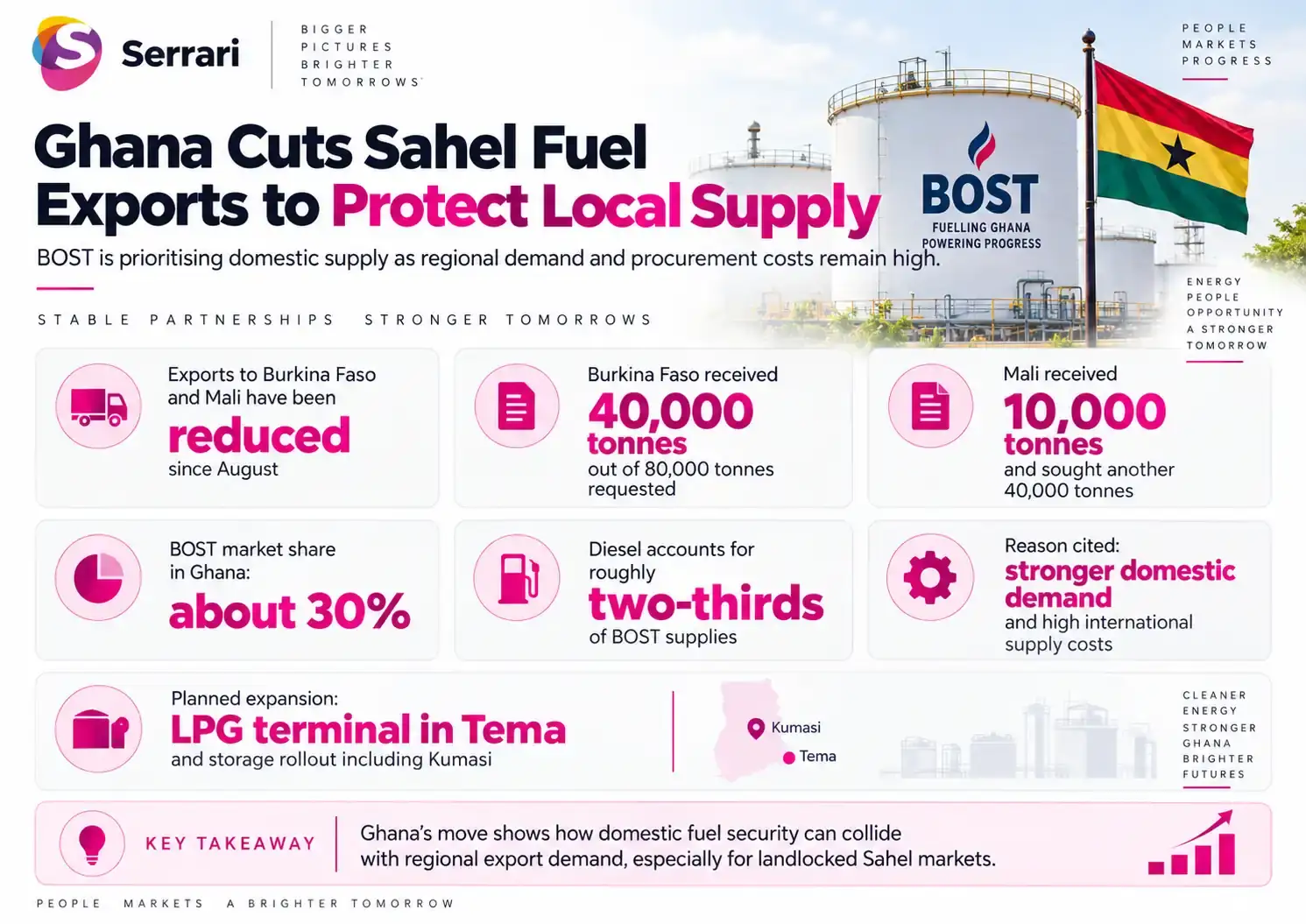
- BOST has reduced fuel exports to Burkina Faso and Mali since August.
- Burkina Faso received about 40,000 tonnes out of 80,000 tonnes requested for July and August.
- Mali received around 10,000 tonnes and sought an additional 40,000 tonnes for August and September.
- BOST has about a 30% share of Ghana’s fuel import and distribution market.
- Diesel accounts for roughly two-thirds of BOST’s fuel supplies.
- The company plans a new LPG terminal in Tema and phased storage facilities at six locations.
Ghana Prioritises Domestic Fuel Availability
The export reductions reflect BOST’s decision to protect local supply as domestic consumption grows. The company says diesel demand has increased alongside economic activity, while international supply conditions have kept procurement costs high.
BOST’s current role is significant because it participates in both domestic fuel supply and regional trade. Its 2025–2029 growth strategy sets a target of expanding fuel-supply and logistics market share in Ghana to at least 30% while also increasing its presence in other West African markets.
The company’s infrastructure includes six depots with combined storage capacity of about 421,913 cubic metres, roughly 349 kilometres of pipelines and inland transport assets. This network allows petroleum products received in coastal areas to be moved toward inland consumption centres and neighbouring markets.
Burkina Faso Receives Half of Requested Volume
Burkina Faso requested 80,000 tonnes of fuel for July and August, but BOST was able to deliver only around 40,000 tonnes. That means the supplied volume was about half of the requested amount.
The reduction is particularly important because landlocked Sahel economies depend heavily on road and corridor access through coastal West African states for petroleum imports. Ghana and Côte d’Ivoire are among the routes used to move refined products inland.
For Mali, BOST supplied approximately 10,000 tonnes during July and August. The country also requested another 40,000 tonnes for August and September, illustrating how regional demand has continued even as Ghana gives greater priority to its domestic market.
Context is everything. Stay ahead of shifting trends with today’s market updates, and uncover emerging opportunities using the Serrari Group Market Index and Marketplace. Then, take control of your own financial future by exploring our Money & Life Reset Transformation Blueprint ™ to build stronger habits, create better systems, and design a path toward lasting wealth.
Global Fuel Costs Add Pressure
The supply adjustment comes against a difficult international energy backdrop. Conflicts affecting major oil and gas markets have contributed to tighter supply conditions and higher procurement costs.
BOST Managing Director Afetsi Awoonor said fuel remained available but at a high cost, making it more difficult to respond simultaneously to strong domestic demand and export requirements. The regional supply reduction has therefore been framed as a measure to keep adequate volumes available within Ghana rather than a complete halt to cross-border trade.
Ghanaian fuel prices rose earlier in the year as global supply concerns increased but later eased as the cedi strengthened and domestic measures helped reduce some pricing pressure.
LPG Infrastructure Becomes the Next Expansion Area
BOST is also preparing to expand beyond its current liquid-fuel distribution network. The company plans to develop an LPG import terminal in Tema by the fourth quarter of 2027 and begin importing cooking gas through the facility.
A separate LPG storage site is planned for Kumasi, with the company intending to develop terminals at six locations in phases. The planned LPG network is intended to strengthen distribution capacity and improve access to cooking gas in different parts of the country.
The expansion is consistent with BOST’s wider shift from a traditional petroleum storage and transportation company toward a more diversified energy logistics business. Its recent strategic repositioning includes cleaner-energy solutions, infrastructure expansion and stronger energy-security functions.
Regional Trade Faces a Delicate Balance
Ghana’s decision highlights the challenge faced by coastal fuel suppliers when domestic demand rises at the same time as neighbouring landlocked countries require additional imports.
For BOST, the immediate priority is maintaining adequate local availability and limiting price pressure while continuing regional trade where supply permits. For Burkina Faso and Mali, reduced volumes from Ghana may increase the need to diversify supply routes or source additional products through other regional markets.
The situation also underlines the importance of storage, pipelines and cross-border logistics in West African energy security. As regional fuel demand grows, additional infrastructure and more diversified supply channels will become increasingly important for both exporting and importing economies.
Sources
Reuters / BOST Energies / Citi Newsroom
Your financial future isn’t something you wait for—it’s something you build.
The real question is: when do you begin?
Move beyond simply staying informed.
Navigate the markets with clarity—track trends through the Serrari Group Market Index, uncover opportunities in the Serrari Marketplace, and build practical knowledge with our Curated Wealth Builder Platform.
Stay connected to what truly matters.
Get daily insights on macro trends and financial movements across Kenya, Africa, and global markets—delivered through the Serrari Newsletter.
Growth opens doors.
Advance your career through professional programs including ACCA, HESI A2, ATI TEAS 7 , HESI EXIT , NCLEX – RN and NCLEX – PN, Financial Literacy!🌟—designed to move you forward with confidence.
See where money is flowing—clearly and in real time.
Track Money Market Funds, Treasury Bills, Treasury Bonds, Green Bonds, and Fixed Deposits, alongside global and African indexes, key economic indicators, and the evolving Crypto and stablecoin landscape—all within Serrari’s Market Index.