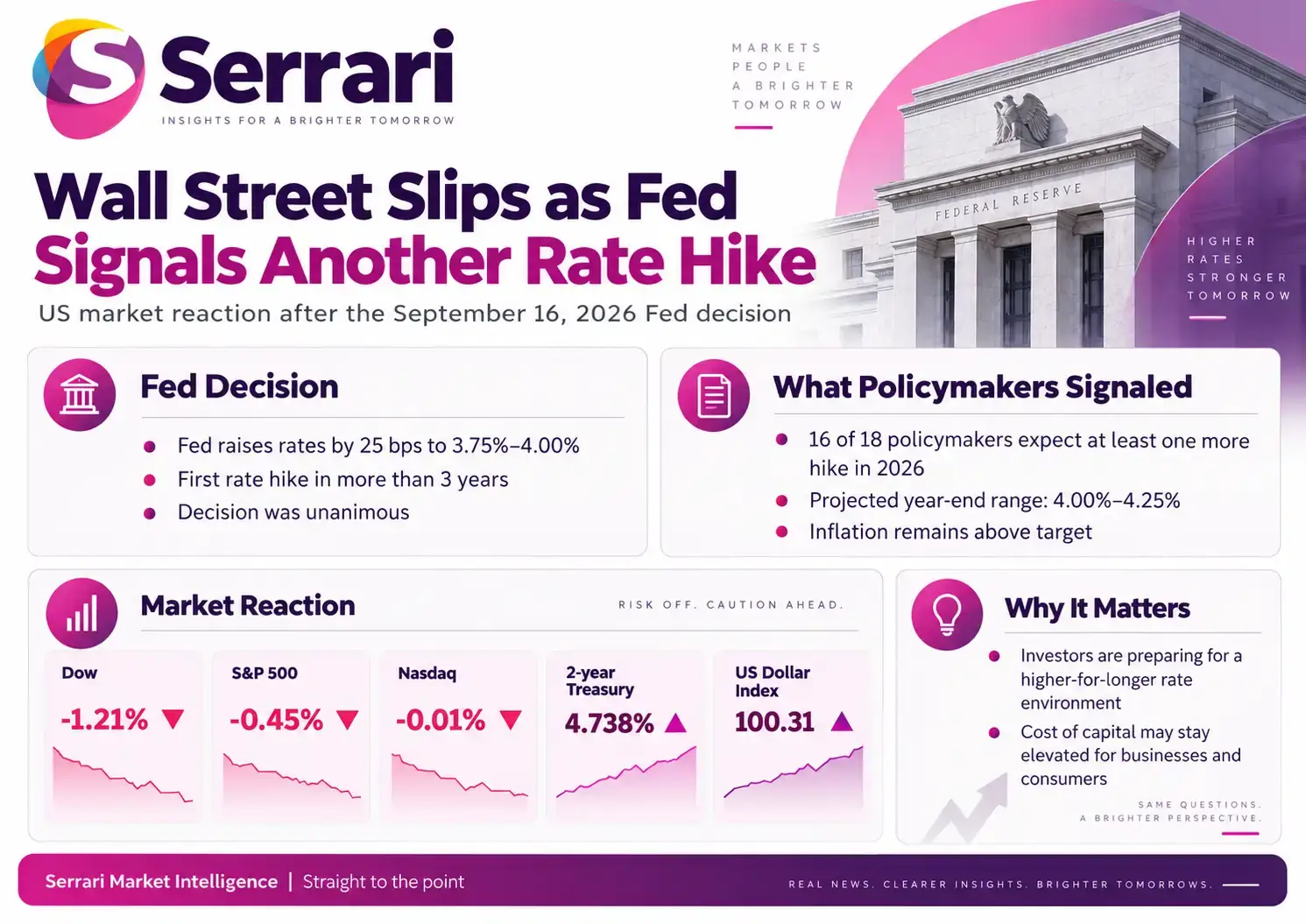
US stocks retreated after the Federal Reserve raised interest rates for the first time in more than three years and indicated that additional tightening could follow. Policymakers raised the federal funds target range by 25 basis points to 3.75%-4.00% on September 16 in a unanimous 12-0 decision.
The market reaction intensified as investors focused on the projected path of interest rates rather than the widely anticipated September increase itself. Stocks surrendered earlier gains, short-term Treasury yields climbed and the US dollar strengthened as investors reassessed how long tighter monetary conditions could persist.
Key Overview
The September projections show that 16 of the 18 policymakers expect rates to end 2026 above their new level, signalling broad support for at least one additional increase before year-end.
The median projection places the federal funds rate midpoint at 4.125% at the end of 2026, corresponding to a target range of 4.00%-4.25%. The median remains at the same level for the end of 2027, suggesting policymakers currently see little scope for quickly reversing the tightening.
Fed Returns to Rate Hikes as Inflation Stays High
The September increase marked a reversal from the easing cycle that had brought rates lower from their previous peaks. It was also the first interest-rate change under Chair Kevin Warsh, who assumed leadership of the central bank in late May.
Policymakers said inflation remains elevated, while describing economic activity as expanding at a solid pace. Domestic spending has remained resilient, productivity growth is strong and capital investment has remained robust.
The latest economic projections reinforce why inflation remains central to the policy debate. Officials now project headline PCE inflation at a median 3.7% in 2026, while core PCE inflation is projected at 3.4%. Both remain well above the central bank’s long-term 2% objective.
At the same time, policymakers project real GDP growth of 2.3% for 2026 and an unemployment rate of 4.1%, indicating that the economy is expected to remain comparatively resilient even as borrowing costs rise.
Wall Street Reverses as Investors Reprice Rate Outlook
US equities initially showed a relatively muted response because the quarter-point increase had largely been anticipated. The tone changed as investors examined the projections and assessed comments from Warsh about the central bank’s determination to restore price stability.
During the immediate post-decision reaction, the S&P 500 fell about 1% and the Nasdaq was down roughly 0.7%. Some of those losses were later recovered, but major US indexes still finished the session lower.
By the closing bell, the Dow Jones Industrial Average had fallen 1.21%, the S&P 500 declined 0.45%, and the Nasdaq Composite slipped 0.01%. Energy and financial stocks were among the main areas weighing on the broader market.
The reaction indicates that investors were less concerned with the September increase itself than with the possibility that the move could mark the beginning of a renewed period of tighter monetary policy.
Context is everything. Stay ahead of shifting trends with today’s market updates, and uncover emerging opportunities using the Serrari Group Market Index and Marketplace. Then, take control of your own financial future by exploring our Money & Life Reset Transformation Blueprint ™ to build stronger habits, create better systems, and design a path toward lasting wealth.
Treasury Yields and Dollar Rise After Decision
The bond market reacted particularly strongly at the shorter end of the yield curve, where securities are more sensitive to expectations about central bank policy.
The two-year Treasury yield climbed about 7.5 basis points to 4.738%, while the benchmark 10-year Treasury yield increased by roughly 2.45 basis points to 5.00%.
The stronger rise in shorter-term yields reflects expectations that the Fed may keep policy rates elevated or raise them further in the coming months.
Currency markets moved in the same direction. The US dollar index gained around 0.63% to 100.31 as higher US interest-rate expectations increased the relative appeal of dollar-denominated assets.
Another Rate Hike Remains on the Table
The most significant signal for markets came from the distribution of policymakers’ interest-rate projections. Of the 18 participants, only two projected that rates would remain around their new September level through the end of 2026.
Twelve policymakers projected a year-end midpoint of 4.125%, while another four projected 4.375%, meaning nearly all officials envisage additional tightening before the year ends.
However, these projections are not predetermined policy commitments. Future rate decisions will continue to depend on inflation, employment, economic growth and other incoming data.
For financial markets, this means upcoming inflation reports could prove especially important. Faster progress toward the 2% target could reduce the need for another increase, while persistent price pressures could strengthen the case for further tightening.
The September decision therefore represents more than a single quarter-point adjustment. It signals that the direction of US monetary policy has shifted back toward containing inflation, with investors now preparing for the possibility that interest rates could remain higher for longer than previously expected.
Sources
Federal Reserve / Reuters
Your financial future isn’t something you wait for—it’s something you build.
The real question is: when do you begin?
Move beyond simply staying informed.
Navigate the markets with clarity—track trends through the Serrari Group Market Index, uncover opportunities in the Serrari Marketplace, and build practical knowledge with our Curated Wealth Builder Platform.
Stay connected to what truly matters.
Get daily insights on macro trends and financial movements across Kenya, Africa, and global markets—delivered through the Serrari Newsletter.
Growth opens doors.
Advance your career through professional programs including ACCA, HESI A2, ATI TEAS 7 , HESI EXIT , NCLEX – RN and NCLEX – PN, Financial Literacy!🌟—designed to move you forward with confidence.
See where money is flowing—clearly and in real time.
Track Money Market Funds, Treasury Bills, Treasury Bonds, Green Bonds, and Fixed Deposits, alongside global and African indexes, key economic indicators, and the evolving Crypto and stablecoin landscape—all within Serrari’s Market Index.