The Bank for International Settlements (BIS) has warned that USD stablecoins could undermine capital controls by enabling cross-border transfers outside traditional financial systems. While regulators continue strengthening cryptocurrency regulation, stablecoin adoption continues to grow rapidly, reflecting increasing demand for digital assets and global cross-border payments.
Key Overview
- BIS warns stablecoins may bypass capital controls.
- The study examined flows across more than 130 economies.
- Stablecoin supply reaches nearly US$293 billion.
- Regulators continue building oversight frameworks.
- Cross-border payments drive adoption.
- Emerging markets face regulatory challenges.
- Stablecoins remain under BIS scrutiny.
- Global digital currency adoption accelerates.
USD Stablecoins Raise Capital Control Concerns as BIS Calls for Stronger Regulation
The Bank for International Settlements (BIS) has renewed its criticism of USD stablecoins, warning that dollar-backed digital currencies could weaken capital controls and complicate financial regulation, particularly in emerging economies. According to a new BIS study, stablecoins are increasingly capable of moving across borders outside traditional financial channels, making them less responsive to restrictions commonly used to regulate international capital flows.
Despite these concerns, stablecoin adoption continues to accelerate worldwide. Regulators across the United States, the European Union, Japan and several Asian financial centres are simultaneously developing comprehensive frameworks designed to integrate stablecoins into the regulated financial system while supporting innovation in cross-border payments and digital finance.
BIS Warns Stablecoins Can Bypass Capital Controls
The latest BIS research examined stablecoin flows across more than 130 economies.
According to the study, USD stablecoins appear to be “largely unaffected” by both broad and targeted capital controls, primarily because they circulate partially outside traditional regulatory frameworks.
Capital controls are policy tools used by governments to regulate the movement of money across national borders, often helping manage exchange rates, foreign currency reserves and financial stability.
The BIS argues that stablecoins create alternative channels for transferring value internationally, potentially reducing the effectiveness of these measures, particularly in countries that rely heavily on foreign exchange restrictions.
The findings reinforce the institution’s longstanding concerns regarding the implications of privately issued digital currencies for the global financial system.
Stablecoins Continue Expanding Despite Regulatory Concerns
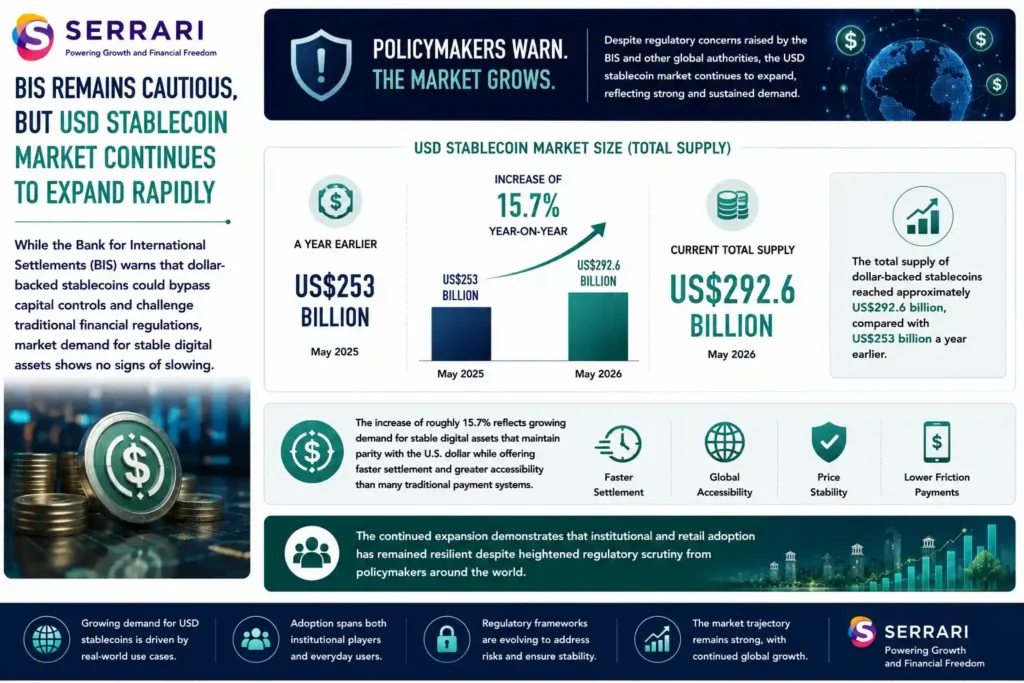
While the BIS remains cautious, the market for USD stablecoins continues to expand rapidly.
According to market data, the total supply of dollar-backed stablecoins reached approximately US$292.6 billion, compared with US$253 billion a year earlier.
The increase of roughly 15.7% reflects growing demand for stable digital assets that maintain parity with the U.S. dollar while offering faster settlement and greater accessibility than many traditional payment systems.
The continued expansion demonstrates that institutional and retail adoption has remained resilient despite heightened regulatory scrutiny from policymakers around the world.
BIS Reiterates Broader Criticism of Stablecoins
The latest report builds on earlier concerns expressed by the Bank for International Settlements (BIS).
In its June 2026 Annual Report, the institution argued that stablecoins still fall short of functioning as true money because they do not fully satisfy several essential characteristics of a modern monetary system.
According to the BIS, these include:
- Singleness.
- Elasticity.
- Interoperability.
- Integrity.
The organisation maintains that these principles are fundamental to maintaining trust, efficiency and stability within financial systems.
As a result, the BIS continues advocating for strong oversight of privately issued digital currencies while encouraging central banks to explore alternative digital payment solutions.
Context is everything. Stay ahead of shifting trends with today’s market updates and uncover emerging opportunities using the Serrari Group Market Index and Marketplace. Then, take control of your own financial future by exploring our Money & Life Reset Transformation Blueprint ™ to build stronger habits, create better systems, and design a path toward lasting wealth.
Global Regulation Continues Advancing
Despite the BIS’s warnings, governments continue developing dedicated cryptocurrency regulation for stablecoins.
In the United States, lawmakers are advancing the proposed GENIUS Act, which aims to establish a federal regulatory framework governing payment stablecoins.
Meanwhile, the European Union continues implementing its Markets in Crypto-Assets (MiCA) framework, providing harmonised rules for stablecoin issuers and other crypto-asset service providers across member states.
Japan has also introduced comprehensive regulations governing stablecoin issuance and custody, reflecting growing acceptance of regulated digital payment instruments.
Rather than prohibiting stablecoins, many jurisdictions are instead seeking to integrate them into existing financial oversight frameworks.
Stablecoins Support Cross-Border Payments
One of the primary drivers behind growing stablecoin adoption is the increasing demand for efficient cross-border payments.
Traditional international payment systems often involve multiple intermediaries, higher transaction costs and longer settlement times.
Dollar-backed stablecoins can facilitate near-instant transfers across borders while maintaining relatively stable value compared with more volatile cryptocurrencies.
Several financial centres—including Singapore, the United Arab Emirates and Hong Kong—have expanded regulated stablecoin initiatives to support international payments, tokenised financial markets and broader digital asset innovation.
These initiatives illustrate how governments increasingly view regulated stablecoins as potential infrastructure for future financial systems.
Emerging Markets Face Greater Policy Challenges
The BIS argues that the impact of USD stablecoins may be particularly significant for emerging economies.
Countries that rely on capital controls to manage exchange rates or limit capital flight may find it more difficult to enforce these policies if financial activity increasingly migrates to blockchain-based payment systems operating beyond conventional banking channels.
As adoption grows, policymakers may therefore face the challenge of balancing financial innovation with the need to preserve monetary policy effectiveness and broader financial stability.
This tension remains one of the central issues shaping international debates on stablecoin regulation.
Financial Stability Remains Central to Policy Debate
The rapid expansion of stablecoins has intensified discussions surrounding financial stability.
Supporters argue that regulated stablecoins can improve payment efficiency, expand financial inclusion and support innovation across digital financial markets.
Critics, including the BIS, caution that widespread adoption without appropriate oversight could create new risks related to regulatory arbitrage, monetary sovereignty and systemic financial resilience.
As a result, many regulators are pursuing frameworks that encourage innovation while imposing requirements related to reserve backing, transparency, governance and consumer protection.
Outlook for USD Stablecoins
The latest BIS report highlights the growing policy challenges created by the rapid expansion of USD stablecoins. While the Bank for International Settlements (BIS) continues warning that stablecoins could weaken capital controls and complicate financial regulation, global adoption continues accelerating as governments establish clearer legal frameworks for digital assets.
With nearly US$293 billion in outstanding supply and increasing use in cross-border payments, stablecoins are becoming an increasingly important component of the global financial system. The ongoing evolution of cryptocurrency regulation will likely determine how these digital currencies coexist with traditional banking systems while supporting innovation without compromising financial stability.
FAQs
Why is the BIS concerned about USD stablecoins?
The Bank for International Settlements (BIS) believes USD stablecoins can move across borders outside traditional banking systems, making them less affected by capital controls and potentially reducing the effectiveness of financial regulations in some countries.
What are capital controls?
Capital controls are government measures that regulate the movement of money into and out of a country. They are often used to manage exchange rates, protect foreign currency reserves and maintain financial stability during periods of economic uncertainty.
How large is the USD stablecoin market?
According to recent market data, the total supply of USD stablecoins reached approximately US$292.6 billion, representing growth of about 15.7% over the previous year as adoption continued expanding globally.
How are regulators responding to stablecoin growth?
Many jurisdictions are introducing dedicated regulatory frameworks rather than banning stablecoins. The United States is advancing the GENIUS Act, the European Union is implementing MiCA, and countries such as Singapore, the United Arab Emirates and Hong Kong are expanding regulated stablecoin initiatives to support digital payments and financial innovation.
Sources: Kucoin, Coinmarketcap, Money Flow Intelligence, Traders Union, The Block
Your financial future isn’t something you wait for—it’s something you build.
The real question is: when do you begin?
Move beyond simply staying informed.
Navigate the markets with clarity—track trends through the Serrari Group Market Index, uncover opportunities in the Serrari Marketplace, and build practical knowledge with our Curated Wealth Builder Platform.
Stay connected to what truly matters.
Get daily insights on macro trends and financial movements across Kenya, Africa, and global markets—delivered through the Serrari Newsletter.
Growth opens doors.
Advance your career through professional programs including ACCA, HESI A2, ATI TEAS 7 , HESI EXIT , NCLEX – RN and NCLEX – PN, Financial Literacy!🌟—designed to move you forward with confidence.
See where money is flowing—clearly and in real time.
Track Money Market Funds, Treasury Bills, Treasury Bonds, Green Bonds, and Fixed Deposits, alongside global and African indexes, key economic indicators, and the evolving Crypto and stablecoin landscape—all within Serrari’s Market Index.