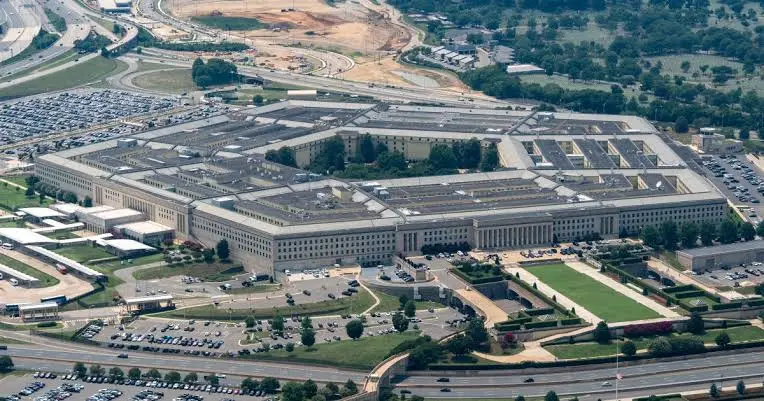
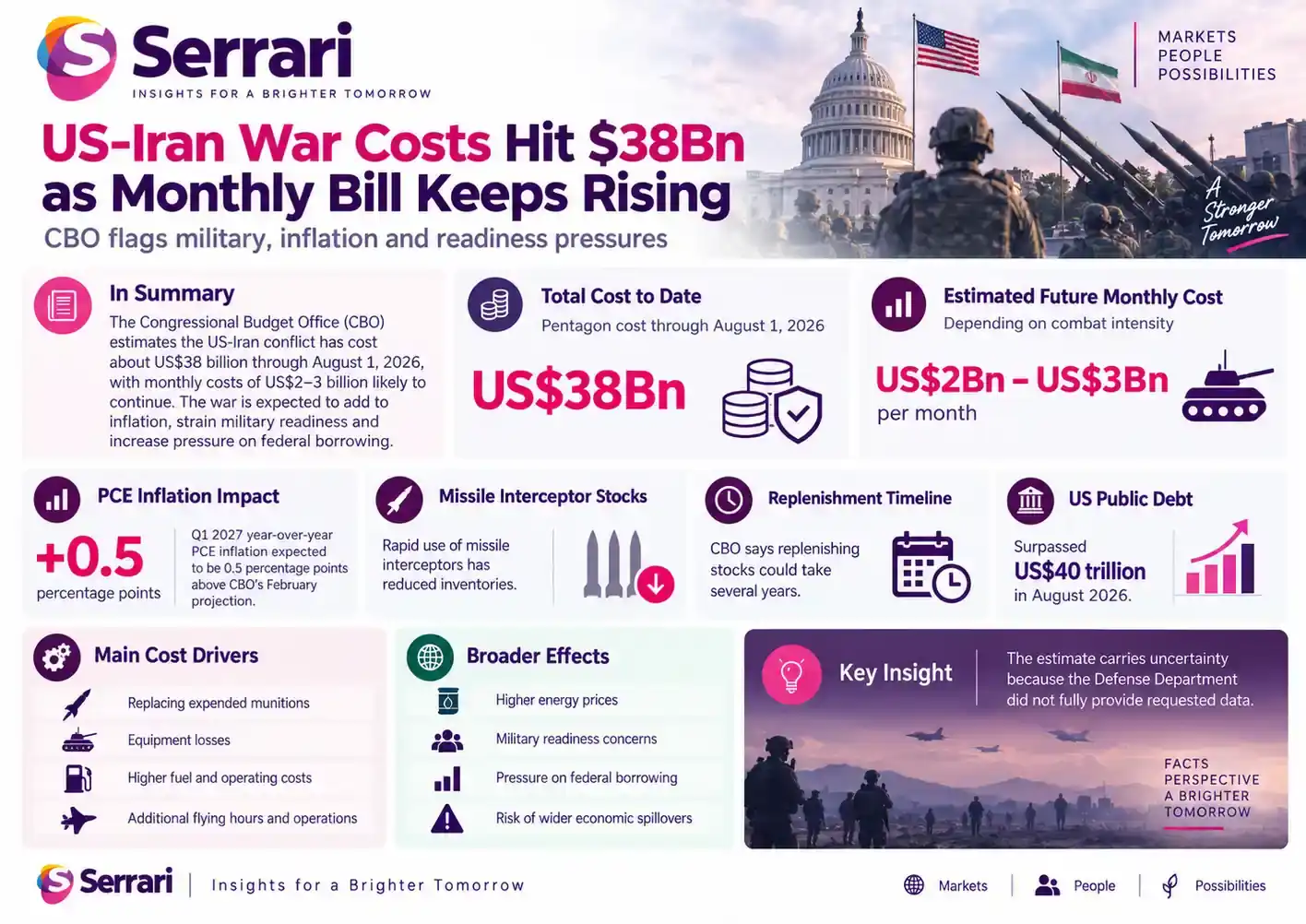
The United States’ combat operations against Iran have cost the Department of Defense about US$38 billion through August 1, according to a new Congressional Budget Office assessment. The official cost estimate includes replacing expended munitions and equipment lost in combat, increased flying hours, additional operations and higher fuel costs.
The budget office estimates that continued fighting could add roughly US$2 billion per month if violence remains relatively limited, or about US$3 billion per month if combat intensity returns to levels seen in July. Costs could rise further if hostilities escalate.
The conflict is also affecting the wider economy. CBO estimates that higher energy prices linked to reduced oil and gas shipments through the Strait of Hormuz and disruption in Red Sea shipping will leave first-quarter 2027 inflation 0.5 percentage points above its February 2026 projection.
Key Overview
- US combat operations against Iran cost the Pentagon about US$38 billion through August 1, 2026.
- Continued operations are projected to add about US$2 billion to US$3 billion per month, depending on combat intensity.
- CBO estimates Q1 2027 year-over-year PCE inflation will be 0.5 percentage points higher than projected before the conflict.
- Expended missile interceptors have created a reduced inventory that CBO says could affect military readiness for several years.
- Defense Secretary Pete Hegseth had earlier put certain war-related costs at about US$37.5 billion through September.
- The US public debt crossed US$40 trillion in August 2026, adding a broader fiscal backdrop to the conflict’s growing cost.
Munitions Account for a Large Share of Costs
Replacing weapons used in combat is one of the largest components of the US$38 billion estimate. CBO says the rapid expenditure of missile defence interceptors has reduced US inventories and could leave the military with constrained stocks for several years.
The munition-replenishment challenge is particularly significant because sophisticated interceptors have long production timelines and require specialised manufacturing capacity. The budget office said the inventory pressure could become more consequential if the United States faced another opponent with large ballistic and cruise missile capabilities.
At a Senate hearing in July, Defense Secretary Pete Hegseth said certain aspects of the conflict were expected to cost US$37.5 billion through the end of September. The administration also sought additional funding for military operations and munitions replenishment.
CBO’s latest estimate is not a complete accounting of every government cost. It excludes expenses borne by other federal agencies and some costs already built into existing military budgets.
Energy Disruption Pushes Up Inflation
The economic consequences extend beyond direct military spending. Shipping disruptions around the Persian Gulf have contributed to higher global energy prices, feeding through to transportation, manufacturing and consumer prices.
Before the conflict, the Strait of Hormuz was one of the world’s most important oil chokepoints. In 2025, about 20% of global petroleum liquids consumption moved through the waterway. By the second quarter of 2026, flows through the strait had fallen sharply as the conflict disrupted shipping.
CBO estimates that energy-price effects added 2.3 percentage points to the annualised rate of overall PCE inflation in the second quarter of 2026. Looking ahead, the agency expects year-over-year headline PCE inflation in the first quarter of 2027 to be 0.5 percentage points above the forecast it issued before the war, while core PCE inflation is projected to be 0.3 percentage points higher.
Higher inflation is also expected to lift Treasury borrowing costs modestly, although CBO says the resulting effects on federal revenues and spending are likely to be broadly offsetting.
Context is everything. Stay ahead of shifting trends with today’s market updates, and uncover emerging opportunities using the Serrari Group Market Index and Marketplace. Then, take control of your own financial future by exploring our Money & Life Reset Transformation Blueprint ™ to build stronger habits, create better systems, and design a path toward lasting wealth.
Cost Estimate Carries Significant Uncertainty
CBO said it relied on government databases and publicly available information because the Department of Defense did not respond to its requests for data. The agency therefore cautioned that its cost estimates are subject to considerable uncertainty.
The US$38 billion figure also excludes the cost of repairing damage to US military installations in the Middle East. Separate reporting has put war-related costs through mid-June at about US$33.4 billion, including damage to diplomatic facilities and military assets.
The conflict’s financial burden is arriving as the US public debt surpassed US$40 trillion in August. That does not mean the Iran conflict caused the debt milestone, but additional war spending adds to federal borrowing requirements when deficits and interest expenses are already elevated.
Monthly Costs Depend on How the Conflict Develops
The key variable for future spending is the intensity and duration of military operations. CBO estimates another month of relatively low-level conflict would cost around US$2 billion, while a return to more intense fighting could increase the monthly bill to around US$3 billion or more.
Those figures do not include all potential costs linked to diplomacy, foreign assistance, long-term healthcare, reconstruction or additional borrowing. As a result, the final fiscal cost cannot yet be determined.
For now, the CBO assessment provides the clearest independent benchmark for the financial scale of the conflict: roughly US$38 billion spent by the Pentagon through August 1, continuing monthly costs in the billions and measurable inflationary effects extending into 2027.
Sources: Congressional Budget Office / Reuters / U.S. Energy Information Administration / U.S. Treasury / CBS News
Your financial future isn’t something you wait for—it’s something you build.
The real question is: when do you begin?
Move beyond simply staying informed.
Navigate the markets with clarity—track trends through the Serrari Group Market Index, uncover opportunities in the Serrari Marketplace, and build practical knowledge with our Curated Wealth Builder Platform.
Stay connected to what truly matters.
Get daily insights on macro trends and financial movements across Kenya, Africa, and global markets—delivered through the Serrari Newsletter.
Growth opens doors.
Advance your career through professional programs including ACCA, HESI A2, ATI TEAS 7 , HESI EXIT , NCLEX – RN and NCLEX – PN, Financial Literacy!🌟—designed to move you forward with confidence.
See where money is flowing—clearly and in real time.
Track Money Market Funds, Treasury Bills, Treasury Bonds, Green Bonds, and Fixed Deposits, alongside global and African indexes, key economic indicators, and the evolving Crypto and stablecoin landscape—all within Serrari’s Market Index.