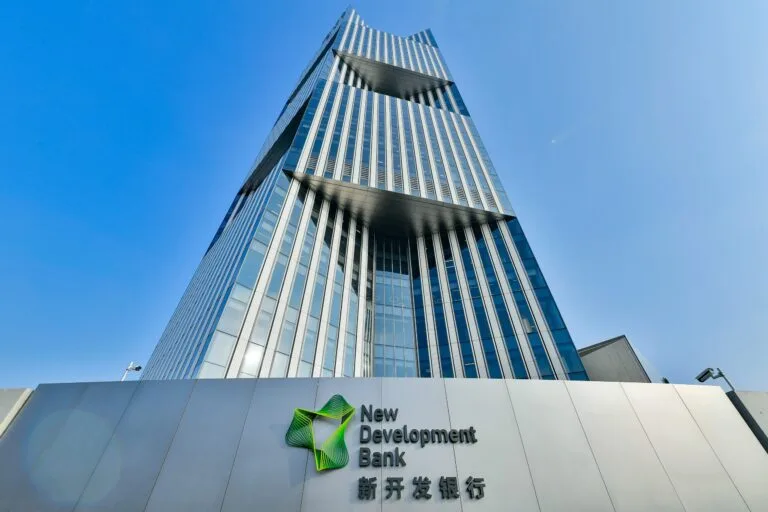
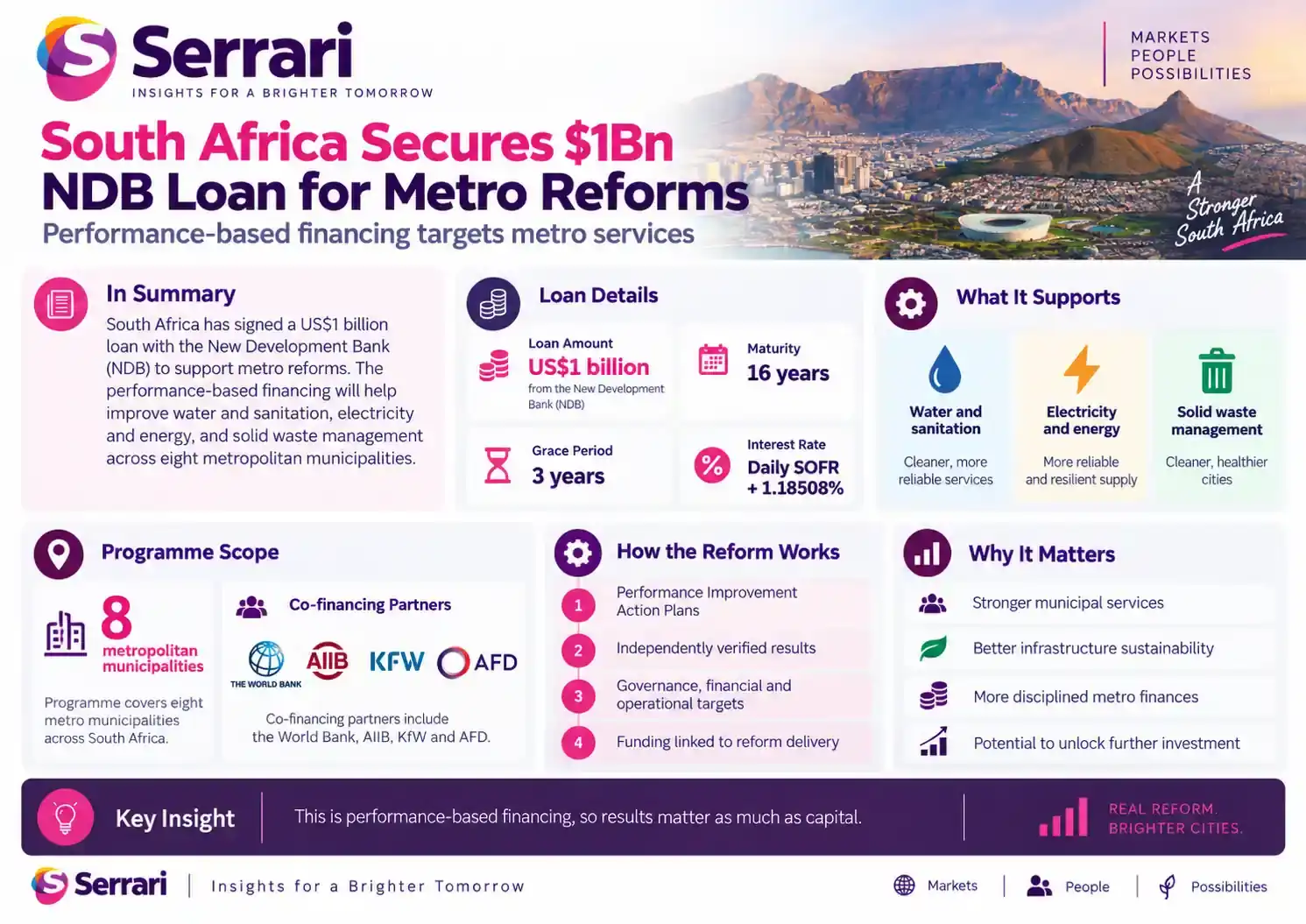
South Africa has signed a US$1 billion loan agreement with the New Development Bank to support the Metro Trading Services Reform Programme, a national effort to improve essential urban services in the country’s metropolitan municipalities. The new financing agreement carries a 16-year maturity, a three-year grace period and a floating interest rate of Daily SOFR plus 1.18508%.
The programme focuses on water and sanitation, electricity and energy, and solid waste management. Unlike a conventional project loan tied to one construction site, the financing is performance-based, meaning disbursements are linked to institutional reforms and independently verified targets approved by metropolitan councils.
Key Overview
- South Africa has signed a US$1 billion loan with the New Development Bank.
- The facility has a 16-year maturity and a three-year grace period.
- Interest is set at Daily SOFR + 1.18508%, meaning the all-in borrowing cost will move with the SOFR benchmark.
- Funding supports reforms in water and sanitation, electricity and energy, and solid waste management.
- The programme covers South Africa’s eight metropolitan municipalities.
- NDB financing sits alongside support from the World Bank, AIIB, KfW and AFD.
Loan Is Tied to Verified Metro Performance
The financing is structured around measurable results rather than simply reimbursing construction expenditure. Under the reform model, metropolitan municipalities prepare council-approved Performance Improvement Action Plans covering governance, financial management and operational performance.
The performance-based financing framework links disbursements to independently verified indicators. These can include measures such as reducing non-revenue water, cutting technical electricity losses and improving the performance of solid-waste systems.
That structure is intended to ensure that new financing is accompanied by institutional improvements capable of making municipal trading services more financially sustainable over time.
The eight metros covered are Buffalo City, Cape Town, Ekurhuleni, Johannesburg, Tshwane, eThekwini, Mangaung and Nelson Mandela Bay. Together, they serve more than 22 million residents and represent a large share of South Africa’s economic activity.
Development Banks Build a Larger Financing Package
The NDB facility is part of a wider international financing package assembled around the metro reform programme.
A US$925 million results-based facility was approved to support the same reform agenda, marking the first use of that type of financing instrument in South Africa.
The Asian Infrastructure Investment Bank later signed a US$500 million sovereign-backed loan, its first investment in South Africa, to strengthen climate-resilient water, electricity and waste services.
Germany and France have also committed €300 million in concessional financing, comprising €200 million through KfW Development Bank and €100 million through Agence Française de Développement.
Combined, the facilities show that the metro programme is being financed through several development institutions rather than relying on a single lender.
Context is everything. Stay ahead of shifting trends with today’s market updates, and uncover emerging opportunities using the Serrari Group Market Index and Marketplace. Then, take control of your own financial future by exploring our Money & Life Reset Transformation Blueprint ™ to build stronger habits, create better systems, and design a path toward lasting wealth.
Reform Targets Infrastructure and Municipal Finances
South Africa’s metros face persistent challenges including ageing electricity networks, water losses, infrastructure maintenance backlogs and weaknesses in the financial performance of municipal utilities.
The reform seeks to change how revenues from trading services are managed so that more funds can be reinvested in infrastructure while municipalities strengthen their ability to borrow for future investment.
National Treasury’s broader reform framework includes an R54 billion performance-based incentive and is expected to help unlock more than R100 billion in metro infrastructure investment over the coming years.
The system requires metros to meet institutional, financial and operational commitments before receiving performance-linked support, creating a direct connection between reform progress and access to financing.
Floating Rate Means Borrowing Cost Can Change
Although Treasury describes the NDB facility as offering favourable concessional terms, its interest rate is not fixed for the full 16-year period.
The loan is priced at Daily SOFR plus 1.18508%. Because SOFR is a floating benchmark tied to overnight US-dollar funding conditions, South Africa’s actual interest expense will rise or fall as the benchmark changes.
The three-year grace period delays principal repayments at the beginning of the facility, while the longer maturity spreads repayment over 16 years. These features can reduce near-term repayment pressure, although foreign-currency and floating-rate exposure remain important considerations over the life of the loan.
The success of the financing will ultimately depend on whether the participating metros meet their verified performance targets and translate the available capital into more reliable water, electricity and waste services.
Sources: National Treasury South Africa / New Development Bank / World Bank / Asian Infrastructure Investment Bank / KfW Development Bank / Agence Française de Développement
Your financial future isn’t something you wait for—it’s something you build.
The real question is: when do you begin?
Move beyond simply staying informed.
Navigate the markets with clarity—track trends through the Serrari Group Market Index, uncover opportunities in the Serrari Marketplace, and build practical knowledge with our Curated Wealth Builder Platform.
Stay connected to what truly matters.
Get daily insights on macro trends and financial movements across Kenya, Africa, and global markets—delivered through the Serrari Newsletter.
Growth opens doors.
Advance your career through professional programs including ACCA, HESI A2, ATI TEAS 7 , HESI EXIT , NCLEX – RN and NCLEX – PN, Financial Literacy!🌟—designed to move you forward with confidence.
See where money is flowing—clearly and in real time.
Track Money Market Funds, Treasury Bills, Treasury Bonds, Green Bonds, and Fixed Deposits, alongside global and African indexes, key economic indicators, and the evolving Crypto and stablecoin landscape—all within Serrari’s Market Index.