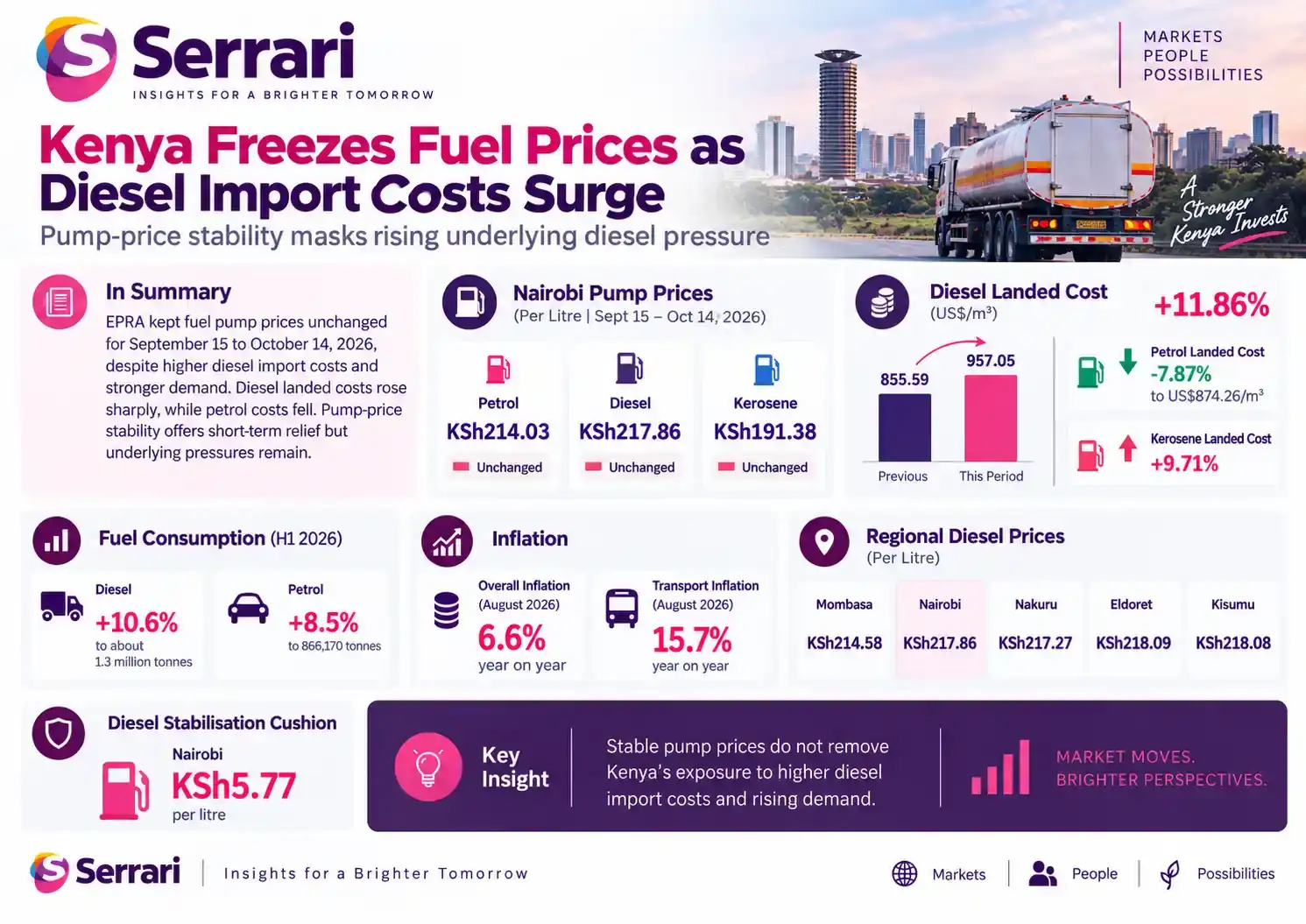
Kenya has retained maximum pump prices for Super Petrol, Diesel and Kerosene for the September 15 to October 14, 2026 pricing cycle even as the cost of imported diesel rose sharply. The latest pump-price schedule keeps Nairobi petrol at KSh214.03 per litre, diesel at KSh217.86 and kerosene at KSh191.38.
The unchanged retail prices mask sharply different movements in underlying import costs. Diesel’s average landed cost rose 11.86% from US$855.59 per cubic metre in July to US$957.05 in August, while kerosene increased 9.71% to US$1,003.87. Petrol moved in the opposite direction, with its landed cost falling 7.87% to US$874.26 per cubic metre.
Key Overview
- Nairobi pump prices remain at KSh214.03 for petrol, KSh217.86 for diesel and KSh191.38 for kerosene.
- Diesel’s landed cost increased 11.86% to US$957.05 per cubic metre.
- Kerosene import costs rose 9.71%, while petrol’s landed cost fell 7.87%.
- Kenya’s diesel consumption increased 10.6% in the first half of 2026 to about 1.3 million tonnes.
- Petrol consumption rose 8.5% to about 866,170 tonnes over the same period.
- Annual inflation reached 6.6% in August, while the transport index rose 15.7% year on year.
Diesel Import Costs Rise Behind Stable Pump Prices
The September pricing review gives motorists another month without a pump-price increase, but the underlying diesel market has moved in the opposite direction.
The latest import-cost figures show diesel climbing by more than US$100 per cubic metre between July and August. Kerosene also became more expensive to import, while the lower petrol landed cost provided some offset within the broader pricing cycle.
The divergence matters because diesel is closely linked to freight, public transport, agriculture, construction and heavy machinery. Businesses that depend on road transport therefore remain exposed to rising international diesel costs even when the regulated retail price is temporarily unchanged.
Rising Demand Increases Kenya’s Exposure
Higher import costs are arriving at a time when domestic fuel demand is also expanding.
Kenya’s diesel consumption increased by 10.6% in the first six months of 2026 to about 1.3 million tonnes from roughly 1.2 million tonnes in the comparable period of 2025. Petrol consumption rose 8.5% to 866,170 tonnes from 798,310 tonnes.
This means higher diesel costs are not being offset by a contraction in demand. Commercial transport, logistics, farming, construction and other diesel-intensive activities continue to require significant fuel volumes.
For businesses, that combination creates a larger exposure to future international price movements. If elevated import costs persist, either the pricing mechanism must continue cushioning consumers or more of the increase could eventually feed into future pump-price reviews.
Context is everything. Stay ahead of shifting trends with today’s market updates, and uncover emerging opportunities using the Serrari Group Market Index and Marketplace. Then, take control of your own financial future by exploring our Money & Life Reset Transformation Blueprint ™ to build stronger habits, create better systems, and design a path toward lasting wealth.
Regional Prices Still Differ Across Kenya
Although September prices were held unchanged, fuel does not cost the same across the country.
Under the regulated town-by-town price structure, diesel remains at KSh214.58 per litre in Mombasa, KSh217.27 in Nakuru, KSh218.09 in Eldoret and KSh218.08 in Kisumu. Nairobi’s maximum is KSh217.86.
A business buying 1,000 litres in Nairobi would therefore spend KSh3,280 more than one buying the same volume at the Mombasa maximum price.
The gap becomes wider in some remote markets because the retail formula incorporates distribution-related costs. These regional differences can affect freight and operating expenses even when the national monthly review produces no headline price change.
Stabilisation Mechanism Cushions Diesel Costs
Kenya’s regulated fuel-pricing system combines landed product costs with storage, transport, wholesale and retail margins, taxes, levies and other approved components. The official pricing formula is used to calculate maximum wholesale and retail prices each month.
In the September Nairobi price build-up, the stabilisation component cushioned diesel by KSh5.77 per litre, helping prevent the higher landed cost from being fully passed to motorists during the current cycle.
That buffer provides short-term price stability, but it does not eliminate Kenya’s exposure to global petroleum markets. If import costs remain high over successive pricing periods, maintaining unchanged retail prices becomes increasingly dependent on the capacity of the stabilisation framework.
Transport Inflation Remains Elevated
The fuel-cost pressure is unfolding against already elevated transport inflation. Kenya’s August inflation report put annual inflation at 6.6%, while prices in the transport category were 15.7% higher than a year earlier.
Fuel is only one component of transport costs, so higher landed diesel prices do not automatically translate into equivalent increases in fares or consumer prices. Operators can absorb some costs, adjust margins or improve efficiency depending on market conditions.
Still, diesel remains a major operating input across the economy. The September freeze therefore gives businesses and households immediate price certainty, while the sharp increase in import costs signals continued risk for future reviews if international diesel prices stay elevated.
Sources: Energy and Petroleum Regulatory Authority / Kenya National Bureau of Statistics / Daily Nation / People Daily
Your financial future isn’t something you wait for—it’s something you build.
The real question is: when do you begin?
Move beyond simply staying informed.
Navigate the markets with clarity—track trends through the Serrari Group Market Index, uncover opportunities in the Serrari Marketplace, and build practical knowledge with our Curated Wealth Builder Platform.
Stay connected to what truly matters.
Get daily insights on macro trends and financial movements across Kenya, Africa, and global markets—delivered through the Serrari Newsletter.
Growth opens doors.
Advance your career through professional programs including ACCA, HESI A2, ATI TEAS 7 , HESI EXIT , NCLEX – RN and NCLEX – PN, Financial Literacy!🌟—designed to move you forward with confidence.
See where money is flowing—clearly and in real time.
Track Money Market Funds, Treasury Bills, Treasury Bonds, Green Bonds, and Fixed Deposits, alongside global and African indexes, key economic indicators, and the evolving Crypto and stablecoin landscape—all within Serrari’s Market Index.