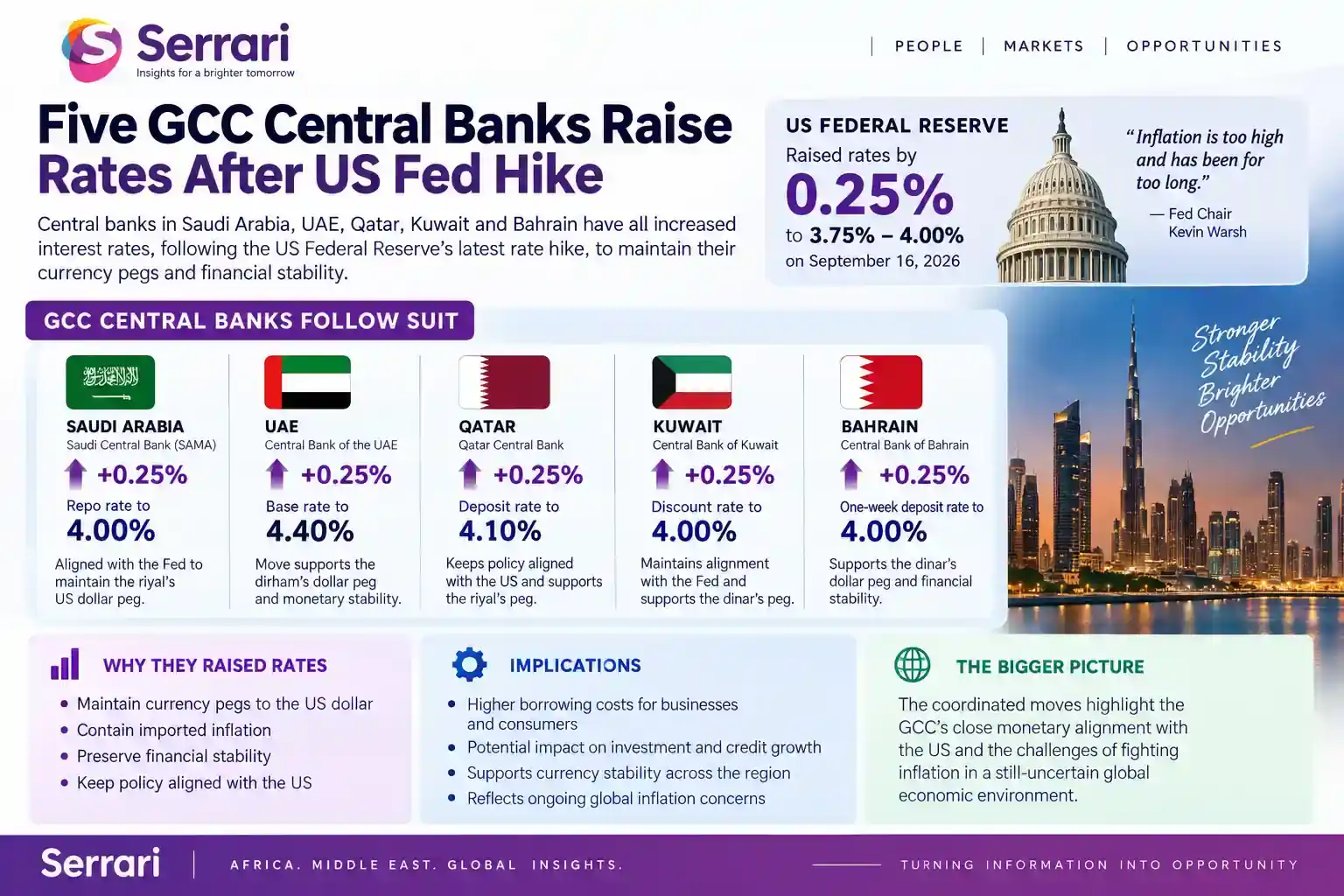
Five Gulf Cooperation Council central banks raised key interest rates after the US Federal Reserve increased its benchmark rate by 25 basis points on September 16, 2026. The Fed lifted the federal funds target range to 3.75%-4.00%, prompting policy adjustments in the UAE, Saudi Arabia, Bahrain, Qatar and Oman.
The increases largely take effect from September 17 and reflect the close relationship between US monetary policy and Gulf financial conditions. Kuwait was the notable exception, keeping its benchmark discount rate unchanged.
Key Overview
The Federal Reserve’s move was its first interest rate increase since 2023, reversing the previous easing cycle as policymakers turned their attention toward persistent inflation.
Most GCC monetary authorities responded with matching 25-basis-point increases. This close alignment is largely explained by the region’s exchange-rate systems, with most GCC currencies pegged directly to the US dollar and domestic monetary policy therefore closely influenced by changes in US interest rates.
Fed Raises Rates as Inflation Remains Elevated
The Federal Open Market Committee unanimously voted to raise its target range by a quarter percentage point to 3.75%-4.00%.
The committee said inflation remains elevated even as economic activity continues to expand at a solid pace. Domestic spending has remained resilient, productivity growth has been strong and capital investment has remained robust.
The Fed said the September increase was intended to support a more timely return of inflation toward its 2% objective.
Alongside the policy-rate increase, the interest rate paid on reserve balances rose to 3.90% from September 17, while the primary credit rate increased by 25 basis points to 4.00%.
Gulf Central Banks Follow With 25-Basis-Point Hikes
In the UAE, the central bank raised the Base Rate for its Overnight Deposit Facility by 25 basis points from 3.65% to 3.90%, effective September 17.
The rate charged for short-term liquidity through standing credit facilities remains 50 basis points above the Base Rate, implying a rate of 4.40% following the adjustment.
Saudi Arabia also increased its repo and reverse repo rates, lifting the repo rate by 25 basis points to 4.50% and the reverse repo rate to 4.00%.
Bahrain raised its overnight deposit rate from 4.25% to 4.50%, with the new rate effective from September 17.
Qatar implemented increases across three policy instruments. Its monetary authorities raised the deposit, lending and repo rates by 25 basis points each, taking the deposit rate to 4.10%, the lending rate to 4.60% and the repo rate to 4.35%.
Oman also increased its repo rate by 25 basis points to 4.50%, with the change taking effect from September 17.
Context is everything. Stay ahead of shifting trends with today’s market updates, and uncover emerging opportunities using the Serrari Group Market Index and Marketplace. Then, take control of your own financial future by exploring our Money & Life Reset Transformation Blueprint ™ to build stronger habits, create better systems, and design a path toward lasting wealth.
Why GCC Rates Closely Follow US Monetary Policy
The coordinated moves reflect the monetary framework used across much of the Gulf. Most GCC currencies are pegged to the US dollar, meaning significant differences between domestic and US interest rates can create pressure on capital flows and currency pegs.
Regional monetary policy has therefore historically tracked changes in US interest rates as central banks seek to maintain exchange-rate and financial stability.
Kuwait operates differently because the dinar is linked to a basket of currencies rather than directly to the dollar. Its discount rate remained at 3.50% following the latest Fed decision, highlighting the greater flexibility created by its different exchange-rate arrangement.
What Higher Rates Mean for Gulf Economies
Higher central bank rates keep monetary conditions relatively tight across the region. Commercial banks generally face higher short-term funding costs when policy rates increase, which can gradually feed into pricing for mortgages, corporate credit and other variable-rate borrowing.
Savers may benefit from stronger deposit returns where banks pass higher market rates through to customers, although the extent and timing of these changes vary between institutions and markets.
The wider economic effect will also depend on liquidity levels, government spending and credit demand. Research on the region has found that US monetary policy significantly influences GCC financial conditions, even though the strength of the transmission to retail borrowing and deposit rates differs across individual economies.
With the September increase, the Fed and most GCC central banks have moved back toward tighter monetary settings, making future inflation readings and subsequent policy decisions increasingly important for households, companies, investors and financial markets across the Gulf.
Sources
Federal Reserve / Central Bank of the UAE / Saudi Central Bank / Central Bank of Bahrain / Qatar News Agency / Central Bank of Oman / Central Bank of Kuwait / International Monetary Fund / Reuters / ZAWYA
Your financial future isn’t something you wait for—it’s something you build.
The real question is: when do you begin?
Move beyond simply staying informed.
Navigate the markets with clarity—track trends through the Serrari Group Market Index, uncover opportunities in the Serrari Marketplace, and build practical knowledge with our Curated Wealth Builder Platform.
Stay connected to what truly matters.
Get daily insights on macro trends and financial movements across Kenya, Africa, and global markets—delivered through the Serrari Newsletter.
Growth opens doors.
Advance your career through professional programs including ACCA, HESI A2, ATI TEAS 7 , HESI EXIT , NCLEX – RN and NCLEX – PN, Financial Literacy!🌟—designed to move you forward with confidence.
See where money is flowing—clearly and in real time.
Track Money Market Funds, Treasury Bills, Treasury Bonds, Green Bonds, and Fixed Deposits, alongside global and African indexes, key economic indicators, and the evolving Crypto and stablecoin landscape—all within Serrari’s Market Index.