Stablecoins have come under renewed scrutiny after the Bank for International Settlements (BIS) warned that their rapid growth could undermine the global monetary system and weaken countries’ control over monetary policy. In its 2026 Annual Economic Report, the BIS argued that privately issued stablecoins lack key characteristics required of money at scale and urged policymakers to accelerate the development of tokenized central bank and commercial bank money as safer alternatives. The report also highlighted growing stablecoin risks for emerging markets and called for stronger stablecoin regulation to preserve financial stability.
Key Overview
- The BIS warned that stablecoins could fragment the global monetary system.
- The global stablecoin market is valued at approximately US$316–320 billion.
- The BIS said stablecoins fail four key tests of sound money.
- Dollar-denominated stablecoins may weaken monetary sovereignty in emerging markets.
- The report warned that widespread adoption could increase bank funding costs.
- Stablecoin market value could reach US$1–3 trillion in future scenarios.
- More than 99% of fiat-backed stablecoins remain pegged to the U.S. dollar.
- The BIS supports tokenized central bank and commercial bank money as alternatives.
Stablecoins Draw Fresh BIS Warning
The rapid growth of stablecoins has prompted renewed concerns from the Bank for International Settlements (BIS), which says privately issued digital tokens could eventually threaten the foundations of the global financial system.
In its 2026 Annual Economic Report, the Basel-based institution argued that although stablecoins have expanded rapidly in recent years, they do not possess the institutional characteristics necessary to function as reliable money on a large scale.
Instead, the BIS believes regulators and financial institutions should accelerate the development of tokenized forms of central bank money and commercial bank deposits that can provide many of the technological benefits of digital assets while maintaining monetary stability.
Stablecoin Market Continues Expanding
The report comes as the global stablecoin market continues experiencing significant growth.
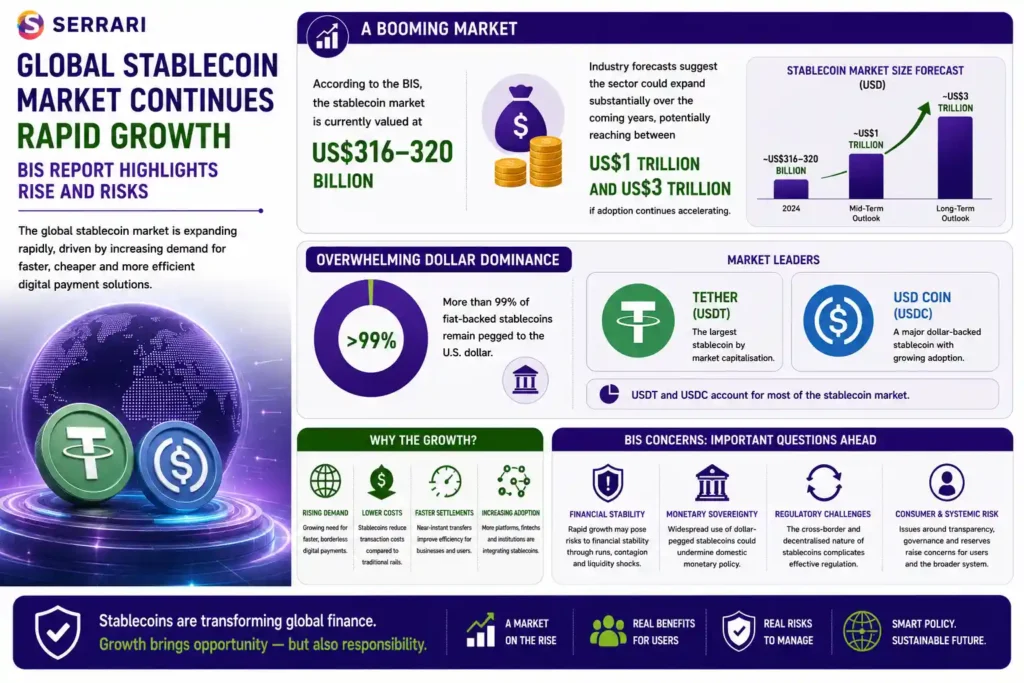
According to the BIS, the sector is currently valued at approximately US$316–320 billion, with the overwhelming majority consisting of U.S. dollar-backed stablecoins.
More than 99% of fiat-backed stablecoins remain pegged to the U.S. dollar, with Tether (USDT) and USD Coin (USDC) accounting for most of the market.
Industry forecasts suggest the sector could expand substantially over the coming years, potentially reaching between US$1 trillion and US$3 trillion if adoption continues accelerating.
While this growth reflects increasing demand for digital payment instruments, the BIS believes it also raises important questions regarding financial stability and monetary sovereignty.
BIS Questions Stablecoins as Money
One of the report’s central conclusions is that stablecoins do not satisfy the fundamental requirements expected of modern money.
The BIS evaluated stablecoins across four core dimensions:
- Singleness
- Elasticity
- Interoperability
- Integrity
According to the institution, current stablecoins fall short in all four areas.
Unlike central bank money, which is universally accepted at face value, privately issued stablecoins depend on the financial health, governance and reserve management practices of individual issuers.
This means they cannot always guarantee uniform value or seamless acceptance across the broader financial system.
The BIS therefore argues that stablecoins resemble investment products more than true payment instruments.
Context is everything. Stay ahead of shifting trends with today’s market updates, and uncover emerging opportunities using the Serrari Group Market Index and Marketplace. Then, take control of your own financial future by exploring our Money & Life Reset Transformation Blueprint ™ to build stronger habits, create better systems, and design a path toward lasting wealth.
Concerns Over Stablecoin Dollarization
The report places particular emphasis on what it describes as stablecoin dollarization.
Many emerging economies are witnessing increased use of U.S. dollar-backed stablecoins as households and businesses seek protection against weaker domestic currencies.
Although this may provide short-term benefits for users, the BIS warns that widespread reliance on foreign-currency stablecoins could gradually reduce the effectiveness of domestic monetary policy.
If residents increasingly hold and transact in dollar-denominated digital assets instead of local currencies, central banks may lose part of their ability to influence economic activity through traditional monetary policy tools.
This could prove especially challenging for countries already facing inflationary pressures or currency instability.
Potential Impact on Banks
The BIS also examined how large-scale stablecoin adoption might affect commercial banks.
Its economic modelling suggests that if stablecoins continue attracting deposits away from traditional banks, financial institutions could face higher funding costs.
Banks typically rely on customer deposits as a relatively stable source of funding for lending activities.
If significant volumes of deposits migrate into stablecoins, banks may need to obtain alternative funding at higher costs, potentially reducing credit availability for households and businesses.
According to the report, even if stablecoin market capitalization eventually reaches several trillion dollars, the overall economic impact could become slightly negative because reduced bank lending may outweigh other benefits.
Financial Stability Remains a Priority
The BIS has consistently expressed caution regarding digital assets over several years.
Previous reports have questioned whether cryptocurrencies can reliably replace traditional monetary systems due to concerns surrounding volatility, scalability, legal uncertainty and operational resilience.
While stablecoins differ from cryptocurrencies such as Bitcoin because they seek to maintain relatively stable values, the BIS argues that they still rely on private issuers rather than public monetary institutions.
As a result, the organisation believes that maintaining financial stability requires preserving confidence in central bank money as the foundation of the monetary system.
Alternative Digital Money
Rather than opposing financial innovation, the BIS advocates developing tokenized versions of existing forms of money.
These include tokenized central bank reserves and tokenized commercial bank deposits that operate on modern digital infrastructure while remaining fully integrated within the regulated financial system.
Such systems could provide faster settlement, greater efficiency and improved interoperability without introducing many of the structural risks associated with privately issued stablecoins.
Several central banks worldwide are already exploring similar initiatives through central bank digital currency (CBDC) projects and wholesale tokenization programmes.
Outlook for Stablecoin Regulation
As stablecoin adoption continues growing globally, regulators are increasingly working to establish comprehensive legal frameworks governing issuance, reserve management and consumer protection.
Several jurisdictions have already introduced or proposed legislation covering stablecoin issuers, reserve requirements and redemption standards.
The BIS report is likely to contribute to these ongoing policy discussions by encouraging governments to prioritise financial stability alongside technological innovation.
Future stablecoin regulation will probably focus on balancing innovation with safeguards designed to protect both consumers and the broader financial system.
Conclusion
The latest BIS report reinforces growing international concerns surrounding stablecoins and their long-term role within the global financial system. Although stablecoins continue expanding rapidly and offer significant technological advantages for payments and digital finance, the Bank for International Settlements argues that privately issued digital tokens do not yet meet the standards required of money at scale. As regulators continue developing new rules and tokenized forms of central bank money emerge, the future of stablecoins will likely depend on striking the right balance between innovation, financial stability and monetary sovereignty.
FAQs
1. Why does the BIS believe stablecoins are not suitable as money?
The BIS argues that stablecoins lack several essential characteristics required for money to function effectively across an economy. Unlike central bank money, which is universally accepted and supported by public institutions, stablecoins depend on private issuers and reserve management practices. The organisation believes this creates challenges relating to consistency of value, scalability, interoperability and overall trust, making stablecoins less suitable as a universal form of money despite their growing popularity.
2. What is stablecoin dollarization?
Stablecoin dollarization refers to the increasing use of U.S. dollar-backed stablecoins instead of domestic currencies, particularly in countries experiencing inflation or currency instability. While this may help individuals preserve purchasing power or reduce transaction costs, the BIS warns that widespread adoption could weaken national monetary policy by reducing demand for local currencies. Over time, this may limit central banks’ ability to manage inflation, interest rates and overall economic activity.
3. How could stablecoins affect commercial banks?
According to the BIS, widespread stablecoin adoption could reduce the amount of customer deposits held by commercial banks. Since deposits are an important source of funding for bank lending, losing them may force banks to rely on more expensive funding sources. Higher funding costs could reduce lending capacity, potentially affecting businesses and consumers seeking loans. Although these effects may develop gradually, the BIS considers them an important financial stability risk if stablecoin adoption continues expanding significantly.
4. What alternatives does the BIS recommend instead of private stablecoins?
Rather than relying on privately issued stablecoins, the BIS recommends accelerating the development of tokenized forms of central bank money and commercial bank deposits. These digital versions of traditional money could offer many of the technological advantages associated with blockchain, including faster settlement and improved efficiency, while preserving monetary sovereignty and maintaining the existing regulatory safeguards that support financial stability. Many central banks are already exploring similar solutions through central bank digital currency and tokenization initiatives.
Sources: Traders Union, Business Day, Trading View, Binance Square, The Block
Your financial future isn’t something you wait for—it’s something you build.
The real question is: when do you begin?
Move beyond simply staying informed.
Navigate the markets with clarity—track trends through the Serrari Group Market Index, uncover opportunities in the Serrari Marketplace, and build practical knowledge with our Curated Wealth Builder Platform.
Stay connected to what truly matters.
Get daily insights on macro trends and financial movements across Kenya, Africa, and global markets—delivered through the Serrari Newsletter.
Growth opens doors.
Advance your career through professional programs including ACCA, HESI A2, ATI TEAS 7 , HESI EXIT , NCLEX – RN and NCLEX – PN, Financial Literacy!🌟—designed to move you forward with confidence.
See where money is flowing—clearly and in real time.
Track Money Market Funds, Treasury Bills, Treasury Bonds, Green Bonds, and Fixed Deposits, alongside global and African indexes, key economic indicators, and the evolving Crypto and stablecoin landscape—all within Serrari’s Market Index.