African electric mobility company Spiro has secured $215 million in equity financing to accelerate expansion of its battery-swapping network and electric vehicle operations across the continent.
The funding will support manufacturing growth, rollout of additional smart battery-swapping stations, and expansion into new African markets including Ethiopia and the Democratic Republic of Congo.
The investment highlights rising international interest in Africa’s growing clean transport sector as countries seek alternatives to imported fossil fuels and expensive fuel-powered transportation.
Key Overview
- Spiro raised $215 million in equity financing
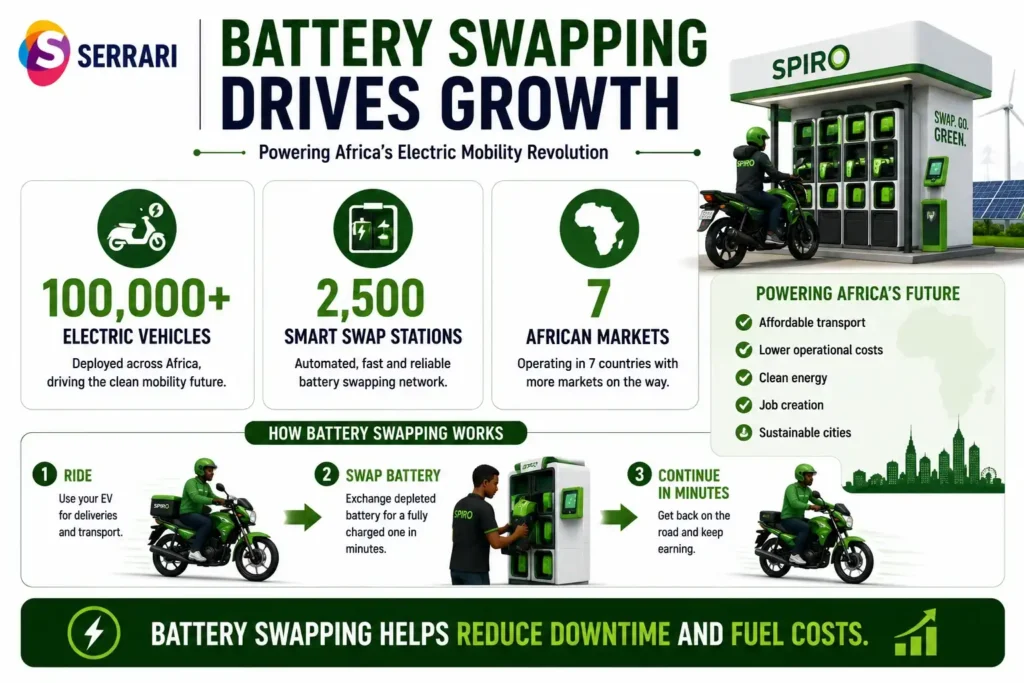
- The company operates in seven African countries
- Funding will support battery-swapping expansion and manufacturing
- Spiro has deployed over 100,000 electric vehicles
- The company operates 2,500 smart battery-swapping stations
- Expansion plans include Ethiopia and the Democratic Republic of Congo
- Investors include Denmark’s Impact Fund
Spiro Expands Africa’s Electric Mobility Network
African electric vehicle company Spiro has raised $215 million in equity financing to expand its battery-swapping and electric mobility infrastructure across the continent.
The funding round was backed by institutional investors from Europe and Africa, including Denmark’s Impact Fund, reflecting growing investor interest in Africa’s emerging clean transport and energy sectors.
Spiro said the capital will support expansion of its battery-swapping network, strengthen local manufacturing and assembly operations, and accelerate entry into additional African markets.
The company currently operates in Kenya, Rwanda, Uganda, Togo, Benin, Nigeria, and Cameroon, with plans to expand into Ethiopia and the Democratic Republic of Congo.
Battery Swapping Drives Growth
Spiro has built one of Africa’s largest battery-swapping ecosystems as electric motorcycles gain momentum across urban transport and delivery sectors.
The company currently operates over 100,000 electric motorcycles supported by approximately 2,500 automated battery-swapping stations across seven African markets.
Battery-swapping systems allow riders to exchange depleted batteries for fully charged ones within minutes, avoiding long charging times and reducing operational downtime.
Analysts say the model is particularly suited to African markets where motorcycles dominate commercial transport and delivery services in many cities.
“This past year marked a defining strategic milestone for Spiro,” said Gagan Gupta, founder of Spiro and chair of Equitane.
“Across seven active markets, our deployment of 100,000 electric vehicles and 2,500 smart-swap stations has turned sustainable mobility into an affordable, everyday reality.”
Gupta added that the company’s next growth phase would focus on expanding access to electric transportation alternatives for millions of riders across Africa.
Manufacturing and Infrastructure Expansion
Spiro said the new financing will strengthen local manufacturing and assembly capabilities as the company scales operations.
The firm currently operates manufacturing plants in Kenya, Rwanda, and Uganda, alongside a battery recycling facility in Nigeria.
The company is also developing solar-powered battery-swapping stations and second-life battery storage systems as part of broader efforts to integrate renewable energy into its operations.
Analysts say localized production could help reduce import costs, strengthen supply chains, and improve affordability for African consumers.
Rising Fuel Prices Support EV Adoption
The funding comes as many African countries seek to reduce dependence on imported fossil fuels amid rising fuel prices and growing concerns over energy security.
Electric motorcycles are emerging as one of the fastest-growing segments within Africa’s clean mobility sector because two-wheelers dominate urban transport networks in many cities.
Industry analysts say economic pressure is becoming one of the strongest drivers behind EV adoption in African markets.
Spiro estimates that riders using its electric motorcycles can reduce daily transport costs by up to 40% compared with gasoline-powered motorcycles.
According to the company, riders can save as much as $2 per day through lower fuel and maintenance costs.
Context is everything. Stay ahead of shifting trends with today’s market updates, and uncover emerging opportunities using the Serrari Group Market Index and Marketplace. Then, take control of your own financial future by exploring our Money & Life Reset Transformation Blueprint ™ to build stronger habits, create better systems, and design a path toward lasting wealth.
Environmental Benefits Gain Attention
Recent third-party lifecycle assessments conducted on Spiro’s Kenyan operations highlighted the environmental benefits of electric mobility infrastructure deployment across African cities.
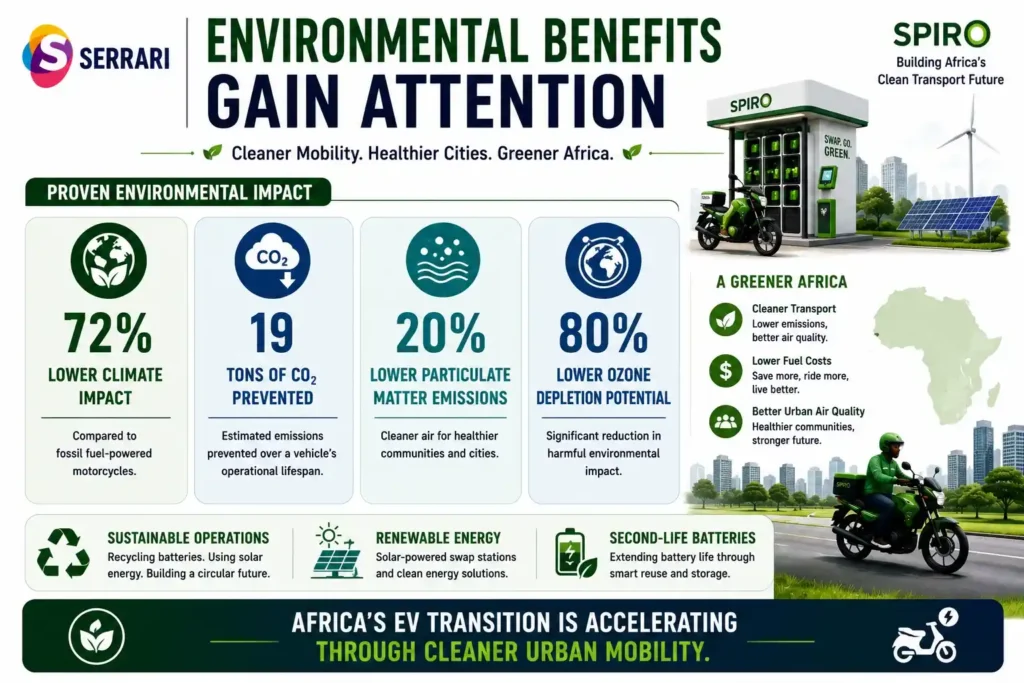
According to the company, its electric motorcycles generate a 72% reduction in climate impact compared with fossil fuel-powered motorcycles.
The study estimated this could prevent approximately 19 tons of CO2 emissions over a vehicle’s operational lifespan.
Researchers also identified an 80% reduction in ozone depletion potential and a 20% reduction in particulate matter emissions.
Analysts say improving urban air quality is becoming increasingly important as African cities continue experiencing rapid population growth and rising transport demand.
Investor Confidence in Africa’s Clean Transport Sector
Lars Bo Bertram, Chief Executive Officer of Impact Fund Denmark, said the investment reflects confidence in the long-term growth potential of Africa’s electric mobility market.
Africa’s electric mobility industry remains relatively small compared with China and Europe.
However, analysts say the sector is expanding rapidly as governments introduce cleaner transport policies and startups develop business models tailored to local conditions.
Battery-swapping technology is attracting attention because it addresses charging infrastructure limitations while improving operational convenience for commercial riders.
Outlook
Spiro’s $215 million financing round marks one of the largest recent investments in Africa’s electric mobility sector and highlights rising investor confidence in clean transportation across the continent.
As fuel prices rise and governments push for cleaner urban transportation systems, companies like Spiro are positioning themselves at the center of Africa’s emerging electric mobility transition.
Your financial future isn’t something you wait for—it’s something you build.
The real question is: when do you begin?
Move beyond simply staying informed.
Navigate the markets with clarity—track trends through the Serrari Group Market Index, uncover opportunities in the Serrari Marketplace, and build practical knowledge with our Curated Wealth Builder Platform.
Stay connected to what truly matters.
Get daily insights on macro trends and financial movements across Kenya, Africa, and global markets—delivered through the Serrari Newsletter.
Growth opens doors.
Advance your career through professional programs including ACCA, HESI A2, ATI TEAS 7 , HESI EXIT , NCLEX – RN and NCLEX – PN, Financial Literacy!🌟—designed to move you forward with confidence.
See where money is flowing—clearly and in real time.
Track Money Market Funds, Treasury Bills, Treasury Bonds, Green Bonds, and Fixed Deposits, alongside global and African indexes, key economic indicators, and the evolving Crypto and stablecoin landscape—all within Serrari’s Market Index.
Sources: Associated Press News, Autocar Professional, Yahoo Finance, AOL