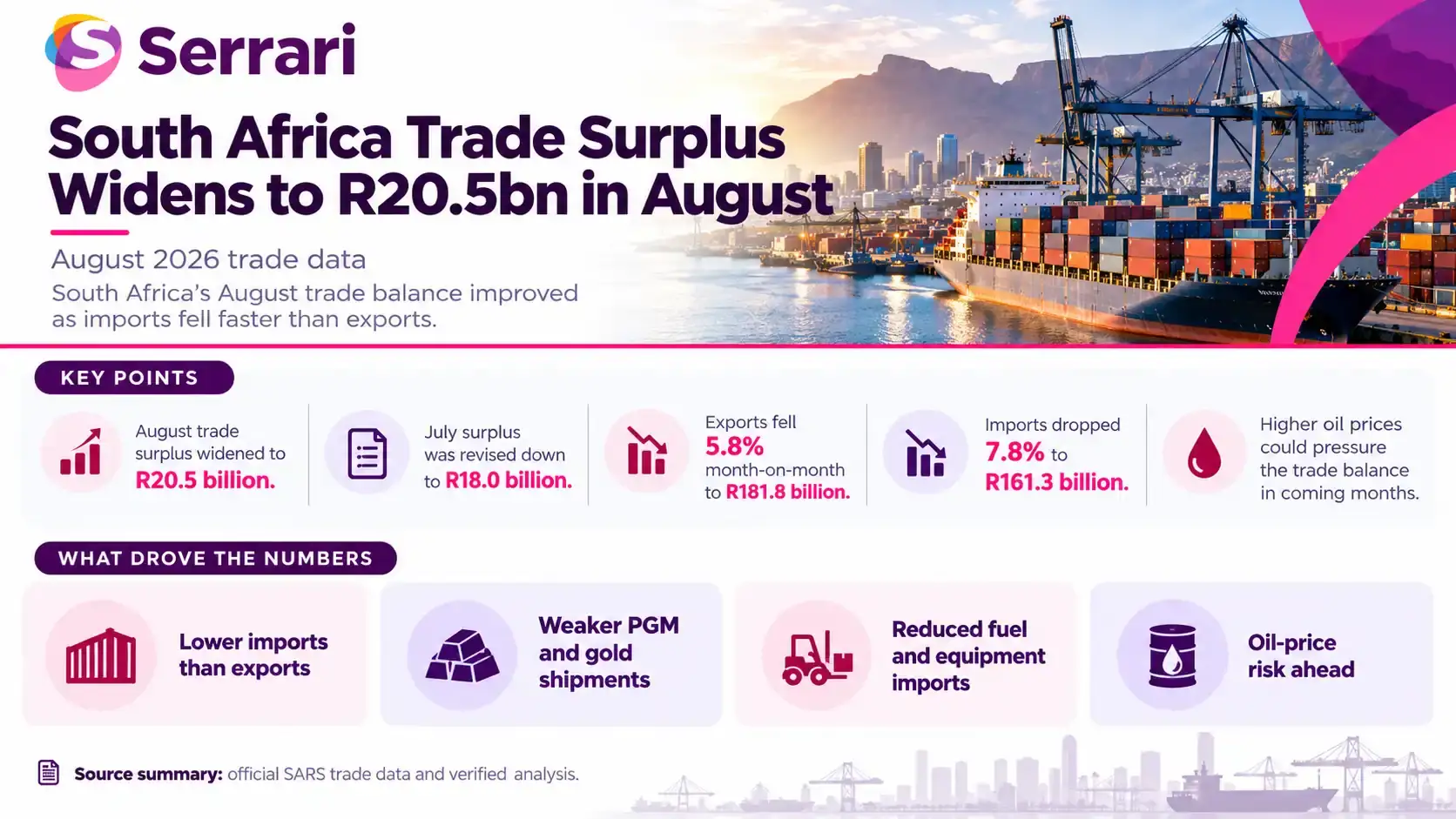
South Africa’s merchandise trade surplus widened to R20.5 billion in August 2026, up from a revised R18.0 billion in July, as imports declined faster than exports. The official August trade figures show exports of R181.8 billion against imports of R161.3 billion.
Although the larger surplus strengthens the country’s external trade position for the month, the improvement came largely from weaker imports rather than stronger exports. Higher international oil prices could also lift South Africa’s import bill in coming months, potentially narrowing the surplus.
Key Overview
- South Africa recorded an R20.5 billion trade surplus in August 2026.
- July’s surplus was revised down from R20.1 billion to R18.0 billion.
- Exports fell 5.8% month-on-month to R181.8 billion.
- Imports declined faster, dropping 7.8% to R161.3 billion.
- Lower PGM, gold and zinc ore shipments weighed on exports.
- PGM production fell 13.5% year-on-year in July.
- The year-to-date trade surplus reached R149.5 billion through August.
- Higher oil prices may increase the cost of South Africa’s fuel imports in the months ahead.
Imports Fall Faster Than Exports
The August surplus increased because imports declined by a larger amount than exports. Export values fell by R11.3 billion, from R193.1 billion in July to R181.8 billion in August, while imports dropped by R13.7 billion, from R175.0 billion to R161.3 billion.
That translated into a 5.8% monthly decline in exports compared with a 7.8% reduction in imports. The difference was enough to widen the trade balance by roughly R2.5 billion.
The July figure was also revised materially. The initially announced R20.1 billion surplus was reduced to a final R18.0 billion following ongoing corrections to customs declarations.
Despite the monthly fall, August exports were still 6.4% higher than a year earlier, while imports were 4.2% below August 2025 levels.
Mining Exports Remain Under Pressure
South Africa’s weaker export performance was partly driven by lower shipments of platinum group metals, gold, and zinc ores and concentrates. Vegetable-product exports also declined, while machinery and electronics shipments were lower.
The weakness in platinum group metals reflects pressure already visible in domestic mining output. PGM production fell 13.5% year-on-year in July, making it the largest negative contributor to the country’s 7.5% decline in total mining production that month.
This matters for trade because precious metals and mineral products remain major components of South Africa’s export base. Softer production or weaker commodity prices can therefore reduce export receipts even when demand for other manufactured or agricultural goods remains stable.
Context is everything. Stay ahead of shifting trends with today’s market updates, and uncover emerging opportunities using the Serrari Group Market Index and Marketplace. Then, take control of your own financial future by exploring our Money & Life Reset Transformation Blueprint ™ to build stronger habits, create better systems, and design a path toward lasting wealth.
Lower Fuel and Equipment Imports Support Surplus
On the import side, the decline was broad-based. Purchases of petroleum oils excluding crude fell, while imports of original equipment components and automatic data-processing machines also decreased.
Major import categories recorded notable monthly declines, with original equipment components dropping sharply and machinery, electronics, vehicles and transport equipment also moving lower.
The reduced petroleum import bill helped improve the August balance, but that relief may not last. Brent crude averaged more than $100 per barrel in September, raising the prospect that South Africa will pay more for imported fuel and related energy products in subsequent months.
Because the country remains dependent on imported crude and refined petroleum products, sustained high oil prices can quickly increase the value of imports even if physical fuel volumes remain unchanged.
Year-to-Date Surplus Strengthens
South Africa’s cumulative trade position remains stronger than it was a year ago. From January through August, the country recorded a preliminary surplus of R149.5 billion, compared with R96.1 billion over the same period in 2025.
Exports reached approximately R1.45 trillion over the first eight months of 2026, while imports totalled about R1.30 trillion. The year-to-date improvement provides some support to the external account despite volatility in mining output and global commodity markets.
The figures also show that the August surplus was not driven by a surge in export demand. Instead, a sharper contraction in imports compensated for weaker export flows.
Oil Prices Could Test the Trade Balance
The main risk heading into the final quarter is the energy import bill. Elevated oil prices can increase the cost of petroleum imports, putting downward pressure on the trade surplus and potentially adding to domestic inflation.
At the same time, South Africa’s export performance will depend on global demand for minerals, manufactured goods and agricultural products. A recovery in PGM production would support export receipts, while continued mining weakness could limit gains.
For now, the August data leave South Africa with a larger monthly and year-to-date trade surplus. Whether that strength persists will increasingly depend on the balance between export earnings and the cost of importing energy as global oil markets remain volatile.
Sources: South African Revenue Service / Statistics South Africa / Business Day / Investec
Your financial future isn’t something you wait for—it’s something you build.
The real question is: when do you begin?
Move beyond simply staying informed.
Navigate the markets with clarity—track trends through the Serrari Group Market Index, uncover opportunities in the Serrari Marketplace, and build practical knowledge with our Curated Wealth Builder Platform.
Stay connected to what truly matters.
Get daily insights on macro trends and financial movements across Kenya, Africa, and global markets—delivered through the Serrari Newsletter.
Growth opens doors.
Advance your career through professional programs including ACCA, HESI A2, ATI TEAS 7 , HESI EXIT , NCLEX – RN and NCLEX – PN, Financial Literacy!🌟—designed to move you forward with confidence.
See where money is flowing—clearly and in real time.
Track Money Market Funds, Treasury Bills, Treasury Bonds, Green Bonds, and Fixed Deposits, alongside global and African indexes, key economic indicators, and the evolving Crypto and stablecoin landscape—all within Serrari’s Market Index.