South Africa has introduced a new sustainable finance framework aimed at mobilizing nearly R3.7 trillion needed to support climate mitigation efforts and environmental commitments over the next decade. The initiative is designed to attract funding from international climate finance institutions, private investors, and capital markets while supporting projects that address climate change, healthcare, education, employment, and food security. The framework represents a major step in the country’s transition toward a greener and more resilient economy.
Key Overview
- South Africa has launched a sustainable finance framework to support climate-related investments.
- The country estimates it will need approximately R3.7 trillion between 2026 and 2035.
- Climate mitigation efforts account for R3.47 trillion of the funding requirement.
- An additional R250 billion is needed for implementation initiatives.
- Average annual funding needs are estimated at R372 billion.
- South Africa plans to secure around R160 billion annually from international climate finance sources by 2030.
- Private sector investment is expected to play a significant role in bridging the funding gap.
- S&P noted that the framework could support social and economic development while highlighting potential implementation uncertainties.
South Africa Unveils Ambitious Climate Finance Strategy
South Africa has taken a significant step toward financing its long-term climate and sustainability objectives by publishing a comprehensive sustainable finance framework designed to attract investment into environmentally and socially beneficial projects.
The framework is expected to play a critical role in helping the country secure the vast amount of capital required to reduce greenhouse gas emissions and meet international climate commitments over the next decade.
According to estimates contained in the framework, South Africa will need approximately R3.7 trillion (about $228 billion) between 2026 and 2035 to fund climate-related initiatives and achieve its environmental targets.
The strategy is intended to provide investors with a clear roadmap for financing projects that support the country’s transition toward a low-carbon and sustainable economy while also addressing key social development priorities.
Climate Commitments Come With a Multi-Trillion-Rand Price Tag
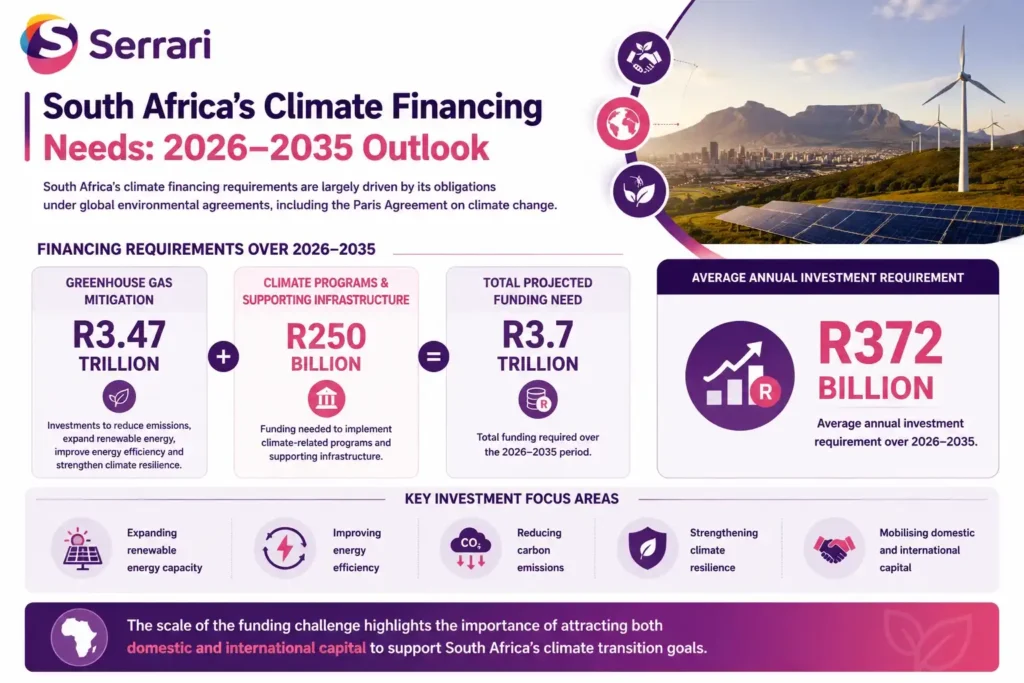
Alt Text: South Africa plans to mobilize approximately R3.7 trillion between 2026 and 2035 for climate financing, including R3.47 trillion for emissions reduction and R250 billion for climate programs and infrastructure.
South Africa’s climate financing requirements are largely driven by its obligations under global environmental agreements, including the Paris Agreement on climate change.
The framework estimates that around R3.47 trillion will be required for greenhouse gas mitigation efforts over the next ten years. These investments are expected to support initiatives aimed at reducing carbon emissions, expanding renewable energy capacity, improving energy efficiency, and strengthening climate resilience.
In addition to mitigation spending, the government estimates that approximately R250 billion will be needed to implement climate-related programs and supporting infrastructure.
Combined, these requirements bring the total projected funding needed to approximately R3.7 trillion over the 2026–2035 period, equivalent to an average annual investment requirement of around R372 billion.
The scale of the funding challenge highlights the importance of attracting both domestic and international capital to support the country’s climate transition goals.
International Climate Funding Expected to Play Key Role
To help meet its financing needs, South Africa plans to significantly increase its access to international climate finance.
The Treasury estimates that climate-finance institutions and global development partners could contribute approximately R160 billion annually by 2030. These funds are expected to come from organizations dedicated to supporting developing economies in their efforts to combat climate change and adapt to environmental risks.
However, international funding alone will not be sufficient to meet the country’s long-term requirements.
The framework acknowledges that a substantial portion of the capital will need to come from private-sector investors, lenders, financial institutions, and domestic spending initiatives. Encouraging private participation is therefore a central objective of the sustainable finance strategy.
By establishing clear guidelines for eligible projects and financing instruments, the government hopes to increase investor confidence and unlock greater participation from both local and global capital markets.
Context is everything. Stay ahead of shifting trends with today’s market updates, and uncover emerging opportunities using the Serrari Group Market Index and Marketplace. Then, take control of your own financial future by exploring our Money & Life Reset Transformation Blueprint ™ to build stronger habits, create better systems, and design a path toward lasting wealth.
Sustainable Finance Beyond Environmental Goals
While climate action remains the primary focus of the framework, South Africa is also positioning sustainable finance as a tool for broader economic and social development.
The framework supports investments in sectors that have a direct impact on citizens’ quality of life, including healthcare, education, employment creation, and food security.
According to ratings agency S&P Global, this broader approach could help address some of the country’s most pressing social and economic challenges while supporting long-term sustainable development.
Projects financed through sustainable instruments may therefore deliver benefits that extend beyond environmental outcomes, helping strengthen communities, improve public services, and support inclusive economic growth.
This integrated approach reflects the growing global trend of linking environmental sustainability with social and economic development objectives.
Opportunities and Challenges Ahead
Although the framework has been welcomed as an important step toward mobilizing climate finance, analysts note that successful implementation will be crucial.
S&P acknowledged the potential benefits of the initiative but also highlighted certain challenges associated with sovereign sustainable finance programs. The agency noted that the broad scope of eligible projects, while common for government issuers, can make it difficult to precisely assess the future environmental, social, and climate impacts of individual investments.
As a result, transparency, reporting standards, and project selection processes will be critical to maintaining investor confidence and ensuring that funds are directed toward initiatives that deliver measurable outcomes.
Investors will likely monitor how the government allocates resources and tracks progress against its stated environmental and development objectives.
Growing Global Demand for Green Finance
South Africa’s latest initiative comes at a time when governments around the world are increasingly turning to sustainable finance instruments to fund climate-related investments.
Green bonds, sustainability-linked bonds, social bonds, and other sustainable financing mechanisms have become important tools for raising capital while demonstrating commitment to environmental and social goals.
By establishing a dedicated framework, South Africa aims to position itself more competitively within the growing global sustainable finance market and attract investors seeking opportunities aligned with environmental, social, and governance (ESG) principles.
The framework could also enhance the country’s ability to access international funding programs designed to support climate adaptation and mitigation efforts in emerging economies.
Outlook
South Africa’s sustainable finance framework represents a major step toward mobilizing the nearly R3.7 trillion required to meet its climate commitments and development objectives over the next decade. With annual funding needs averaging R372 billion, success will depend on the country’s ability to attract international climate finance, encourage private-sector participation, and maintain transparency in project implementation. If executed effectively, the initiative could help accelerate South Africa’s transition to a greener economy while delivering meaningful social and economic benefits for its citizens.
Sources: News 24, Financial Post
Your financial future isn’t something you wait for—it’s something you build.
The real question is: when do you begin?
Move beyond simply staying informed.
Navigate the markets with clarity—track trends through the Serrari Group Market Index, uncover opportunities in the Serrari Marketplace, and build practical knowledge with our Curated Wealth Builder Platform.
Stay connected to what truly matters.
Get daily insights on macro trends and financial movements across Kenya, Africa, and global markets—delivered through the Serrari Newsletter.
Growth opens doors.
Advance your career through professional programs including ACCA, HESI A2, ATI TEAS 7 , HESI EXIT , NCLEX – RN and NCLEX – PN, Financial Literacy!🌟—designed to move you forward with confidence.
See where money is flowing—clearly and in real time.
Track Money Market Funds, Treasury Bills, Treasury Bonds, Green Bonds, and Fixed Deposits, alongside global and African indexes, key economic indicators, and the evolving Crypto and stablecoin landscape—all within Serrari’s Market Index.