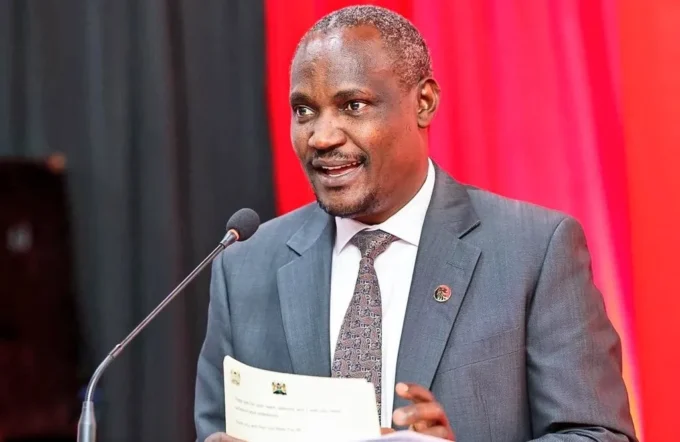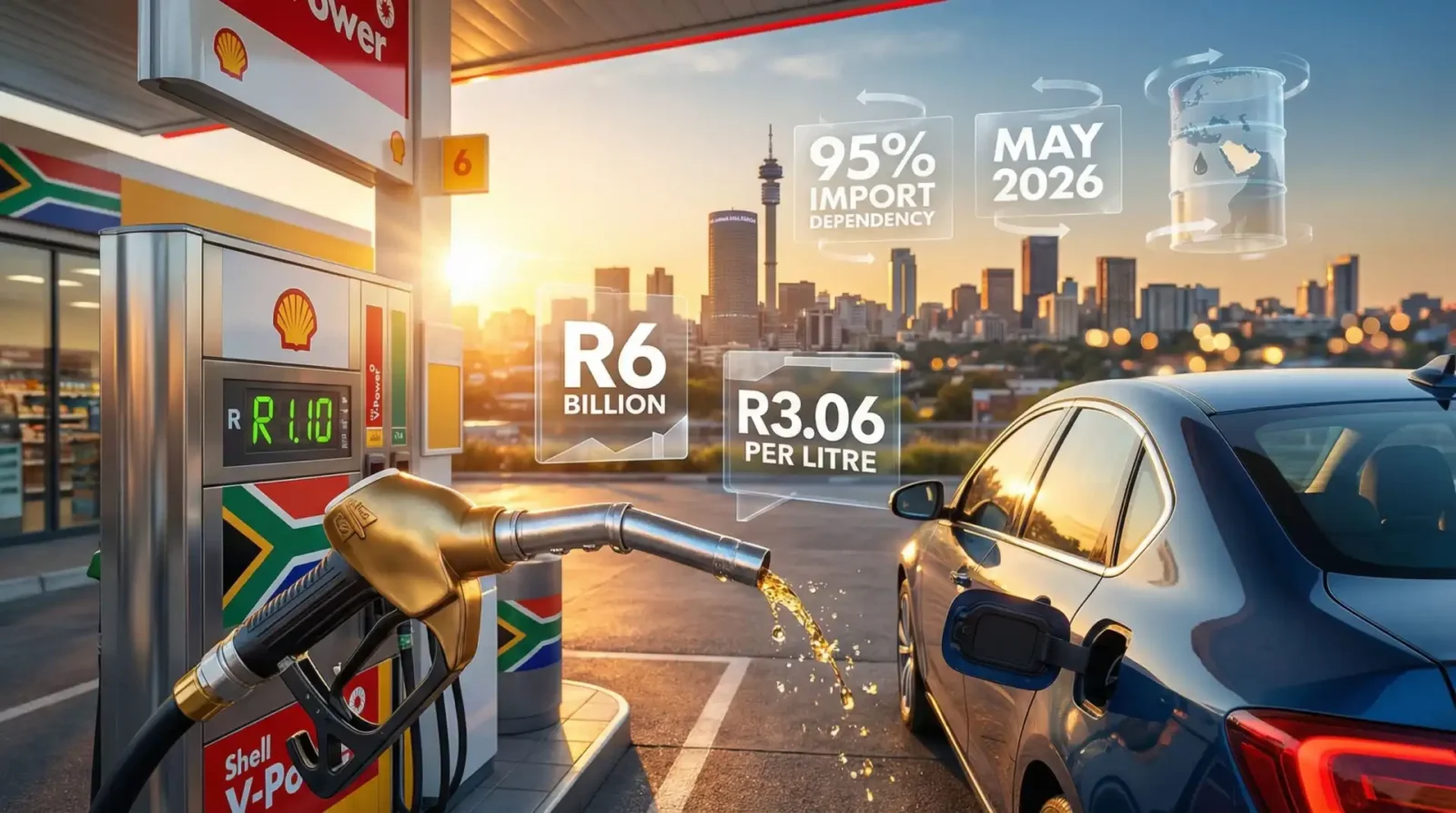
South Africa’s Finance Minister Enoch Godongwana has announced a temporary R3 per litre reduction in the general fuel levy for both petrol and diesel, effective from 1 April to 5 May 2026, in an emergency intervention to cushion consumers and businesses from a fuel price shock triggered by the Iran war. The measure, announced at the South Africa Investment Conference in Johannesburg, will cost the government approximately R6 billion in foregone tax revenue for the one-month period and will reduce the petrol levy from R4.10 to R1.10 per litre and the diesel levy from R3.93 to R0.93 per litre. Despite the relief, official fuel price adjustments confirmed by the Department of Mineral and Petroleum Resources show petrol still rising by R3.06 per litre and diesel surging by between R7.37 and R7.51 per litre — increases that would have been significantly higher without the intervention. Brent Crude oil averaged $95 per barrel in March, up 38% from $69 the previous month, driven by the US-Iran conflict and disruption around the Strait of Hormuz. The announcement comes as localised fuel shortages triggered by panic buying have disrupted supply at dozens of stations across the country.
Key Overview
- Fuel levy reduction: R3 per litre for both petrol and diesel
- Effective period: 1 April to 5 May 2026 (re-evaluation for May and June)
- Fiscal cost: ~R6 billion in foregone revenue for one month
- Petrol levy after cut: R1.10/litre (down from R4.10)
- Diesel levy after cut: R0.93/litre (down from R3.93)
- Petrol price increase (after levy cut): R3.06/litre
- Diesel price increase (after levy cut): R7.37 to R7.51/litre
- Petrol price without levy cut (projected): ~R5.82/litre increase
- Diesel price without levy cut (projected): ~R10.13 to R10.27/litre increase
- Brent Crude (March average): ~$95/barrel (up from $69 in February)
- Oil price surge: ~50% since the US-Iran conflict began on 28 February
- Inflation target: 3% (South African Reserve Bank)
- Pre-conflict GDP growth forecast: 1.6% for 2026
- Fuel levy annual revenue: ~R97 billion
Markets move fast; don’t get left behind. We’ve paired the Serrari Group Market Index with a curated Marketplace and a comprehensive Wealth Builder Course to ensure you have the data—and the skills—to act on it.
An Emergency Intervention at the Investment Conference
Finance Minister Enoch Godongwana dropped the announcement at the South Africa Investment Conference (SAIC) in Johannesburg on Tuesday — an event designed to showcase South Africa’s economic credentials to the world. Instead, the Minister found himself announcing what amounts to an emergency fiscal intervention to shield the economy from a global energy crisis.
“I will temporarily be lowering the fuel levy for this month of April by R3 and then I am still discussing what we can do for the next two months,” Godongwana said at the conference.
The formal details were laid out in a joint statement from the National Treasury and the Department of Mineral and Petroleum Resources, issued later in the day. The R3 per litre reduction in the general fuel levy will apply from Wednesday 1 April 2026 to Tuesday 5 May 2026, reducing the petrol levy from R4.10 to R1.10 per litre and the diesel levy from R3.93 to R0.93 per litre. The relief measure will be re-evaluated on a monthly basis for the following two months.
The intervention will cost approximately R6 billion in foregone tax revenue for the one-month period. The government described the measure as “fiscally neutral”, indicating it will implement mechanisms to recoup the lost revenue within the fiscal framework approved during the 2026 Budget — though how exactly that will be achieved remains to be seen.
Godongwana cautioned that the government’s capacity to sustain such measures is limited. “This is a shock to the economy and a blow. Government can mitigate the effects for a specific period, but we cannot sustain it for longer without collapsing the tax system,” he said. Any continued relief would likely be capped at a maximum of three months, depending on global developments.
The Scale of the Price Shock
Even with the R3 per litre levy reduction, the official fuel price adjustments that took effect on 1 April are substantial. The Department of Mineral and Petroleum Resources confirmed the following increases: petrol 93 and 95 both rose by R3.06 per litre, while diesel (0.05% sulphur) increased by R7.37 per litre and diesel (0.005% sulphur) by R7.51 per litre. Illuminating paraffin — a critical fuel for low-income households — saw a wholesale increase of R11.67 per litre.
Without the levy cut, the damage would have been far worse. Unaudited data from the Central Energy Fund (CEF) had previously pointed to petrol increases of between R5.31 and R5.82 per litre, with diesel set to surge by between R10.13 and R10.27 per litre. The levy reduction absorbed roughly R3 of those projected increases, but the remaining pass-through remains the largest monthly fuel price increase in recent memory.
The result is that a litre of 95 Unleaded petrol now costs R22.53 at the coast and R23.36 in Gauteng. Diesel prices have jumped even more dramatically, with 50ppm diesel reaching R25.91 per litre wholesale in Gauteng. The single maximum national retail price for illuminating paraffin has been set at R31.47 per litre for April, nearly double the R15.87 per litre that applied during the previous period.
Context is everything. While you follow today’s updates, use the Serrari Group Market Index and Marketplace to spot emerging shifts. Need to sharpen your edge? Our Wealth Builder Course turns these insights into a professional-grade strategy.
The Iran War and Global Oil Dynamics
The driving force behind the price shock is the surge in international oil prices triggered by the US-Iran conflict that began on 28 February 2026. Oil prices have climbed almost 50% since the attacks began, with Brent Crude averaging around $95 per barrel in March, up from $69 the previous month — a 38% increase during the pricing review period.
At various points in March, Brent traded well above $100 per barrel, with some spikes above $115 following specific escalations in the conflict. The closure and disruption around the Strait of Hormuz — the critical chokepoint through which approximately 20% of global oil supply flows — has been central to the supply fears driving prices higher.
South Africa is particularly vulnerable to these dynamics. The country is a net importer of refined fuel, having seen its domestic refining capacity shrink significantly following the shutdown of the Sapref refinery in Durban in 2022. With only the Natref facility in Sasolburg, Astron Energy in Cape Town, and Sasol’s Secunda coal-to-liquids plant still operational, South Africa now refines less than 35% of its own fuel requirements, down from around 80% previously. Every dollar increase in the international oil price feeds directly into the Basic Fuel Price (BFP) that determines pump costs.
The rand’s weakening has compounded the problem. The average rand/dollar exchange rate during the March pricing period was R16.64, compared to R15.99 during the previous period. While the oil price is the primary driver of the current increases, the weaker currency has added an additional layer of cost.
Panic Buying and Localised Shortages
The announcement came against a backdrop of growing chaos at fuel stations across the country. Reports of queues and stations running dry had been escalating in the days leading up to the April price adjustment, as motorists and businesses rushed to fill up before the increases took effect.
The South African Petroleum Retailers Association (SAPRA) moved to reassure the public that the shortages were not a supply problem. SAPRA Chairperson Henry van der Merwe said the situation was a “short-term strain on distribution caused by a surge in demand as consumers rush to fill up ahead of the increase,” rather than any lack of product in the national system.
Western Cape Premier Alan Winde reported that the province had 30 stations without diesel and 20 without petrol, attributing the problem to logistics rather than supply. Meanwhile, reports from Gauteng indicated that some stations had begun rationing sales to 30 litres per vehicle.
The government sought to calm nerves in its joint statement, asserting that South Africa has sufficient fuel supply to meet current and projected demand and urging motorists and businesses to “purchase fuel responsibly and avoid unnecessary stockpiling.”
Economic Ripple Effects: Inflation, Transport, and Agriculture
The fuel price shock threatens to ripple through the South African economy with particular ferocity. Diesel — which powers the logistics networks, farming operations, and mining activity that form the backbone of the economy — has absorbed the most severe increases. Godongwana himself acknowledged that “the diesel sector powers the economy, and changes in diesel prices affect everything — food, fertiliser and transport costs.”
Agricultural bodies including AgriSA and Agbiz have welcomed the levy relief but stressed that farmers are dealing with a combination of price increases, supply constraints, and operational uncertainty — particularly during critical winter and summer grain production periods. Fuel and fertiliser together can account for 35% to 50% of agricultural production costs, and both are under upward pressure from global supply disruptions.
Economists had warned that without the levy cut, fuel increases on the scale originally projected would have added at least 1 percentage point to annual consumer inflation. With the intervention, Godongwana indicated that inflation is expected to rise by a more moderate 1.2 percentage points, remaining within the targeted range. The South African Reserve Bank targets inflation at 3%, and the government was projecting GDP growth of 1.6% for 2026 before the conflict began.
Historical Precedent: The 2022 Ukraine Crisis Playbook
South Africa has taken this step before. In 2022, following Russia’s invasion of Ukraine, the government temporarily reduced the general fuel levy to help offset a similar energy price surge. That precedent informed the speed with which the current intervention was designed and implemented.
The fuel levy is a significant revenue stream for the government, raising an estimated R97 billion in the financial year ending on Tuesday. A sustained reduction would therefore create serious fiscal pressures, which is why Godongwana has been careful to frame the current measure as temporary and subject to monthly review.
The measure mirrors steps being taken by other oil-importing nations. South Korea and the Philippines have both announced relief measures to soften the impact of the Iran war on their economies, reflecting the global nature of the energy supply disruption.
What Comes Next
The current R3 per litre relief expires on 5 May 2026, at which point the government will need to decide whether to extend, modify, or withdraw the support. If oil prices remain elevated and the rand does not recover meaningfully, the removal of the relief at that point would trigger another substantial increase — potentially larger than what was absorbed in April.
The government has signalled that a broader package of reforms is in development, including reviewing the fuel pricing framework over the medium term and exploring additional measures to support households and key economic sectors. Agricultural organisations have called for greater flexibility in the fuel price adjustment mechanism, more frequent pricing reviews during periods of volatility, and an extension of the diesel rebate for primary agricultural users to 100%.
For now, South Africans are absorbing a fuel price shock that, even with the levy cut, represents one of the sharpest monthly increases in the country’s history. The next official fuel price announcement will cover the period from 1 April to 26 April, with adjustments taking effect on 6 May — by which time the trajectory of the Iran conflict and global oil markets may have shifted again.
Your financial future isn’t something you wait for—it’s something you build.
The real question is: when do you begin?
Move beyond simply staying informed.
Navigate the markets with clarity—track trends through the Serrari Group Market Index, uncover opportunities in the Serrari Marketplace, and build practical knowledge with our Curated Wealth Builder Course.
Stay connected to what truly matters.
Get daily insights on macro trends and financial movements across Kenya, Africa, and global markets—delivered through the Serrari Newsletter.
Growth opens doors.
Advance your career through professional programs including ACCA, HESI A2, ATI TEAS 7 , HESI EXIT , NCLEX – RN and NCLEX – PN, Financial Literacy!🌟—designed to move you forward with confidence.
See where money is flowing—clearly and in real time.
Track Money Market Funds, Treasury Bills, Treasury Bonds, Green Bonds, and Fixed Deposits, alongside global and African indexes, key economic indicators, and the evolving Crypto and stablecoin landscape—all within Serrari’s Market Index.