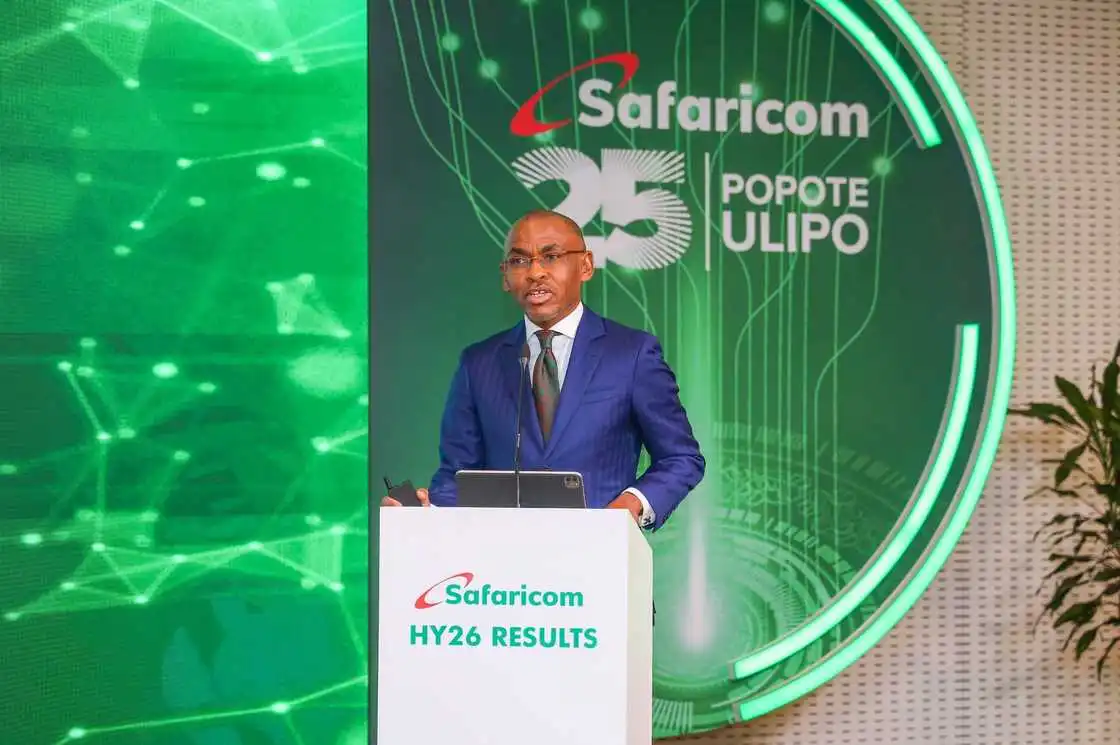
Safaricom has been granted a 25-year operating licence by Kenya’s Communications Authority (CA), one of the longest tenure approvals the regulator has ever issued. The licence, granted under Kenya’s Unified Licensing Framework, replaces a temporary two-year permit and consolidates multiple authorisations, including spectrum usage rights, into a single instrument. The approval provides long-term regulatory certainty for Kenya’s dominant telecoms operator as it navigates a major ownership restructuring with Vodacom Group and continued expansion into Ethiopia.
Key Overview
- Licence Duration: 25 years, replacing a two-year interim permit issued in 2024
- Licensing Framework: Unified Licensing Framework, consolidating voice, data, and infrastructure authorisations
- Licence Costs: Direct licence-related costs rose to approximately $126.7 million in FY2026, up from $113.4 million the prior year
- Regulatory Precedent: The CA has historically issued 10-year licences, making this approval a significant departure
- Ownership Restructuring: Vodacom’s $2.1 billion deal to increase its Safaricom stake from 35% to 55% remains subject to court proceedings
- FY2026 Performance: Record net profit of KSh 99.7 billion, a 67.3% year-on-year increase
Safaricom has secured a 25-year operating licence from Kenya’s Communications Authority, granting the telecoms giant an unprecedented period of regulatory certainty in one of Africa’s most important mobile markets. The approval, issued under the country’s Unified Licensing Framework, is a significant departure from the CA’s historical practice of issuing licences on 10-year cycles and closes a protracted period of regulatory uncertainty during which Kenya’s largest operator had been running on a temporary extension.
The new framework consolidates what was previously a patchwork of separate authorisations for voice, data, and infrastructure into a single licence instrument that includes spectrum usage rights. For Safaricom, a company that serves more than 46 million subscribers and processes the vast majority of Kenya’s mobile money transactions through M-PESA, the consolidation eliminates the administrative complexity of managing multiple legacy permits.
Board chairman Adil Khawaja described the approval as a major strategic milestone, noting that the licence “provides long-term certainty and strengthens our ability to invest with confidence” as the company celebrates its first 25 years of operations.
From Temporary Permits to Long-Term Certainty
The path to the 25-year licence was neither smooth nor straightforward. In late 2024, the CA opted to issue Safaricom and Airtel Kenya temporary two-year operating licences rather than the standard 10-year renewals. The interim permits were introduced while regulators and telecoms operators negotiated key issues including spectrum allocation, licensing fees, and penalties linked to service outages. At the time, Safaricom CEO Peter Ndegwa downplayed the shorter licence, describing it as an extension to complete the full renewal process.
Safaricom paid approximately KSh 1.63 billion for its two-year interim permit plus additional administrative charges. Airtel Kenya received its own extension to January 2027 after paying KSh 494.2 million in fees, reflecting its smaller spectrum footprint relative to Safaricom. Under the previous regime, the two operators had collectively paid KSh 2.3 billion for their 10-year permits, making the sharp escalation in interim fees a clear signal that the value of spectrum and operating rights in Kenya was being reassessed.
Now, with the 25-year licence secured, Safaricom’s regulatory costs have climbed further. According to disclosures in the company’s FY2026 financial results, direct licence-related costs reached approximately KSh 16.38 billion for the year ended March 2026, up from KSh 14.66 billion the previous year. Safaricom declined to disclose the specific amount paid for the 25-year licence itself. It remains unclear whether Airtel Kenya, whose temporary permit is valid until January 2027, will receive equivalent long-term terms under the same framework.
Broader Regulatory Reforms: Toward Spectrum Auctions
The unified licensing framework under which Safaricom’s new licence was issued forms part of a wider overhaul of Kenya’s telecoms regulation. The CA is working to shift the market away from administrative spectrum allocation towards an auction-based system, a move expected to reshape spectrum pricing and competition dynamics across the sector. Under the existing model, the CA issued spectrum licences on a first-come-first-served basis, with approval processes taking approximately 135 days.
Countries including Japan, the Netherlands, India, and South Africa have already adopted auction-based spectrum licensing. In Africa, Ethiopia and Tanzania have successfully used auctions to assign wireless frequencies. Spectrum auctions are widely regarded as best practice where demand exceeds availability, as they allow regulators to extract fair market value while providing transparency for operators.
The shift also introduces new quality-of-service requirements. The CA has been pushing for rules that would set standards for voice and data reliability and establish penalties and consumer compensation for outages. Service disruptions on Safaricom’s network had surged nearly five-fold to an average of 19.5 minutes per week in the year to March 2024, prompting the regulator to consider reforms that would require operators to credit subscribers after network failures.
Context is everything. While you follow today’s updates, use the Serrari Group Market Index and Marketplace to spot emerging shifts. Need to sharpen your edge? Our Wealth Builder Platform turns these insights into a professional-grade strategy.
Record Financial Performance Underscores Market Dominance
The licence comes at a moment of extraordinary financial strength for Safaricom. The company posted a record net profit of KSh 99.7 billion for FY2026, representing a 67.3% increase year-on-year. Group service revenue crossed the KSh 400 billion threshold for the first time, reaching KSh 414.1 billion, while EBITDA grew 35.4% to KSh 220.5 billion.
M-PESA remains the engine of Safaricom’s profitability. Kenya’s mobile money platform contributed 45.6% of Kenya’s service revenue, generating KSh 182.7 billion in revenue during the year. Total transaction values on M-PESA reached KSh 41.68 trillion, with 41 million active customers in Kenya alone. The platform has expanded well beyond basic money transfer into lending, savings, wealth management, and securities trading through products like Ziidi Trader, which allows customers to buy and sell NSE-listed shares directly from their phones.
Mobile data has also overtaken voice as Safaricom’s single largest connectivity revenue contributor, accounting for 42.1% of connectivity revenue at KSh 83.4 billion. Smartphones on the network grew 21.2% to 33.2 million devices.
Ethiopia: Losses Narrowing, Scale Building
Safaricom’s Ethiopian operations represent one of Africa’s largest telecoms market entries. The subsidiary reached 13.6 million active customers by March 2026, a 54.2% increase year-on-year, with its network now covering 60% of the population through 3,504 sites. Service revenue in Ethiopia grew 130.9% year-on-year in local currency terms.
While Ethiopia remains loss-making, the trajectory is rapidly improving. EBITDA losses narrowed by 64.8% from KSh 43 billion to KSh 15.1 billion, and in the second half of FY2026, EBITDA losses fell to just KSh 2.7 billion compared to KSh 12.4 billion in the first half. M-PESA Ethiopia has grown to 5.2 million active customers across 70,000 merchants, with management guiding for EBITDA breakeven in FY2027. Total investment in the Ethiopian business stands at $2.6 billion.
The Vodacom Deal: Ownership in Limbo
Running parallel to the licence approval is a major ownership restructuring. In December 2025, Vodacom agreed to acquire an additional 20% stake in Safaricom for approximately $2.1 billion, increasing its shareholding from 35% to 55% and gaining majority control of the company. The deal includes the purchase of a 15% stake from the Kenyan government and an additional 5% from Vodafone International Holdings.
Under the transaction, the government would reduce its shareholding from 35% to 20%, with proceeds earmarked for a newly established National Infrastructure Fund created by President William Ruto in March 2026. Parliament approved the deal on March 11, 2026.
However, the transaction is currently blocked by court orders from the High Court of Kenya. Constitutional petitions challenge the sale on several grounds, including claims that the KSh 34 per share price undervalues the company, that the process lacked adequate public participation, and that transferring majority control of Safaricom, which hosts sensitive digital infrastructure including M-PESA and the e-Citizen platform, to a foreign entity raises national security and data sovereignty concerns. Vodacom CEO Shameel Joosub told investors in May 2026 that if conservatory orders are not lifted, the court case could take several more months.
What the Licence Means for Kenya’s Telecoms Future
The 25-year licence provides Safaricom with a planning horizon long enough to fully depreciate major infrastructure investments, from fibre networks and tower builds to data centres and 5G rollout. The unified framework also ends the fragmented system under which separate licences governed different services, simplifying compliance for both operators and regulators.
For the wider East African region, Kenya’s regulatory approach is being closely watched. Countries including Tanzania, Uganda, and Rwanda face similar questions about licensing frameworks and spectrum management. The outcome of Safaricom’s licence, and the ongoing ownership battle, will likely influence how other African governments structure telecoms regulation and manage the sale of strategic assets.
Sources: TechTrends Kenya / Business Daily Africa / Developing Telecoms / Innovation Village / IT Web Africa / TechAfrica News / Techweez / The Kenya Times / Khusoko / Abojani / Ecofin Agency / Tech-ish / Kenyan Wallstreet / Vodacom
Your financial future isn’t something you wait for—it’s something you build.
The real question is: when do you begin?
Move beyond simply staying informed.
Navigate the markets with clarity—track trends through the Serrari Group Market Index, uncover opportunities in the Serrari Marketplace, and build practical knowledge with our Curated Wealth Builder Platform.
Stay connected to what truly matters.
Get daily insights on macro trends and financial movements across Kenya, Africa, and global markets—delivered through the Serrari Newsletter.
Growth opens doors.
Advance your career through professional programs including ACCA, HESI A2, ATI TEAS 7 , HESI EXIT , NCLEX – RN and NCLEX – PN, Financial Literacy!🌟—designed to move you forward with confidence.
See where money is flowing—clearly and in real time.
Track Money Market Funds, Treasury Bills, Treasury Bonds, Green Bonds, and Fixed Deposits, alongside global and African indexes, key economic indicators, and the evolving Crypto and stablecoin landscape—all within Serrari’s Market Index.