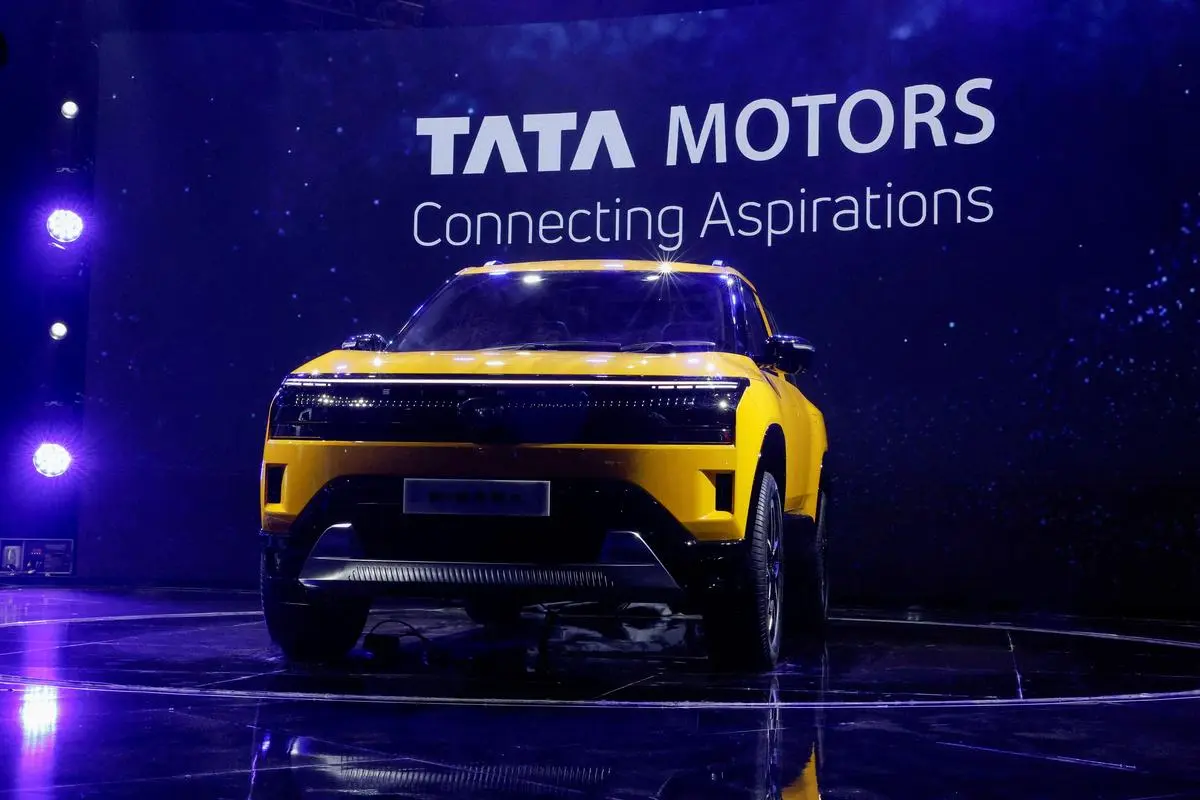
Tata Motors plans to use an electric vehicle platform from China’s Chery Automobile to develop premium EVs under its Avinya brand after delays disrupted its earlier partnership strategy with Jaguar Land Rover.
The move highlights how Indian automakers are increasingly relying on Chinese EV technology despite political sensitivities and investment restrictions between the two countries.
The partnership is expected to help Tata accelerate development of premium electric vehicles while maintaining its leadership position in India’s rapidly evolving EV market.
Key Overview
- Tata Motors will use Chery’s EV platform for Avinya models
- The first Avinya EV is expected to launch in 2027
- Vehicles will be assembled in India using imported kits from China
- Tata will manufacture the EVs at its Tamil Nadu factory
- The move follows delays involving Jaguar Land Rover’s EMA platform
- Tata aims for EVs to account for 30% of sales by 2030
- Competition is increasing from Mahindra and JSW MG Motor
Tata Resets Premium EV Strategy
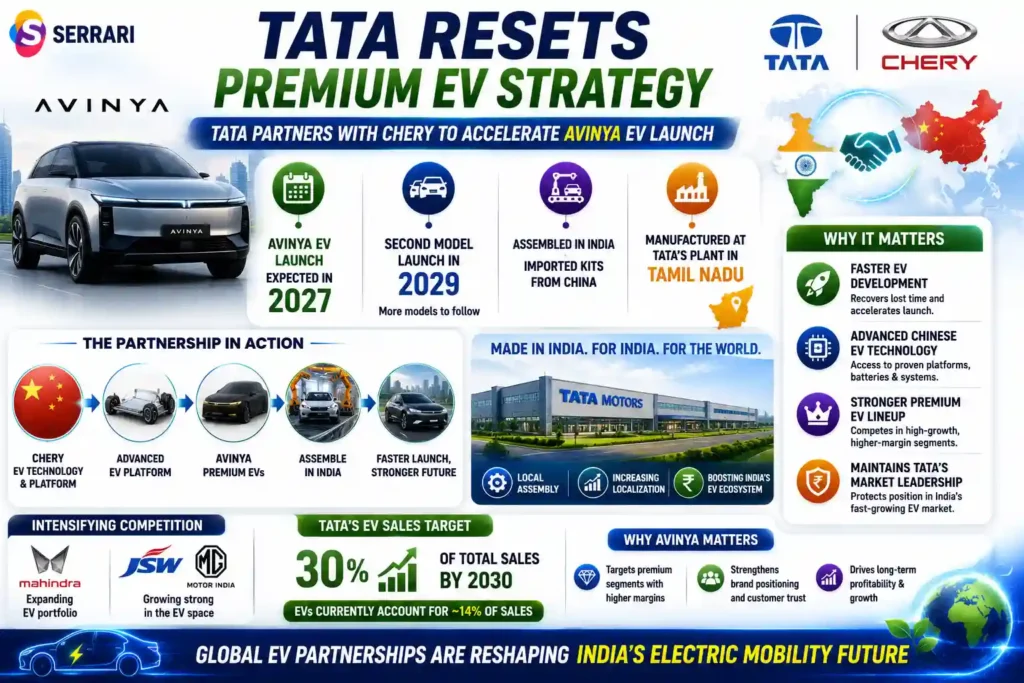
Tata Motors is reshaping its premium electric vehicle strategy by turning to Chinese automaker Chery Automobile for technology support after delays disrupted its original development plans.
The company will use Chery’s vehicle platform to locally build electric vehicles under its premium Avinya brand.
The decision marks a significant shift for India’s largest electric vehicle manufacturer as it works to accelerate development of premium EV models and maintain its position in India’s growing electric mobility market.
According to people familiar with the matter, the first Avinya model based on Chery’s platform is expected to launch in 2027. A second model is planned to be launched in 2029, with additional models potentially following later.
The vehicles will initially be shipped from China as kits and assembled locally in India, while efforts to increase localization of components are already underway.
Production will take place at Tata Motors’ manufacturing facility in Tamil Nadu.
Jaguar Land Rover Plans Were Shelved
Tata’s decision follows the collapse of its earlier plan to use Jaguar Land Rover’s Electrified Modular Architecture platform for Avinya models originally targeted for launch in 2025.
That roadmap was disrupted after Jaguar Land Rover shelved plans to build EMA-based EVs in India, forcing Tata to rethink its premium EV strategy.
Industry analysts say the Chery partnership helps Tata recover lost development time while gaining access to advanced EV technology that would otherwise require significantly more investment and development time.
Tata Motors confirmed the collaboration in a statement, saying its partnership with Jaguar Land Rover and associated partners would remain an important component of its long-term premium EV strategy.
The company will reportedly use the Freelander platform developed jointly by Chery and Jaguar Land Rover in China.
Chinese Technology Expands in India
The arrangement reflects a broader trend emerging within India’s automotive industry, where domestic manufacturers are increasingly relying on Chinese EV technology despite political and regulatory restrictions.
Since 2020, India has imposed strict controls on investments from neighboring countries, particularly China, limiting deeper equity partnerships and large-scale participation in the auto industry.
However, technology licensing agreements have remained possible, allowing Indian automakers to access advanced EV systems without direct ownership involvement from Chinese firms.
Analysts say Chinese companies currently maintain major advantages in EV development speed, battery technology, production scale, and manufacturing costs.
As a result, Indian manufacturers are increasingly seeking technology partnerships to remain competitive in the global EV race.
JSW Motor, another emerging Indian automotive player, has also entered into a platform licensing agreement with Chery.
Context is everything. Stay ahead of shifting trends with today’s market updates, and uncover emerging opportunities using the Serrari Group Market Index and Marketplace. Then, take control of your own financial future by exploring our Money & Life Reset Transformation Blueprint ™ to build stronger habits, create better systems, and design a path toward lasting wealth.
Competition in India’s EV Market Intensifies
Tata Motors remains India’s leading electric vehicle manufacturer, but competition in the market is increasing rapidly.
Electric vehicles currently account for approximately 14 percent of Tata’s total sales, with the company targeting 30% by 2030.
However, delays in launching premium EV models have exposed weaknesses in Tata’s lineup and allowed rivals to narrow the gap.
Mahindra & Mahindra and JSW MG Motor India have both been steadily expanding their electric portfolios in recent years.
Industry analysts say Tata’s premium Avinya lineup is strategically important because it targets higher-margin segments of the electric vehicle market.
The Chery partnership is therefore viewed as a temporary but necessary solution to help Tata defend market share while developing longer-term in-house EV architectures.
Chery Expands Global Influence
For Chery Automobile, the agreement further strengthens its growing global role within the electric vehicle supply chain.
The Chinese automaker has been expanding internationally through platform-sharing and licensing, and joint development agreements across Europe, Southeast Asia, and Latin America.
Analysts say Chinese manufacturers are increasingly becoming major technology suppliers for automakers globally, even in markets where direct Chinese vehicle sales face political or regulatory barriers.
Chery’s collaboration with Tata also demonstrates how Chinese EV expertise is becoming difficult for global automakers to avoid as competition intensifies worldwide.
Outlook
Tata Motors’ decision to adopt Chery’s EV platform highlights the growing importance of Chinese technology within the global electric vehicle industry.
While political sensitivities remain between India and China, the partnership reflects the commercial realities facing automakers seeking faster EV development and stronger competitiveness.
As India’s EV market expands and competition intensifies, technology collaborations like this are likely to play a growing role in shaping the country’s electric mobility future.
Sources: CnEVPost, ET Sustainability News, Firstpost
Your financial future isn’t something you wait for—it’s something you build.
The real question is: when do you begin?
Move beyond simply staying informed.
Navigate the markets with clarity—track trends through the Serrari Group Market Index, uncover opportunities in the Serrari Marketplace, and build practical knowledge with our Curated Wealth Builder Platform.
Stay connected to what truly matters.
Get daily insights on macro trends and financial movements across Kenya, Africa, and global markets—delivered through the Serrari Newsletter.
Growth opens doors.
Advance your career through professional programs including ACCA, HESI A2, ATI TEAS 7 , HESI EXIT , NCLEX – RN and NCLEX – PN, Financial Literacy!🌟—designed to move you forward with confidence.
See where money is flowing—clearly and in real time.
Track Money Market Funds, Treasury Bills, Treasury Bonds, Green Bonds, and Fixed Deposits, alongside global and African indexes, key economic indicators, and the evolving Crypto and stablecoin landscape—all within Serrari’s Market Index.