Japan has approved a ¥3.1 trillion ($19 billion) supplementary budget to help shield households and businesses from soaring fuel and energy costs linked to the prolonged Middle East crisis.
The package will mainly fund gasoline and utility subsidies as Japan faces severe oil supply disruptions because of its heavy dependence on Middle Eastern energy imports.
Officials say the emergency spending aims to stabilize consumer prices and protect the economy from worsening inflation pressures tied to global energy market volatility.
Key Overview
- Japan approved a ¥3.1 trillion ($19 billion) supplementary budget
- The package will fund fuel and electricity subsidies
- Most funding will come from deficit-financing bonds
- Japan remains heavily dependent on Middle East oil imports
- Crude oil imports dropped sharply following regional disruptions
- The government is using reserves to stabilize supply
- Rising energy prices are increasing inflation pressure on households
Japan Expands Emergency Energy Support
Japanese Prime Minister Sanae Takaichi’s government has finalized a ¥3.1 trillion ($19.47 billion) supplementary budget aimed at reducing the impact of rising fuel and energy prices on households and businesses.
The emergency package comes as the prolonged Middle East crisis continues disrupting global oil and gas supply chains, intensifying energy market volatility and pushing up commodity prices worldwide.
Most of the additional spending will replenish contingency reserves already being used to subsidize gasoline prices and utility bills across Japan.
Officials said the package is designed to cushion consumers from inflationary pressure while helping stabilize the economy during heightened geopolitical uncertainty.
The supplementary budget will reportedly be financed entirely through deficit-financing bonds.
However, the government said it hopes to avoid increasing the country’s broader bond issuance burden by offsetting some costs through stronger tax revenues and non-tax income.
Fuel Subsidies Become Immediate Priority
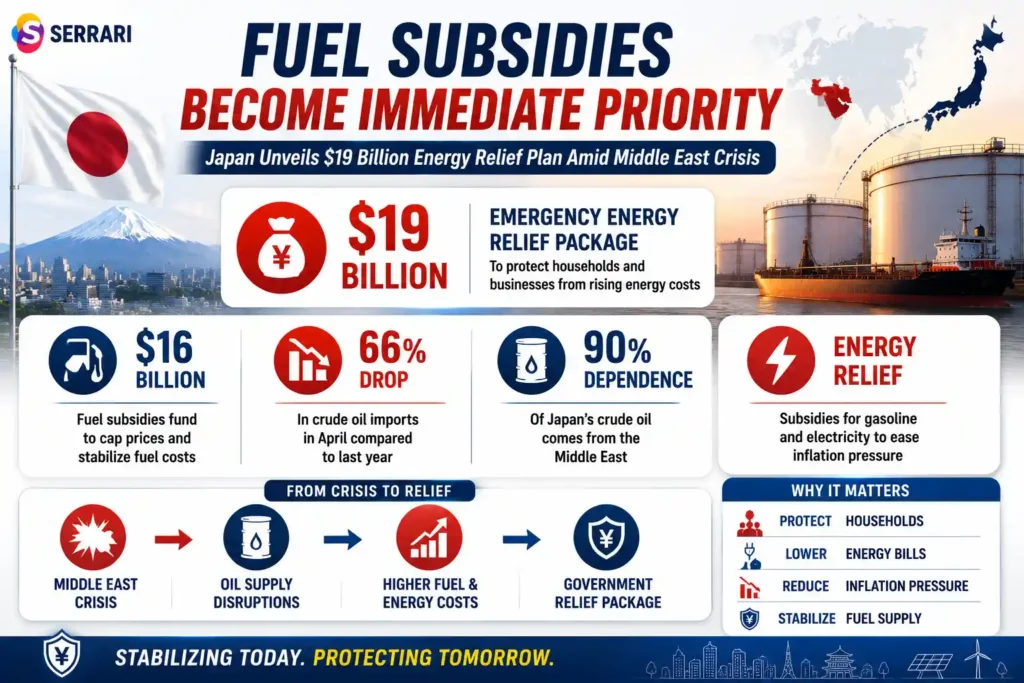
A major portion of the package will go toward controlling fuel prices as Japan faces growing pressure from higher oil import costs.
Reports indicate roughly $16 billion of the emergency budget will support a reserve fund specifically designed to cap energy commodity prices through additional subsidies.
The government plans to first use the money to subsidise gasoline prices before expanding broader energy support measures.
Japan has become one of the countries most vulnerable to the fallout from the Middle East crisis because of its heavy reliance on imported energy.
The country imports most of its crude oil from the Persian Gulf region, making it highly exposed to disruptions involving shipping routes and oil-producing nations.
Oil Imports Fall Sharply
Japanese government data shows crude oil imports fell sharply following escalating tensions and supply disruptions linked to the Middle East conflict.
Japan’s crude oil imports reportedly slumped by 66% in April compared with the same period last year.
Imports from Saudi Arabia declined by nearly 58%, while crude shipments from the United Arab Emirates plunged by 69.4%.
Despite efforts to diversify supply sources, the Middle East still accounted for 90% of Japan’s total crude imports, at 93.7% in April.
Analysts say replacing Middle Eastern crude supplies quickly has proven difficult despite additional shipments from alternative suppliers, including the United States.
The sharp decline in imports has increased concerns over fuel availability, energy inflation, and long-term energy security within Japan.
Context is everything. Stay ahead of shifting trends with today’s market updates, and uncover emerging opportunities using the Serrari Group Market Index and Marketplace. Then, take control of your own financial future by exploring our Money & Life Reset Transformation Blueprint ™ to build stronger habits, create better systems, and design a path toward lasting wealth.
Japan Releases Strategic Oil Reserves
Since the Middle East crisis intensified, Japan has moved aggressively to stabilize domestic fuel supplies by releasing oil from strategic reserves.
Japan maintains some of the world’s largest strategic petroleum reserves because of its long-standing dependence on imported fossil fuels.
Officials hoped reserve releases would help offset supply disruptions and ease pressure on fuel prices.
However, analysts say the releases have not been sufficient to fully contain inflation linked to higher global oil and gas prices.
The government’s latest spending package reflects growing concern that prolonged instability in the Middle East could continue driving energy costs higher through the remainder of the year.
Inflation and Economic Pressure Increase
The latest energy support measures come as Japanese households continue facing rising living costs tied to imported inflation.
Higher fuel and electricity prices have increased pressure on consumers and businesses already dealing with elevated food prices and broader supply chain disruptions.
Analysts say energy inflation remains one of the biggest risks to Japan’s economic recovery because the country remains heavily exposed to imported commodity costs.
The Takaichi government has therefore prioritized fuel subsidies and consumer support measures to prevent a deeper slowdown in household spending.
Outlook
Japan’s $19 billion emergency energy package highlights the growing economic risks posed by prolonged instability in global energy markets.
The government’s decision to expand fuel subsidies and utility support reflects mounting concern over inflation, supply disruptions, and consumer affordability pressures.
As Middle East tensions continue affecting global oil flows, Japan is likely to remain focused on balancing short-term energy relief measures with longer-term efforts to strengthen energy security and reduce dependence on imported fossil fuels.
Sources: Yahoo Finance, New Straits Times, Crude Oil Prices Today, US News Money
Your financial future isn’t something you wait for—it’s something you build.
The real question is: when do you begin?
Move beyond simply staying informed.
Navigate the markets with clarity—track trends through the Serrari Group Market Index, uncover opportunities in the Serrari Marketplace, and build practical knowledge with our Curated Wealth Builder Platform.
Stay connected to what truly matters.
Get daily insights on macro trends and financial movements across Kenya, Africa, and global markets—delivered through the Serrari Newsletter.
Growth opens doors.
Advance your career through professional programs including ACCA, HESI A2, ATI TEAS 7 , HESI EXIT , NCLEX – RN and NCLEX – PN, Financial Literacy!🌟—designed to move you forward with confidence.
See where money is flowing—clearly and in real time.
Track Money Market Funds, Treasury Bills, Treasury Bonds, Green Bonds, and Fixed Deposits, alongside global and African indexes, key economic indicators, and the evolving Crypto and stablecoin landscape—all within Serrari’s Market Index.