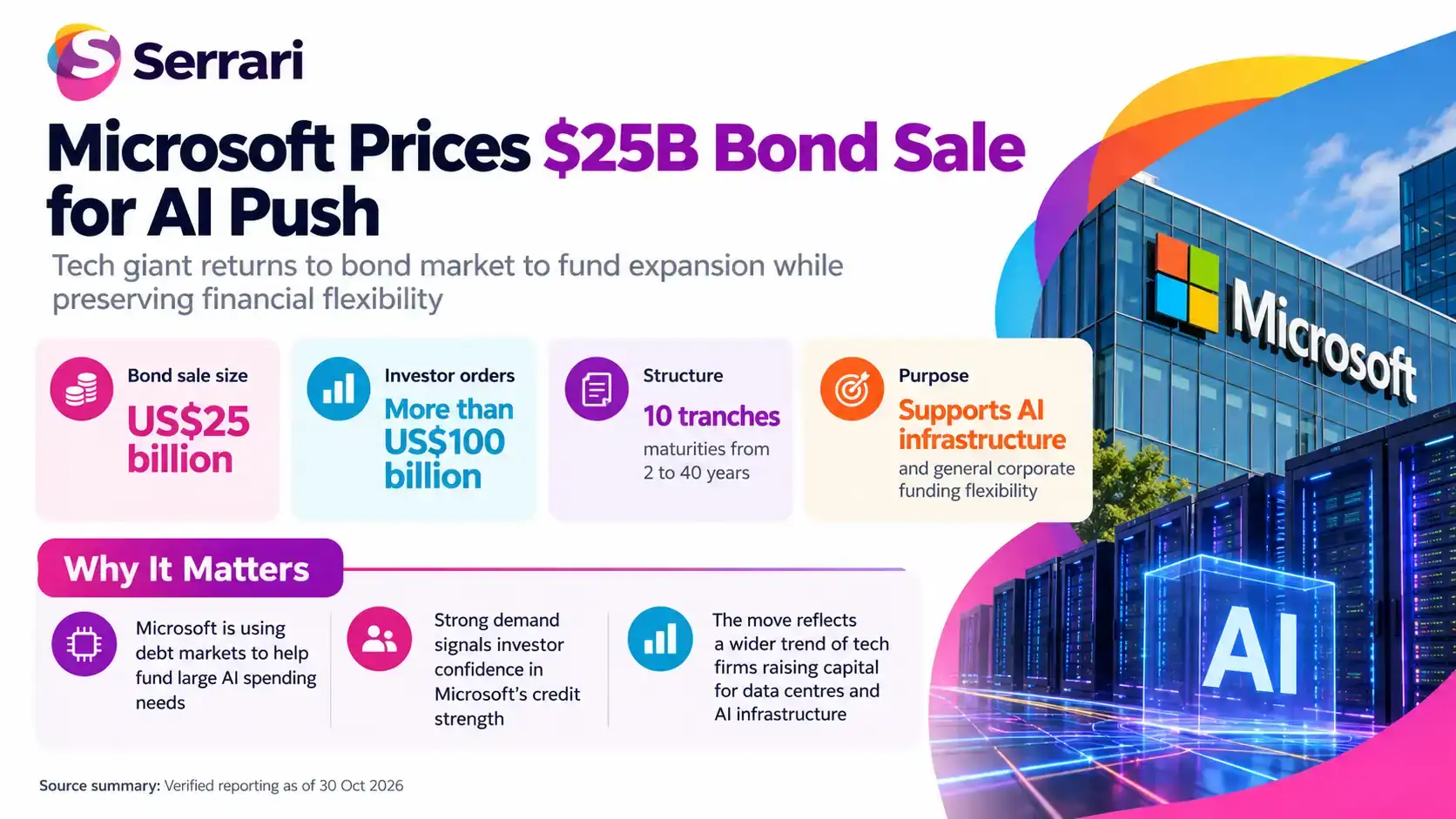
Microsoft has priced a US 25 billion bond offering marking its return to the US investment grade bond market after more than nine years. The transaction attracted reported orders exceeding US$100 billion as technology companies seek fresh financing options for capital-intensive artificial intelligence (AI) infrastructure. The offering also follows strong quarterly cloud growth, highlighting Microsoft’s effort to balance expansion with financial flexibility.
Key Overview
- Microsoft confirmed pricing of US$25 billion in senior unsecured debt on October 29, 2026.
- Investor orders reportedly exceeded US$100 billion, more than four times the offering size.
- The issue comprises 10 tranches, with maturities stretching from 2028 to 2066.
- Fixed-rate coupons range from 4.85% to 6.35%, alongside two floating-rate tranches.
- The offering is expected to close on November 4, 2026, subject to customary conditions.
Strong Investor Demand Meets a Finalised Bond Offering
Microsoft’s US$25 billion debt offering was formally priced on October 29, replacing earlier reports that the final transaction size remained undecided. The offering consists of eight fixed-rate and two floating-rate tranches, spanning roughly two to 40 years.
The largest individual tranches include US4billionofnotesduein2036,carryinga5.55%coupon,andUS4 billion due in 2056, carrying a 6.25% coupon. The longest-dated securities mature in 2066 and pay 6.35%, while two floating-rate issues total US$2 billion.
Investor orders topped US$100 billion, according to reporting citing people familiar with the transaction. Such demand suggests substantial institutional appetite for the company’s long-term credit, although orders are not the same as completed purchases.
Microsoft named JPMorgan, UBS and Wells Fargo among its joint book-running managers. It expects the offering to close on November 4. The proceeds are designated for general corporate purposes, including possible capital expenditures, working capital, share repurchases, acquisitions and debt repayments; the company has not earmarked the full US$25 billion exclusively for AI.
Context is everything. Stay ahead of shifting trends with today’s market updates, and uncover emerging opportunities using the Serrari Group Market Index and Marketplace. Then, take control of your own financial future by exploring our Money & Life Reset Transformation Blueprint ™ to build stronger habits, create better systems, and design a path toward lasting wealth.
AI Infrastructure Spending Reshapes Financing Strategy
The bond sale comes as expanding data centres, computing capacity and AI services place greater demands on technology companies’ capital budgets. Borrowing allows Microsoft to spread financing across several maturities rather than relying solely on operating cash or drawing down existing liquidity.
During its October 28 earnings discussion, chief financial officer Amy Hood said the company had various financing options, including leases and access to debt markets, and would use them when attractive. She also expressed confidence in Microsoft’s ability to remain free-cash-flow positive.
The financing strategy therefore reflects a choice about capital structure as well as an investment cycle: Microsoft can raise long-term debt while preserving capacity for future spending. However, added borrowing also entails interest costs and future repayment obligations.
Cloud Growth Supports Microsoft’s Investment Case
Microsoft’s fiscal first-quarter results showed revenue rising 19% year on year to US92.3billionforthethreemonthsendedSeptember30,2026.MicrosoftCloudrevenuegrew30%toUS63.9 billion, while Azure revenue increased 48%.
The company also reported operating income of US45.9billion,up21%,andnetincomeofUS36.6 billion, up 32% on a reported basis. These results provide a strong earnings backdrop for its latest borrowing, although revenue growth alone does not guarantee returns on every AI-related investment.
The wider market is watching whether technology firms can convert heavy infrastructure commitments into sustainable cash generation. For Microsoft, the immediate test will be maintaining that balance as its AI network grows and the new debt becomes part of its longer-term funding mix.
Sources: Microsoft / Reuters
Your financial future isn’t something you wait for—it’s something you build.
The real question is: when do you begin?
Move beyond simply staying informed.
Navigate the markets with clarity—track trends through the Serrari Group Market Index, uncover opportunities in the Serrari Marketplace, and build practical knowledge with our Curated Wealth Builder Platform.
Stay connected to what truly matters.
Get daily insights on macro trends and financial movements across Kenya, Africa, and global markets—delivered through the Serrari Newsletter.
Growth opens doors.
Advance your career through professional programs including ACCA, HESI A2, ATI TEAS 7 , HESI EXIT , NCLEX – RN and NCLEX – PN, Financial Literacy!🌟—designed to move you forward with confidence.
See where money is flowing—clearly and in real time.
Track Money Market Funds, Treasury Bills, Treasury Bonds, Green Bonds, and Fixed Deposits, alongside global and African indexes, key economic indicators, and the evolving Crypto and stablecoin landscape—all within Serrari’s Market Index.