Multilateral development banks (MDBs) committed a record $163 billion in climate finance during 2025, marking the highest annual total ever recorded. According to the 2025 Joint Summary Report on Multilateral Development Banks’ Climate Finance, the funding supported renewable energy, climate adaptation, resilient infrastructure, and sustainable development across both developing and high-income economies. The milestone also demonstrates that MDBs remain on track to meet their 2030 climate finance commitments announced at COP29.
Key Overview
- MDB climate finance reached a record $163 billion in 2025.
- Developing countries received $103 billion, up 21% year-on-year.
- High-income economies secured $60 billion in climate finance.
- MDBs mobilized $115 billion in private investment globally.
- Institutions remain on track to meet their 2030 climate finance targets.
MDB Climate Finance Hits Record High
Multilateral development banks (MDBs) delivered a record $163 billion in climate finance during 2025, reflecting growing global efforts to accelerate the clean energy transition while strengthening climate resilience.
The figures, published in the 2025 Joint Summary Report on Multilateral Development Banks’ Climate Finance, represent the largest annual climate investment ever provided by the institutions. The report shows significant growth in financing across both developing and advanced economies as governments seek greater investment to address climate risks and reduce greenhouse gas emissions.
According to the European Investment Bank (EIB), which coordinated the report, the results indicate that MDBs remain on track to achieve the ambitious climate finance commitments announced during COP29 in Baku.
Developing Countries Receive Record Support
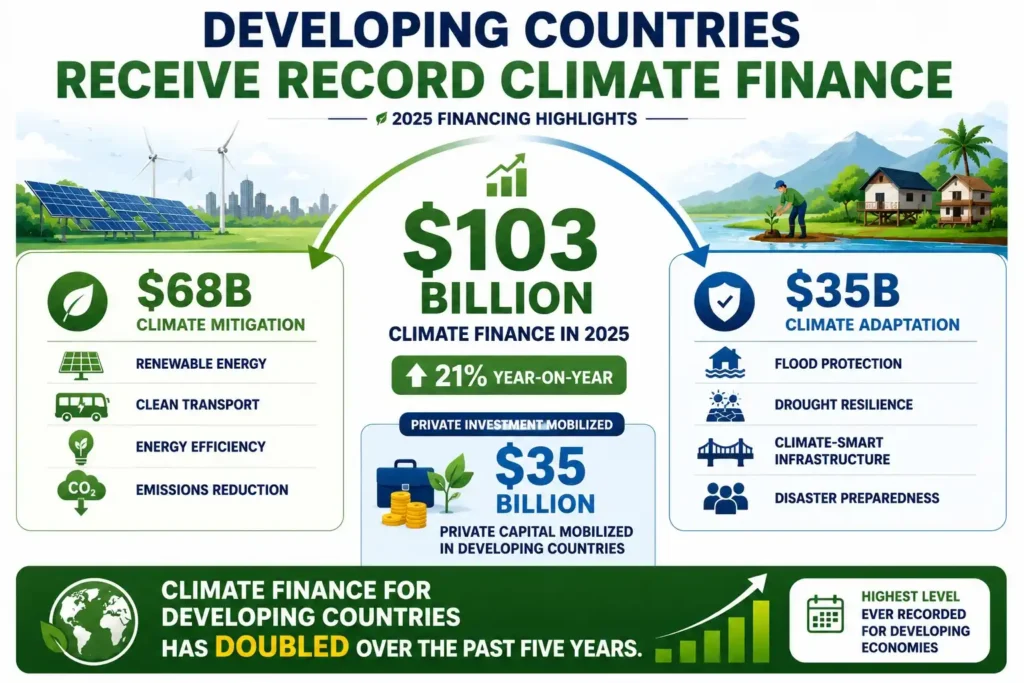
Low- and middle-income countries received the largest share of funding, with $103 billion allocated to climate-related projects during 2025. This represents a 21% increase compared with the previous year and the highest level ever recorded for developing economies.
Climate mitigation accounted for $68 billion, financing projects such as renewable energy, cleaner transport systems, energy efficiency improvements and emissions reduction initiatives.
Meanwhile, $35 billion was directed toward climate adaptation projects that help communities strengthen resilience against floods, droughts, extreme weather and other climate-related risks.
The report also highlighted growing private sector participation, with MDBs mobilizing $35 billion in private investment for developing countries. Over the past five years, climate finance for these economies has doubled, demonstrating increasing investor confidence in sustainable development projects.
Advanced Economies Continue Expanding Climate Investment
Climate finance for high-income economies also reached record levels during 2025.
MDBs provided $60 billion in financing, comprising $53 billion for climate mitigation and $7 billion for climate adaptation projects.
Private investment mobilized alongside MDB financing totaled $80 billion, reflecting continued confidence from institutional investors in climate-focused infrastructure and clean energy projects.
According to the report, funding for advanced economies has already reached or exceeded the MDBs’ projected 2030 climate finance targets, achieving those milestones five years ahead of schedule.
Private Capital Plays a Bigger Role
Alongside direct financing, MDBs continued expanding their role in attracting private investment into climate projects.
Combined private sector mobilization reached $115 billion globally during 2025, including $35 billion in developing economies and $80 billion in high-income countries.
This blended finance approach allows MDBs to reduce investment risks while encouraging commercial banks, institutional investors and private companies to finance projects that might otherwise struggle to secure funding.
The growing participation of private capital is viewed as essential to meeting global climate goals, particularly as investment needs continue to rise across renewable energy, resilient infrastructure and industrial decarbonization.
Context is everything. Stay ahead of shifting trends with today’s market updates, and uncover emerging opportunities using the Serrari Group Market Index and Marketplace. Then, take control of your own financial future by exploring our Money & Life Reset Transformation Blueprint ™ to build stronger habits, create better systems, and design a path toward lasting wealth.
African Development Bank Surpasses Climate Target
The African Development Bank (AfDB) also recorded a significant milestone during 2025.
Climate finance represented 54% of the Bank’s total project approvals, equivalent to approximately $5.93 billion. Around 58% of this financing supported climate adaptation projects, reflecting Africa’s increasing vulnerability to climate impacts.
The AfDB also exceeded its commitment to mobilize $25 billion in climate finance between 2020 and 2025, reaching approximately $25.5 billion during the period.
The achievement reinforces the growing role of African development finance institutions in supporting climate resilience alongside economic development.
MDBs Remain on Track for 2030 Targets
During COP29 in Baku, MDBs committed to substantially increasing climate finance over the remainder of the decade.
By 2030, the institutions aim to provide:
- $120 billion annually for low- and middle-income countries.
- $42 billion of that funding is dedicated to climate adaptation.
- $50 billion annually for high-income economies.
- $65 billion annually in mobilized private finance for developing countries.
- Another $65 billion annually in private investment for advanced economies.
The 2025 results indicate that MDBs are progressing steadily toward these commitments while continuing to expand financing across multiple sectors.
Improving Climate Finance Transparency
MDBs are also improving how climate finance information is reported.
In April 2026, the institutions launched a pilot MDB Climate Finance Dashboard, providing stakeholders with interactive access to climate finance data, investment breakdowns and harmonized reporting methodologies.
The digital platform is intended to improve transparency, strengthen accountability and make climate finance information more accessible for governments, investors and researchers.
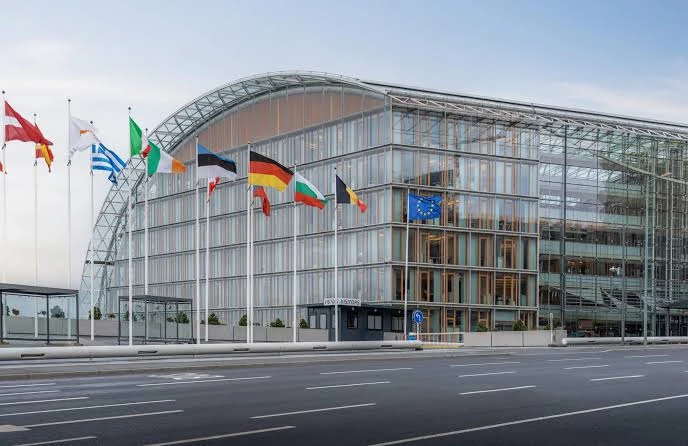
The annual report itself was coordinated by the European Investment Bank, with support from the European Bank for Reconstruction and Development (EBRD), and includes data from ten major multilateral development banks, including the World Bank Group, Asian Development Bank, African Development Bank, Asian Infrastructure Investment Bank, and others.
Outlook
The record $163 billion committed by multilateral development banks during 2025 highlights their expanding role in financing the global response to climate change. As countries accelerate efforts to decarbonize their economies while adapting to increasingly severe climate impacts, MDBs are expected to remain critical providers of long-term capital and catalysts for private investment. Continued growth in blended finance, stronger international cooperation and greater transparency are likely to further strengthen the ability of development banks to support climate resilience, clean energy deployment and sustainable economic development over the coming years.
FAQs
1. How much climate finance did MDBs provide in 2025?
MDBs provided a record $163 billion in climate finance during 2025.
2. How much funding went to developing countries?
Low- and middle-income countries received $103 billion, including $68 billion for mitigation and $35 billion for adaptation projects.
3. How much private investment did MDBs mobilize?
MDBs mobilized $115 billion in private finance globally—$35 billion in developing economies and $80 billion in high-income countries.
4. What are the MDBs’ climate finance targets for 2030?
MDBs aim to provide $120 billion annually for developing countries, $50 billion for high-income economies, and mobilize $130 billion in private investment each year by 2030.
Sources: Devdiscourse, African Development Bank Group, Asian Development Bank, European Bank for Reconstruction and Development, CHANNEL AFRICA, DevelopmentAid
Your financial future isn’t something you wait for—it’s something you build.
The real question is: when do you begin?
Move beyond simply staying informed.
Navigate the markets with clarity—track trends through the Serrari Group Market Index, uncover opportunities in the Serrari Marketplace, and build practical knowledge with our Curated Wealth Builder Platform.
Stay connected to what truly matters.
Get daily insights on macro trends and financial movements across Kenya, Africa, and global markets—delivered through the Serrari Newsletter.
Growth opens doors.
Advance your career through professional programs including ACCA, HESI A2, ATI TEAS 7 , HESI EXIT , NCLEX – RN and NCLEX – PN, Financial Literacy!🌟—designed to move you forward with confidence.
See where money is flowing—clearly and in real time.
Track Money Market Funds, Treasury Bills, Treasury Bonds, Green Bonds, and Fixed Deposits, alongside global and African indexes, key economic indicators, and the evolving Crypto and stablecoin landscape—all within Serrari’s Market Index.