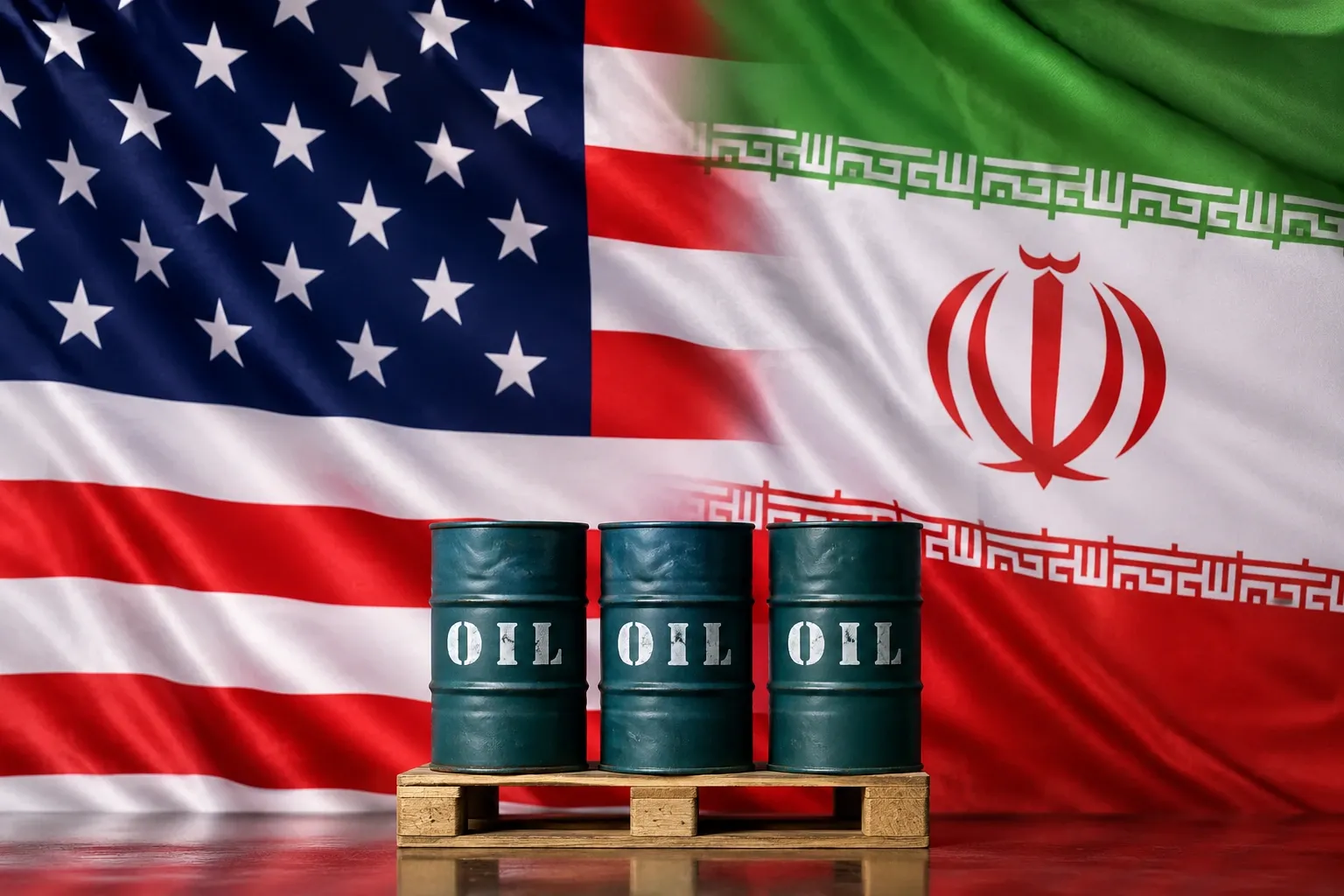
Oil prices surged to their highest levels in a month after renewed military conflict between the United States and Iran heightened fears of supply disruptions in the Strait of Hormuz. Brent crude climbed above $84 per barrel, while West Texas Intermediate (WTI) approached $80, as markets reacted to escalating attacks, reduced tanker traffic, and growing uncertainty over one of the world’s most important energy shipping routes.
Key Overview
- Brent crude rose above $84 per barrel, its highest level in a month.
- WTI crude approached $80 per barrel following renewed conflict.
- The US resumed military operations targeting Iranian infrastructure.
- Iran launched missile strikes on oil tankers and US military bases.
- The Strait of Hormuz remains a major source of supply concerns, carrying about 20% of global oil and LNG trade.
Oil Prices Surge on Escalating Conflict
Global oil prices climbed sharply on Tuesday after renewed military exchanges between the United States and Iran increased concerns over energy supplies from the Middle East.
Brent crude futures rose more than 3% to around $86 per barrel, marking their highest level in four weeks, while U.S. West Texas Intermediate (WTI) crude gained nearly 2% to trade close to $80 per barrel. The rally reflects growing fears that prolonged conflict could disrupt one of the world’s most important oil-export routes.
The price increase follows renewed military operations after the collapse of a previous ceasefire agreement signed in June.
Strait of Hormuz Back in Focus
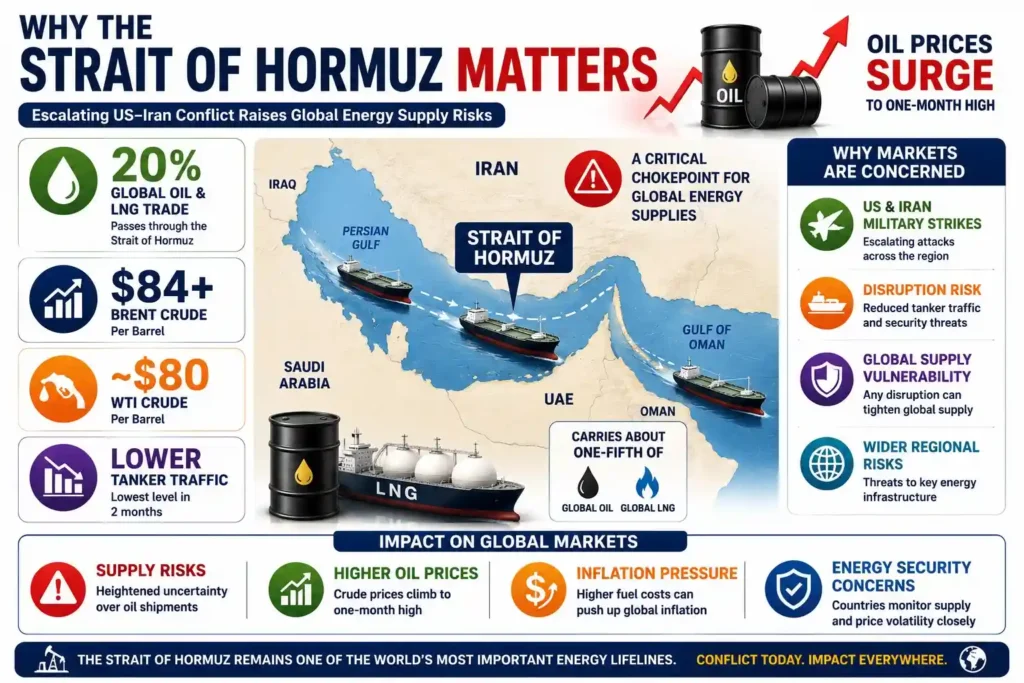
The latest escalation has once again placed the Strait of Hormuz at the center of global energy markets.
The narrow waterway serves as the primary export route for Gulf oil producers and normally transports roughly a fifth of the world’s daily oil and liquefied natural gas supplies. Any disruption to shipping through the strait immediately raises concerns about global energy security.
The United States recently reinstated naval operations aimed at protecting commercial shipping while restricting Iranian maritime activity. Washington said the latest military actions were intended to weaken Iran’s ability to threaten international shipping lanes.
Although U.S. officials maintain that commercial vessels continue to transit the strait under military protection, shipping data indicates tanker movements have fallen to their lowest level in two months.
Military Tensions Intensify
Hostilities continued overnight as both countries exchanged fresh military strikes.
According to regional reports, Iran launched cruise missile attacks against two oil supertankers operating near the United Arab Emirates, resulting in casualties among crew members. Tehran also carried out missile strikes targeting U.S. military facilities in Bahrain and Jordan.
Meanwhile, U.S. Central Command announced another round of attacks targeting Iranian military infrastructure across the region, saying the operations were designed to reduce threats against commercial shipping.
The renewed fighting has increased uncertainty surrounding future oil exports from the Gulf.
Supply Risks Keep Markets on Edge
Energy analysts believe the market is increasingly pricing in the possibility of prolonged supply disruptions.
Although oil exports from Iran have reportedly continued despite tighter U.S. sanctions, traders remain concerned that further military escalation could interrupt production or shipping across the region.
Analysts at ANZ said oil prices could remain between US$85-US$90 per barrel if disruptions persist, while some market observers believe prices could reach $100 per barrel if physical shortages begin to emerge.
Financial institutions have also warned that uncertainty surrounding diplomatic negotiations may keep energy markets volatile for an extended period.
Context is everything. Stay ahead of shifting trends with today’s market updates, and uncover emerging opportunities using the Serrari Group Market Index and Marketplace. Then, take control of your own financial future by exploring our Money & Life Reset Transformation Blueprint ™ to build stronger habits, create better systems, and design a path toward lasting wealth.
Broader Regional Risks
The conflict is also creating wider risks across the Middle East.
Yemen’s Houthi movement has expanded attacks toward Saudi Arabia, raising concerns that additional energy infrastructure could become targets. Any disruption to Saudi crude exports through the Red Sea would place further pressure on global oil markets.
Elsewhere, Ukraine reported strikes on Russian oil refineries, adding another layer of uncertainty to global energy supplies.
With multiple geopolitical flashpoints affecting production, refining and transportation, investors continue to monitor developments closely.
Global Markets Monitor Inflation Risks
Higher crude oil prices could have broader implications beyond the energy sector.
Sustained increases in oil prices typically raise transportation, manufacturing and fuel costs, contributing to higher inflation worldwide. Central banks may therefore face renewed pressure to balance economic growth against rising price pressures if energy costs remain elevated.
Businesses with significant fuel expenses, including airlines, shipping companies and logistics providers, may also experience higher operating costs if crude prices continue climbing.
Outlook
Oil markets are expected to remain highly volatile as geopolitical tensions continue to evolve. While military protection has helped keep the Strait of Hormuz partially operational, reduced tanker traffic and ongoing attacks highlight the vulnerability of global energy supply chains. If hostilities continue or shipping disruptions worsen, crude prices could remain elevated or move higher, increasing inflationary pressures and reinforcing concerns over global energy security. Conversely, any renewed diplomatic agreement between the United States and Iran could help stabilize markets and ease supply concerns.
FAQs
1. Why are oil prices rising?
Oil prices are increasing because renewed military conflict between the United States and Iran has raised fears of disruptions to global oil supplies.
2. Why is the Strait of Hormuz important?
The Strait of Hormuz carries about 20% of the world’s oil and LNG exports, making it one of the most critical energy shipping routes globally.
3. How high have oil prices reached?
Brent crude climbed above $84–86 per barrel, while WTI crude approached $80 per barrel, both reaching their highest levels in about a month.
4. Could oil prices reach $100 per barrel?
Some analysts believe prices could approach $100 per barrel if military tensions worsen and physical disruptions to oil supplies become more severe.
Sources: Yahoo Finance, Euronext Markets, The Globe and Mail, Aljazeera
Your financial future isn’t something you wait for—it’s something you build.
The real question is: when do you begin?
Move beyond simply staying informed.
Navigate the markets with clarity—track trends through the Serrari Group Market Index, uncover opportunities in the Serrari Marketplace, and build practical knowledge with our Curated Wealth Builder Platform.
Stay connected to what truly matters.
Get daily insights on macro trends and financial movements across Kenya, Africa, and global markets—delivered through the Serrari Newsletter.
Growth opens doors.
Advance your career through professional programs including ACCA, HESI A2, ATI TEAS 7 , HESI EXIT , NCLEX – RN and NCLEX – PN, Financial Literacy!🌟—designed to move you forward with confidence.
See where money is flowing—clearly and in real time.
Track Money Market Funds, Treasury Bills, Treasury Bonds, Green Bonds, and Fixed Deposits, alongside global and African indexes, key economic indicators, and the evolving Crypto and stablecoin landscape—all within Serrari’s Market Index.