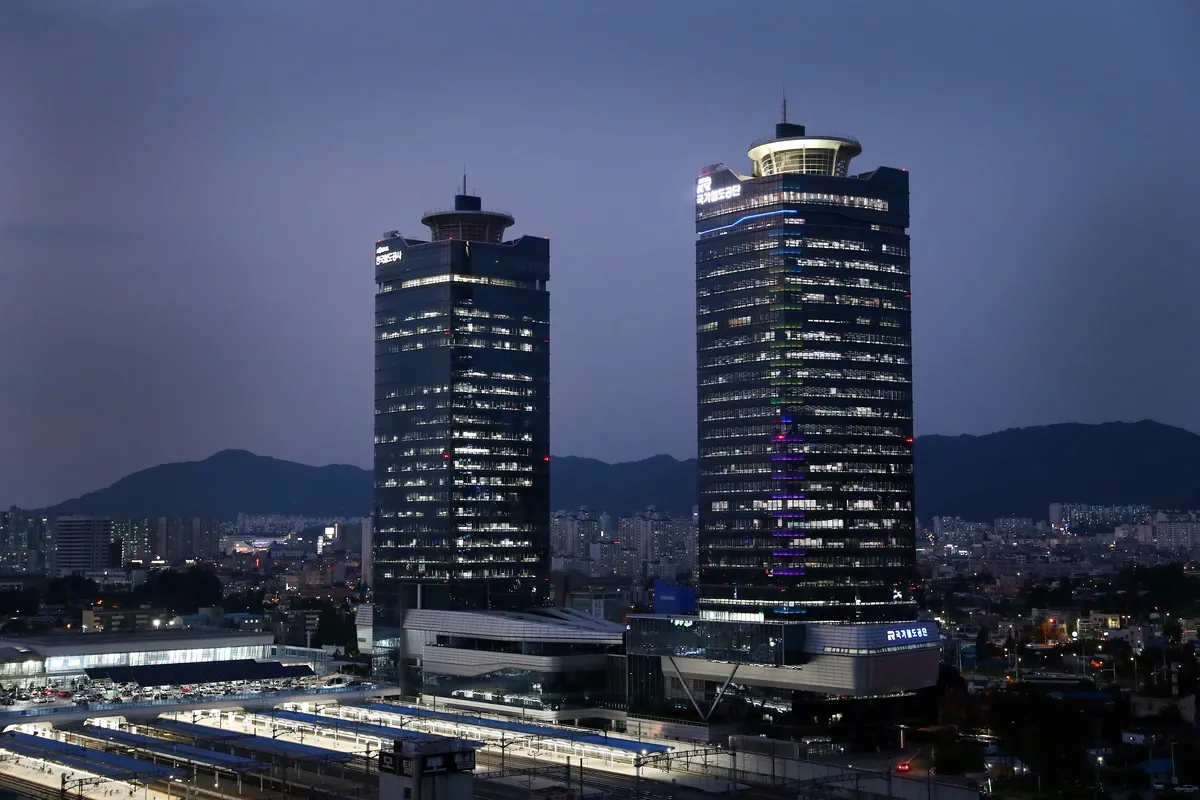
The Korea Rail Network Authority (KR) has issued its largest green bond to date, raising 150 billion won to finance the Pyeongtaek-Osong Double-Track Roadbed Construction project. The funding will support the expansion of high-speed rail capacity, improve eco-friendly transport infrastructure and strengthen the authority’s ESG financing strategy. The issuance continues KR’s annual growth in green bond financing since 2023 and follows a successful ESG certification and government support under South Korea’s Green Bond Issuance Interest Subsidy Programme.
Key Overview
- Korea Rail Network Authority issued 150 billion won in green bonds, its largest issuance so far.
- Proceeds will fully finance the Pyeongtaek-Osong Double-Track Roadbed Construction project.
- The project aims to increase transport capacity on the Gyeongbu high-speed railway.
- The authority plans to expand high-speed rail coverage and strengthen South Korea’s eco-friendly transport system.
- The green bond received a “Suitable” ESG certification rating and qualifies for a 0.2% annual interest subsidy.
The Korea Rail Network Authority (KR) has issued 150 billion won in green bonds, marking the largest green bond issuance in the authority’s history as it increases investment in sustainable railway infrastructure.
The authority said the entire proceeds will be invested in the Pyeongtaek-Osong Double-Track Roadbed Construction project, a major infrastructure development designed to increase transport capacity along South Korea’s Gyeongbu high-speed railway.
By expanding capacity on one of the country’s busiest high-speed rail corridors, the authority aims to widen access to high-speed rail services while accelerating the development of an environmentally friendly transportation system.
Green bonds are issued specifically to finance projects that deliver environmental benefits, including climate change mitigation, renewable energy development and sustainable transport infrastructure. Railway construction is regarded as one of the key sectors eligible for green financing because of its role in reducing transport-related emissions.
Largest Green Bond Issuance to Date
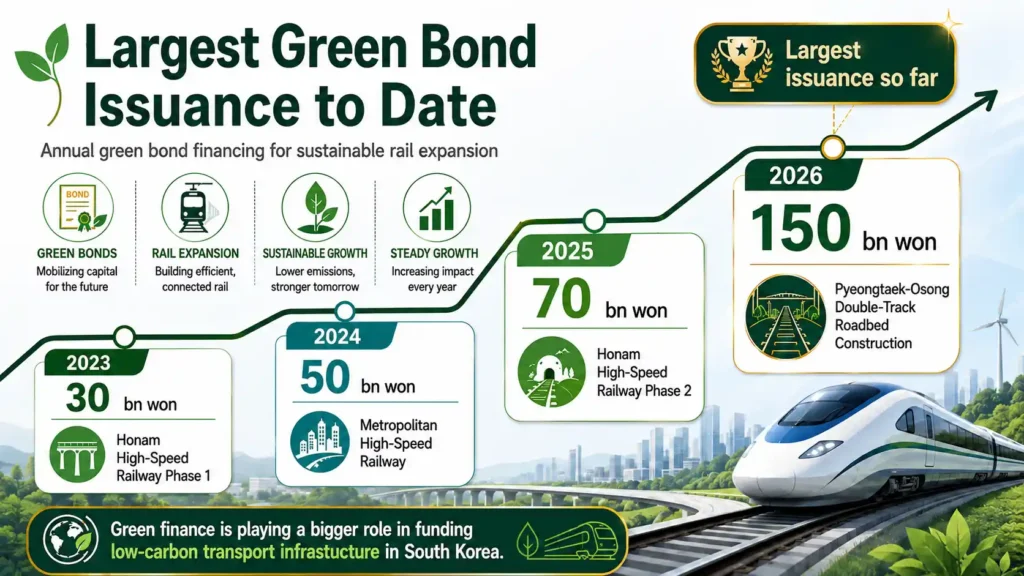
The latest transaction continues the authority’s strategy of steadily increasing its use of green finance.
The Korea Rail Network Authority first entered the green bond market in 2023, issuing 30 billion won to support the Honam High-Speed Railway Phase 1 project.
It followed this with a 50 billion won issuance in 2024 for the Metropolitan High-Speed Railway construction project and 70 billion won in 2025 to finance Honam High-Speed Railway Phase 2.
The new 150 billion won issuance represents the authority’s largest green bond transaction to date, reflecting its growing reliance on ESG financing to fund major rail infrastructure projects.
ESG Certification and Government Support
Ahead of the issuance, the authority received a “Suitable” rating during an ESG bond certification assessment conducted by Korea Ratings.
The assessment recognised the authority’s compliance with the Korean Green Taxonomy (K-Taxonomy) guidelines, the appropriateness of its project selection process and the transparency of its fund management practices.
The authority also secured additional financial support earlier this year after being selected for the 2026 Korean Green Bond Issuance Interest Subsidy Project, administered by the Korea Environmental Industry and Technology Institute.
Through the programme, the authority receives 0.2% annual interest support, helping reduce financing costs and improve fiscal efficiency.
Context is everything. Stay ahead of shifting trends with today’s market updates, and uncover emerging opportunities using the Serrari Group Market Index and Marketplace. Then, take control of your own financial future by exploring our Money & Life Reset Transformation Blueprint ™ to build stronger habits, create better systems, and design a path toward lasting wealth.
Green Finance Supports Sustainable Rail Development
Acting Chairman Lee An-ho said the Korea Rail Network Authority will continue expanding its use of green finance to support environmentally friendly railway development while strengthening the organisation’s ESG management strategy.
“We will actively utilize green finance in railway construction, an eco-friendly means of transportation,” he said.
The authority noted that expanding high-speed rail infrastructure will improve transport connectivity, increase the areas served by high-speed rail services and encourage greater use of low-carbon public transportation. By directing green bond proceeds into strategic railway projects, the authority aims to reduce environmental impacts associated with transport while supporting South Korea’s broader transition toward a more sustainable and climate-friendly transportation system. The latest issuance also reinforces the growing role of green capital markets in financing long-term public infrastructure projects.
Outlook
The record 150 billion won green bond demonstrates the Korea Rail Network Authority’s growing commitment to financing sustainable transport infrastructure through ESG capital markets. As demand for cleaner and more efficient public transportation continues to rise, green finance is expected to play an increasingly important role in supporting railway expansion, network modernisation and infrastructure upgrades across South Korea. The authority’s steadily increasing annual green bond issuances also reflect growing investor confidence in environmentally focused infrastructure projects and could provide a stronger foundation for future sustainable financing initiatives that contribute to the country’s long-term climate, transportation and economic development objectives.
FAQs
1. What will the Korea Rail Network Authority use the green bond proceeds for?
The entire 150 billion won raised will finance the Pyeongtaek-Osong Double-Track Roadbed Construction project, which aims to increase transport capacity on the Gyeongbu high-speed railway and expand access to high-speed rail services.
2. Why are railway projects financed through green bonds?
Railway infrastructure is considered an environmentally friendly investment because it supports low-carbon transportation, helps reduce emissions from the transport sector and contributes to climate change mitigation objectives.
3. How has the Korea Rail Network Authority expanded its green bond programme?
Since launching its green bond programme in 2023, the authority has steadily increased its annual issuances from 30 billion won in 2023 to 50 billion won in 2024, 70 billion won in 2025 and 150 billion won in 2026.
4. What ESG recognition did the latest green bond receive?
Before the issuance, the green bond received a “Suitable” rating from Korea Ratings, recognising its compliance with the Korean Green Taxonomy (K-Taxonomy), appropriate project selection and transparent fund management.
Your financial future isn’t something you wait for—it’s something you build.
The real question is: when do you begin?
Move beyond simply staying informed.
Navigate the markets with clarity—track trends through the Serrari Group Market Index, uncover opportunities in the Serrari Marketplace, and build practical knowledge with our Curated Wealth Builder Platform.
Stay connected to what truly matters.
Get daily insights on macro trends and financial movements across Kenya, Africa, and global markets—delivered through the Serrari Newsletter.
Growth opens doors.
Advance your career through professional programs including ACCA, HESI A2, ATI TEAS 7 , HESI EXIT , NCLEX – RN and NCLEX – PN, Financial Literacy!🌟—designed to move you forward with confidence.
See where money is flowing—clearly and in real time.
Track Money Market Funds, Treasury Bills, Treasury Bonds, Green Bonds, and Fixed Deposits, alongside global and African indexes, key economic indicators, and the evolving Crypto and stablecoin landscape—all within Serrari’s Market Index.