Europe’s electric-car market is accelerating, with battery-electric vehicles reaching a 25.7% share of new registrations in July 2026 across 16 major markets. BEV registrations rose 13.6% year-on-year, while nearly 1.5 million electric cars have been registered across Europe so far this year. However, adoption varies widely, with Denmark leading at 80.1% and Italy falling to 5.9% after incentives expired.
Key Overview
- July BEV market share: 25.7% across 16 major European markets.
- July registrations: 224,266 battery-electric vehicles, up 13.6% year-on-year.
- 2026 registrations: Nearly 1.5 million BEVs, about 30% higher than the same period in 2025.
- Leading market: Denmark, with an 80.1% BEV share.
- Major markets: France reached 35%, while Germany recorded 29.3%.
- Policy impact: Italy’s BEV share fell to 5.9% after previous incentives expired.
- Consumer motivation: 62% in a late-July Carwow poll cited protection from fuel-price volatility as a reason to switch to EVs.
Europe’s Electric-Car Market Crosses a Major Milestone
Europe’s electric-car market has crossed another important threshold, with battery-electric vehicles (BEVs) accounting for 25.7% of new registrations across 16 major European markets in July. This means more than one in four new cars sold in the region was fully electric.
BEV registrations increased 13.6% year-on-year to 224,266 vehicles in July. Since the beginning of 2026, nearly 1.5 BEVs have been registered across Europe, representing an increase of around 30% more than during the same period in 2025.
The figures indicate that electric mobility is continuing to gain momentum across the continent, although adoption remains highly uneven between individual markets.
EV Registrations Continue to Rise
Data from E-Mobility Europe, New Automotive and Fier Automotive showed that BEV registrations across the 16 key European markets reached 224,266 vehicles in July.
The increase comes after several years in which European automakers invested heavily in electric vehicle production, battery manufacturing and related infrastructure while consumer adoption developed at a slower pace.
The latest figures suggest that demand is increasingly catching up with the substantial investments made by manufacturers and suppliers across the region.
The growth in the electric-car market is also significant for automakers seeking to meet increasingly ambitious emissions and electrification targets while competing in a rapidly changing global automotive industry.
France and Germany Drive Major Market Growth
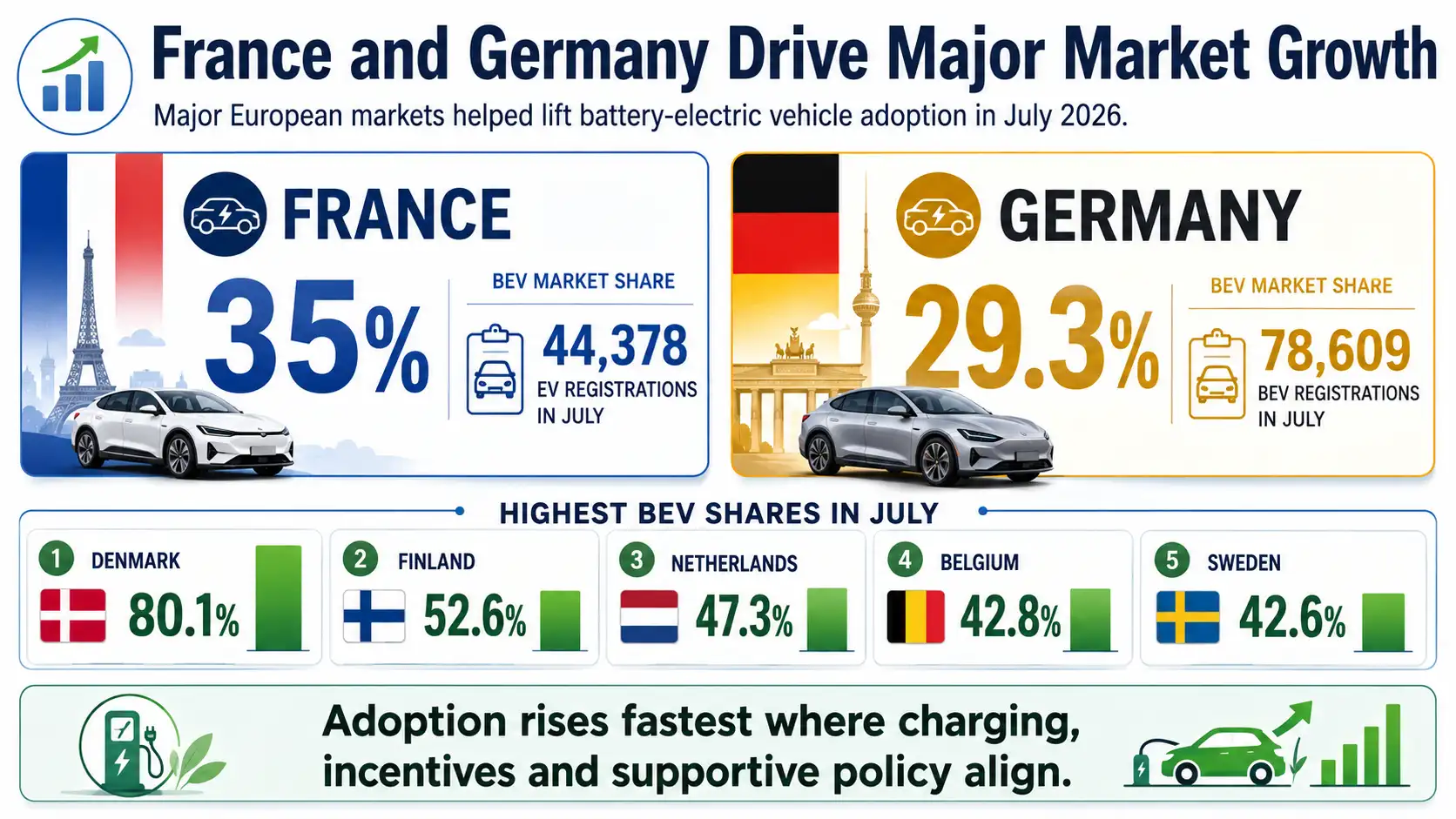
France recorded a 35% BEV market share in July, with 44,378 registrations.
Germany, Europe’s largest automotive market, recorded a 29.3% share with 78,609 registrations.
The performance of these two major markets contributed significantly to the region’s overall electric vehicle growth.
However, adoption rates remain considerably higher in several Nordic and Benelux countries.
Denmark led the European markets in July with an impressive 80.1% of new registrations.Finland reached 52.6%, the Netherlands 47.3%, Belgium 42.8% and Sweden 42.6%. .
These figures demonstrate how quickly electric vehicles can become mainstream when charging infrastructure, consumer incentives and supportive policies align.
Policy Changes Affect Electric-Car Adoption
While the overall trend remains positive, July’s figures also highlight the impact government policies can have on the electric-car market.
Italy’s BEV market share fell to 5.9% from 10.1% in June after previous incentives expired.
Poland and the Czech Republic also remained among Europe’s least electrified markets, recording BEV shares of approximately 4% and 7.5%, respectively.
The sharp differences between countries suggest that consumer demand is influenced not only by vehicle availability and pricing but also by government incentives and the broader policy environment.
Chris Heron, secretary general of E-Mobility Europe, said electric cars remain one of Europe’s major success stories in 2026 and argued that governments need to provide stable and predictable policies to maintain the momentum.
Context is everything. Stay ahead of shifting trends with today’s market updates, and uncover emerging opportunities using the Serrari Group Market Index and Marketplace. Then, take control of your own financial future by exploring our Money & Life Reset Transformation Blueprint ™ to build stronger habits, create better systems, and design a path toward lasting wealth.
Consumers Increasingly Focus on Fuel Savings
Consumer economics is also playing an important role in the continued expansion of electric mobility.
A late-July Carwow poll found that 62% of respondents identified protection against fuel-price volatility as a primary motivation for switching to an EV.
Lower running costs can make electric vehicles increasingly attractive as drivers consider the long-term cost of ownership alongside purchase prices.
The growing availability of electric models across different vehicle categories is also giving consumers more choice, while manufacturers continue expanding their battery-electric portfolios.
Renault, for example, recorded UK orders exceeding 50%, according to the information provided.
Europe’s Electric Mobility Transition Remains Uneven
Despite the strong regional growth, the development of Europe’s electric-car market remains highly fragmented.
Denmark’s 80.1% BEV share contrasts sharply with Italy’s 5.9%, while Poland and the Czech Republic also trail the leading markets.
The differences reflect variations in government incentives, charging infrastructure, vehicle availability, consumer preferences and market conditions.
The figures also show that policy decisions can quickly affect EV adoption. Italy’s decline following the expiration of incentives provides a clear example of how changes in financial support can influence monthly registration figures.
For manufacturers, this uneven adoption creates both challenges and opportunities as they decide where to allocate electric vehicle production, charging partnerships and marketing investment.
Nearly 1.5 Million BEVs Registered in 2026
Despite the differences between markets, the overall European trend remains positive.
Nearly 1.5 million BEVs have been registered across Europe so far this year, approximately 30% more than during the corresponding period of 2025.
The continued increase suggests that electric vehicles are becoming an increasingly important part of Europe’s new-car market.
The growth could also encourage further investment in charging infrastructure, battery production and other parts of the electric mobility ecosystem.
As more consumers switch to electric vehicles, manufacturers and policymakers will need to ensure that charging networks and electricity systems can accommodate rising demand.
Outlook
The latest figures show that Europe’s electric-car market is moving further into the mainstream, with BEVs reaching a 25.7% share across 16 major markets in July.
However, the wide gap between leading and lagging countries demonstrates that the transition is far from uniform. Stable government policies, consumer incentives, accessible charging infrastructure and competitive vehicle pricing will remain important factors in determining how quickly adoption grows.
With nearly 1.5 million BEVs already registered this year, Europe’s electric mobility transition is gaining significant momentum.
FAQs
1. What was Europe’s BEV market share in July 2026?
Battery-electric vehicles accounted for 25.7% of new car registrations across 16 major European markets in July 2026.
2. How many BEVs have been registered in Europe in 2026?
Nearly 1.5 million battery-electric vehicles have been registered across Europe so far in 2026, around 30% more than during the same period in 2025.
3. Which European country had the highest BEV share in July?
Denmark recorded the highest BEV market share at 80.1%, followed by Finland at 52.6%.
4. How do government incentives affect EV adoption?
The figures indicate that incentives can significantly influence EV sales. Italy’s BEV share fell from 10.1% in June to 5.9% in July after previous incentives expired.
Sources: European Business Magazine, Ground News, Euronext Markets, Global Banking & Finance Review, Business Times
Your financial future isn’t something you wait for—it’s something you build.
The real question is: when do you begin?
Move beyond simply staying informed.
Navigate the markets with clarity—track trends through the Serrari Group Market Index, uncover opportunities in the Serrari Marketplace, and build practical knowledge with our Curated Wealth Builder Platform.
Stay connected to what truly matters.
Get daily insights on macro trends and financial movements across Kenya, Africa, and global markets—delivered through the Serrari Newsletter.
Growth opens doors.
Advance your career through professional programs including ACCA, HESI A2, ATI TEAS 7 , HESI EXIT , NCLEX – RN and NCLEX – PN, Financial Literacy!🌟—designed to move you forward with confidence.
See where money is flowing—clearly and in real time.
Track Money Market Funds, Treasury Bills, Treasury Bonds, Green Bonds, and Fixed Deposits, alongside global and African indexes, key economic indicators, and the evolving Crypto and stablecoin landscape—all within Serrari’s Market Index.