African stablecoin remittances are shifting from customer-held crypto balances toward infrastructure used behind the scenes by fintech companies. In the LemFi and BVNK partnership, stablecoins are used to settle value between markets, while senders and recipients continue dealing in conventional currencies. This matters because traditional remittance settlement can rely on correspondent banks, SWIFT chains, prefunded accounts and multiple intermediaries. Stablecoin rails may reduce settlement time, improve weekend liquidity and lower the need to hold capital in many countries. But the model still depends on regulation, stablecoin issuer quality, reserve management, custody, payout partners and corridor-specific approvals.
Key Overview
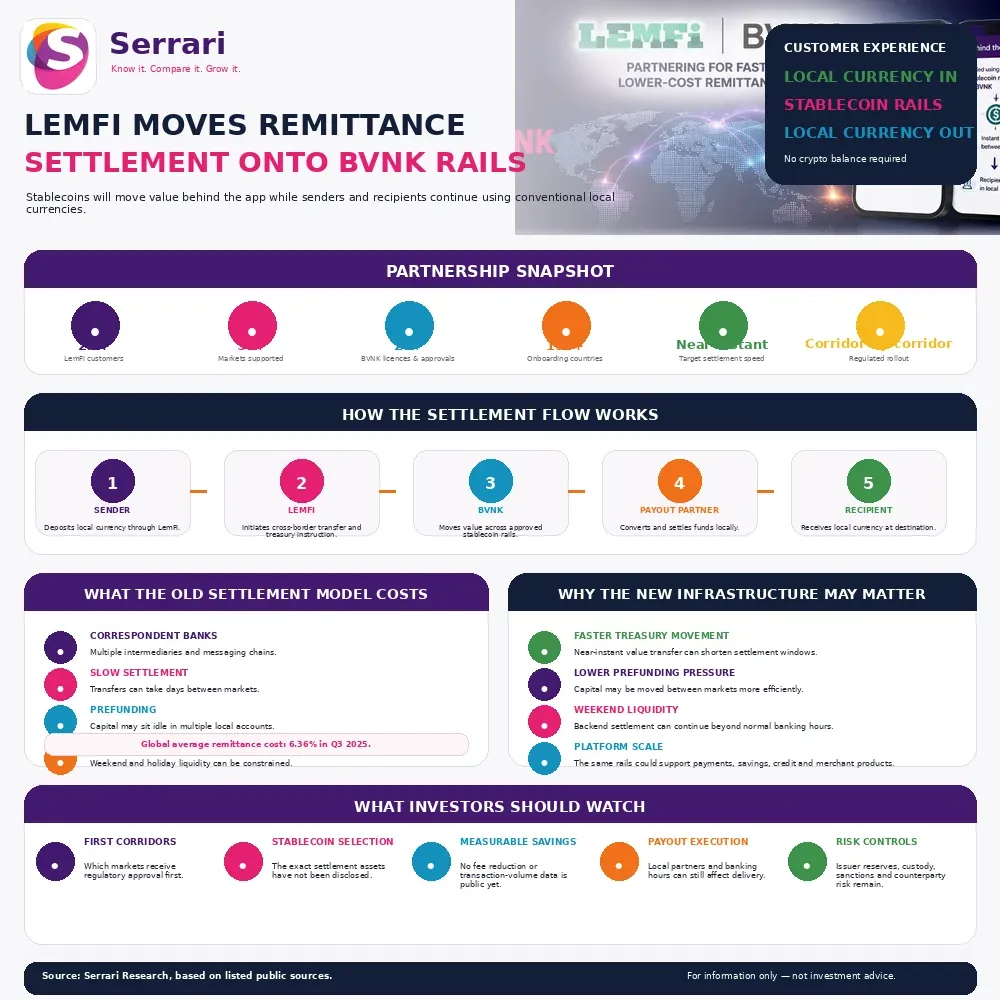
- LemFi will move cross-border settlement onto BVNK’s regulated stablecoin infrastructure.
- Customers will continue using local currencies and will not need to hold crypto.
- The partnership targets near-instant value transfer between markets.
- Rollout will happen corridor by corridor where local regulation permits.
- LemFi serves more than two million customers.
- LemFi supports transfers to more than 30 markets.
- BVNK says it has more than 25 licences and regulatory approvals.
- BVNK supports onboarding in more than 130 countries.
- The companies have not disclosed transaction volumes, fee reductions, the exact stablecoins to be used or first corridors to launch. (Finextra Research)
LemFi Stablecoin Settlement Moves Remittances to BVNK
Stablecoins Move Behind the App
The strongest point in this story is invisibility. LemFi says users will not need to touch a stablecoin, hold a crypto balance or leave their local currency. A sender can deposit funds through the LemFi app, settlement can move across stablecoin rails through BVNK’s infrastructure, and the recipient receives local currency at the destination. (Finextra Research)
That distinction matters for African payments. Stablecoins are not being sold here as an investment product for consumers. They are being used as payment plumbing. The visible product remains a remittance app; the invisible infrastructure changes how LemFi settles balances between markets.
Why the Old Rails Are the Problem
Cross-border remittances often involve two separate processes. The customer sees money sent from one country to another. Behind the scenes, financial institutions must settle balances across markets, often through correspondent banks, SWIFT messages, liquidity partners and local payout networks.
TechAfrica News reported that the LemFi and BVNK partnership is designed to address the long-standing problem of international transfers taking days and attracting multiple intermediary costs. FinTech Magazine made the same point, describing legacy correspondent banking and SWIFT chains as a key bottleneck in transfers from markets such as the UK, Europe, Australia and North America to recipients across Africa, Asia and Latin America. (TechAfrica News)
The Cost Gap Is Still Large
The economics matter because remittance fees remain high globally. The World Bank’s Remittance Prices Worldwide page says the global average cost of sending remittances stood at 6.36% in Q3 2025. The United Nations SDG framework targets a reduction in remittance costs to 3% by 2030. (Remittance Prices Worldwide)
That gap is why stablecoin settlement is attracting fintech attention. Even small improvements in foreign-exchange routing, liquidity usage, settlement speed and intermediary fees can matter when millions of migrants send money frequently to families and businesses at home.
LemFi’s Strategy Is Broader Than Remittances
Finextra’s republished LemFi announcement says the BVNK partnership is part of LemFi’s evolution from a remittance specialist into a broader financial platform for globally mobile communities, spanning payments, credit, savings and connectivity. (Finextra Research)
That makes settlement infrastructure strategic. A company that only sends money once a week can tolerate slower settlement more easily than a platform trying to support wallets, savings, credit, merchant payments and multi-country financial services. Faster backend settlement can improve liquidity management across the entire product stack.
BVNK Brings the Infrastructure Layer
BVNK’s value in the partnership is infrastructure, licensing and operational coverage. Finextra’s LemFi announcement describes BVNK as a compliance-first enterprise-grade platform with more than 25 licences and regulatory approvals across the UK, Europe and the US, and coverage in more than 130 countries. BVNK’s own site also says it has 25+ licences and regulatory approvals, and supports onboarding in more than 130 countries. (Finextra Research)
For fintech investors, this is where the business model becomes interesting. If remittance companies can outsource parts of stablecoin settlement to regulated infrastructure providers, firms such as BVNK may capture revenue that previously sat with correspondent banks, foreign-exchange intermediaries and payment processors.
Context is everything. Stay ahead of shifting trends with today’s market updates, and uncover emerging opportunities using the Serrari Group Market Index and Marketplace. Then, take control of your own financial future by exploring our Money & Life Reset Transformation Blueprint ™ to build stronger habits, create better systems, and design a path toward lasting wealth.
Prefunding Could Become Less Capital-Heavy
Traditional remittance companies often need liquidity in multiple countries before customer transfers are paid out. That can tie up capital in local accounts, create idle balances, and increase operational complexity across corridors.
Stablecoin settlement could reduce the need to pre-position as much capital if value can move quickly across approved corridors. This does not remove the need for liquidity, local compliance or payout partners. But it may improve treasury efficiency by making funds available faster and reducing the number of slow settlement hops.
Rollout Depends on Regulation
The companies are not promising instant global rollout. LemFi says stablecoin settlement will be introduced progressively across corridors and products, only where local central-bank and regulatory frameworks support it. (Finextra Research)
That caveat is essential for Africa. Remittance rules, foreign-exchange controls, crypto-asset treatment, consumer-protection rules and licensing conditions differ by country. A corridor that works legally and operationally in one market may not be ready in another.
The Risks Remain in the Infrastructure
Customers may not hold stablecoins directly, but the risks do not disappear. Stablecoin issuer risk, reserve quality, custody arrangements, blockchain-network risk, counterparty exposure, sanctions screening and payout-partner reliability still matter.
There is also disclosure risk. The companies have not publicly identified the exact stablecoins to be used, the first African corridors, the expected fee reduction or the transaction volume to be routed through BVNK. Investors should therefore treat the partnership as a major infrastructure signal, not as proof of immediate margin expansion.
What Investors Should Watch
Investors should watch four items. First, which corridors go live first. Second, whether LemFi discloses measurable reductions in settlement time, capital tied up or remittance costs. Third, whether the partnership expands into other LemFi products such as savings, credit or merchant payments. Fourth, whether African regulators respond with clearer rules for stablecoin settlement infrastructure.
They should also watch competitors. If LemFi proves that stablecoin rails reduce costs without changing the customer experience, other remittance providers may need similar infrastructure partnerships.
Conclusion
LemFi Stablecoin Settlement marks a practical step in the evolution of African remittance infrastructure. The partnership with BVNK does not ask customers to become crypto users. Instead, it uses regulated stablecoin rails behind the scenes to move value between markets more quickly and efficiently.
For investors, the story is bigger than one fintech partnership. Stablecoins are becoming part of the backend of remittances, treasury and cross-border payments. The opportunity is faster settlement, lower prefunding pressure and new infrastructure revenue. The risk is that regulation, corridor approvals, reserve governance and payout execution still determine whether the model scales safely.
FAQs
1. What is LemFi Stablecoin Settlement?
LemFi Stablecoin Settlement refers to LemFi’s partnership with BVNK to route cross-border settlement over regulated stablecoin payment rails. Customers continue using the LemFi app and local currencies, while stablecoins operate behind the scenes to move value between markets. (Finextra Research)
2. Will LemFi customers need to hold crypto?
No. The partnership is designed so customers do not need to buy, hold or manage stablecoins. Senders deposit funds in their local currency through LemFi, and recipients receive local currency at the destination. The stablecoin infrastructure sits behind the customer experience. (FinTech Magazine)
3. Why is BVNK involved?
BVNK provides enterprise stablecoin payments infrastructure. The company says it has 25+ licences and regulatory approvals and supports onboarding in more than 130 countries. LemFi is using BVNK’s infrastructure to support faster backend settlement across approved corridors. (BVNK)
4. What problem does this solve for African remittances?
The partnership targets slow and expensive settlement across correspondent banking and SWIFT-linked chains. Stablecoin rails may help move value between markets faster, reduce intermediary friction and lower the capital that remittance firms need to pre-position across multiple countries.
5. What are the main risks?
The main risks include unclear stablecoin selection, corridor-specific regulation, issuer reserve risk, custody risk, payout-partner delays, compliance obligations and the absence of disclosed transaction volumes or quantified fee savings. Settlement speed may still depend on local payout partners and banking hours.
Sources: Finextra Research, BVNK, TechAfrica News, Fintech Global, Fintech Magazine, WorldBank, United Nations SDG
Your financial future isn’t something you wait for—it’s something you build.
The real question is: when do you begin?
Move beyond simply staying informed.
Navigate the markets with clarity—track trends through the Serrari Group Market Index, uncover opportunities in the Serrari Marketplace, and build practical knowledge with our Curated Wealth Builder Platform.
Stay connected to what truly matters.
Get daily insights on macro trends and financial movements across Kenya, Africa, and global markets—delivered through the Serrari Newsletter.
Growth opens doors.
Advance your career through professional programs including ACCA, HESI A2, ATI TEAS 7 , HESI EXIT , NCLEX – RN and NCLEX – PN, Financial Literacy!🌟—designed to move you forward with confidence.
See where money is flowing—clearly and in real time.
Track Money Market Funds, Treasury Bills, Treasury Bonds, Green Bonds, and Fixed Deposits, alongside global and African indexes, key economic indicators, and the evolving Crypto and stablecoin landscape—all within Serrari’s Market Index.