Kenya is positioning public institutions at the centre of a major clean-cooking investment push after identifying an estimated $600 million opportunity across schools, healthcare facilities and correctional institutions.
The government wants to aggregate institutional demand and convert it into larger, commercially viable projects capable of attracting private capital. The strategy could combine local-currency financing, guarantees and results-based funding to reduce risks that have historically limited investment in clean cooking.
The $600 million represents the estimated scale of investment opportunities identified through Kenya’s institutional clean-cooking programme. It is not funding that has already been raised or committed.
Key Overview
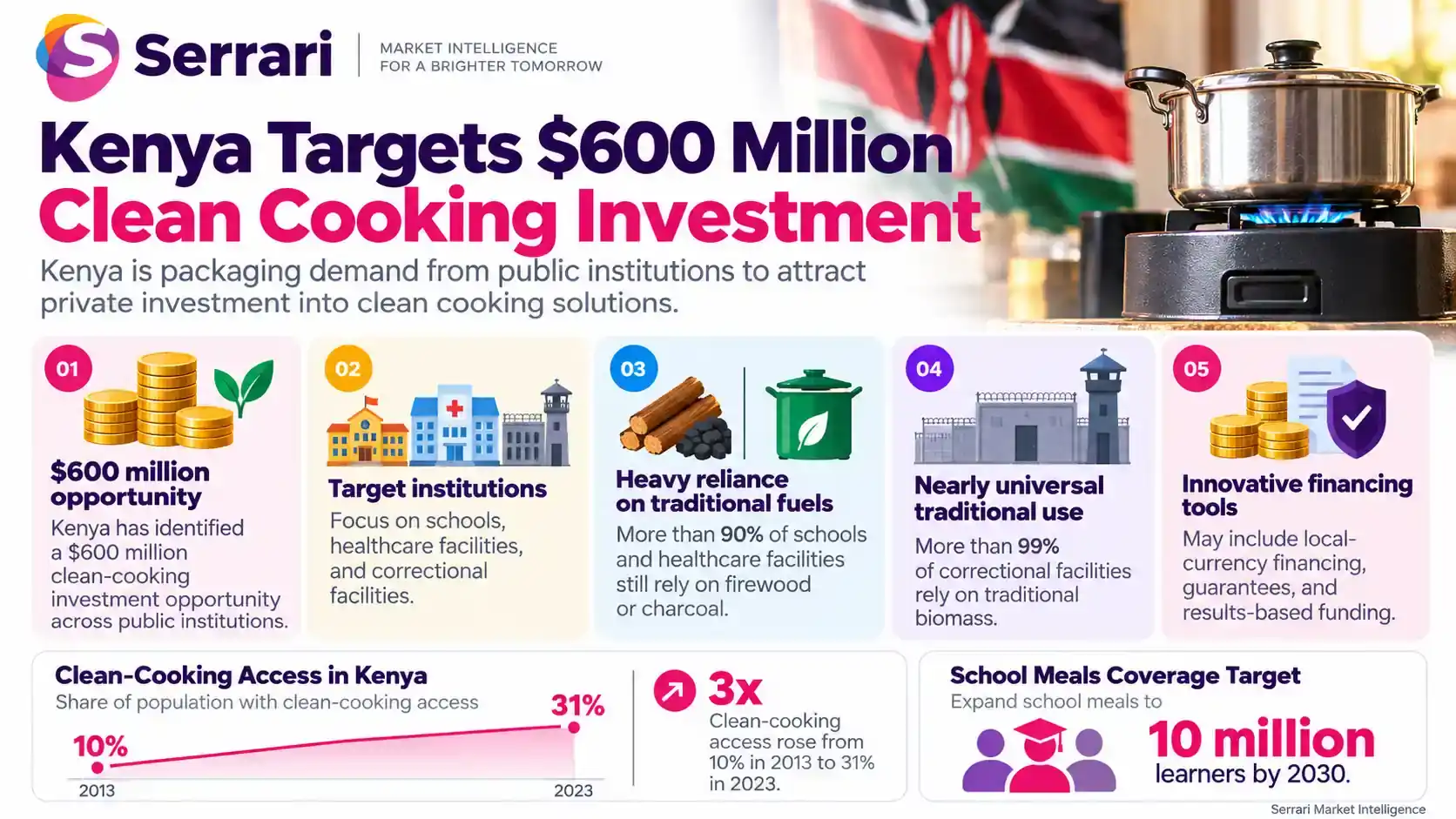
- Kenya has identified a $600 million clean-cooking investment opportunity across public institutions.
- Schools, healthcare facilities and correctional institutions are the primary target markets.
- More than 90% of schools and healthcare facilities still depend on firewood or charcoal.
- More than 99% of correctional facilities rely on traditional biomass fuels.
- Kenya’s clean-cooking access rate rose from 10% in 2013 to 31% in 2023.
- Financing options include local-currency lending, guarantees and results-based funding.
- Kenya wants school meals coverage to expand to 10 million learners by 2030.
- Around $740 million of the $2.2 billion pledged at the 2024 Africa clean-cooking summit had been deployed by July 2026.
Public Institutions Create a Large Investment Market
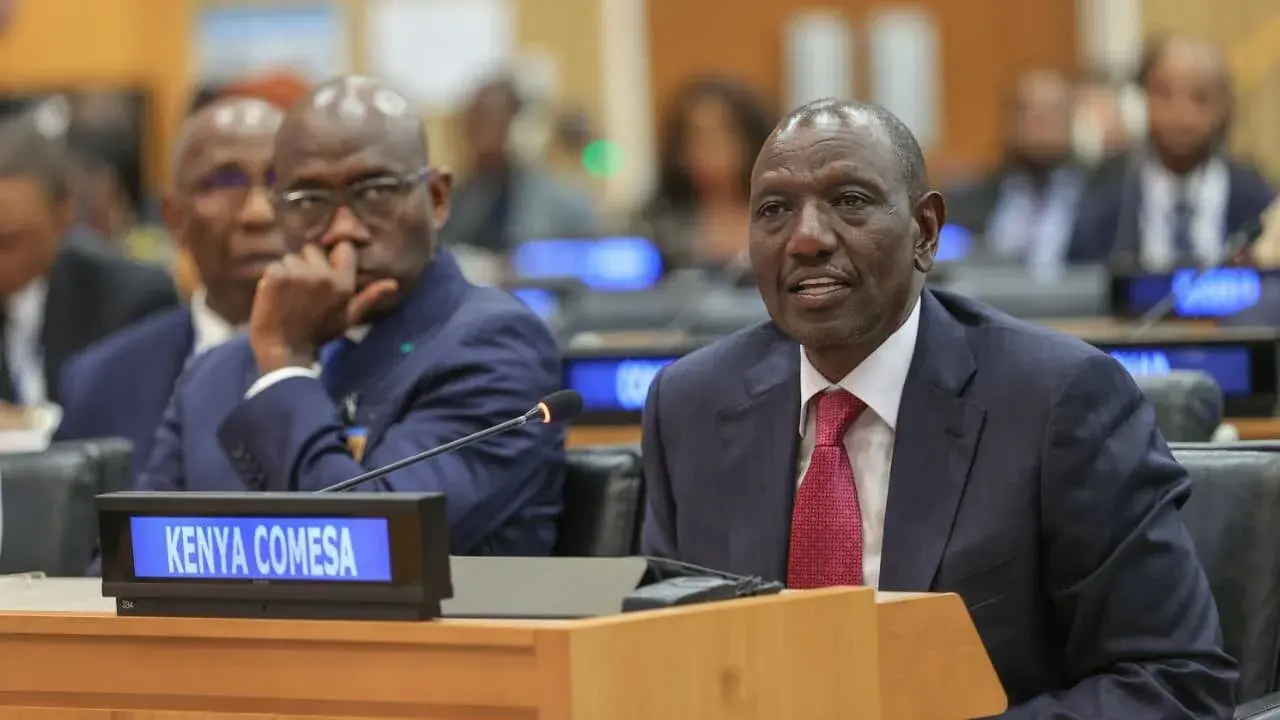
The investment opportunity was highlighted during a high-level clean-cooking meeting held alongside the United Nations General Assembly in New York.
Kenya’s institutional clean-cooking investment framework is designed to bring together demand from thousands of public facilities and present it to investors as a scalable market rather than a collection of small individual projects.
The opportunity is significant because Kenya has more than 97,000 educational institutions, 13,000 healthcare facilities and 130 correctional facilities. More than 90% of schools and healthcare facilities and over 99% of correctional facilities continue to rely on firewood or charcoal for cooking.
That creates potential demand for alternatives including LPG, electricity, biogas and more efficient biomass systems.
By grouping institutions together, the government hopes investors can achieve sufficient scale while gaining greater visibility over future demand.
Financing Tools Could Reduce Investor Risk
One of the biggest obstacles facing clean-cooking projects is not necessarily demand but the ability to structure projects in a way that commercial investors can finance.
Kenya therefore wants to use mechanisms such as local-currency financing, guarantees and results-based funding to help convert institutional demand into investable projects.
Local-currency financing could reduce exposure to exchange-rate movements for projects earning revenue in Kenyan shillings, while guarantees could help address concerns around payment risks or early-stage technologies.
Results-based financing can also link funding to verified outcomes such as installations completed, institutions converted or households and learners gaining access to cleaner cooking.
Context is everything. Stay ahead of shifting trends with today’s market updates, and uncover emerging opportunities using the Serrari Group Market Index and Marketplace. Then, take control of your own financial future by exploring our Money & Life Reset Transformation Blueprint ™ to build stronger habits, create better systems, and design a path toward lasting wealth.
Kenya Still Faces a Large Clean-Cooking Gap
Kenya has made substantial progress in expanding clean cooking, but access remains far from universal.
The country’s clean-cooking access rate increased from 10% in 2013 to 31% in 2023, meaning roughly 69% of the population still relied primarily on polluting cooking fuels at that point.
Traditional fuels remain particularly dominant in rural areas, where firewood continues to play a major role. The national clean-cooking transition therefore has implications for health, household expenditure, deforestation and the amount of time spent collecting fuel.
Public institutions offer a different route to accelerating adoption because one investment can potentially replace large volumes of traditional fuel at a school, hospital or prison.
School Meals Could Strengthen Future Demand
Schools could become one of the largest institutional clean-cooking markets as Kenya expands its national school meals programme.
Government plans call for school meals coverage to rise from about 2.6 million learners to 10 million by 2030, significantly increasing the amount of food prepared in public schools.
The school meals expansion plan also incorporates climate-friendly cooking and a broader shift toward cleaner energy in schools.
If implemented at scale, this could give clean-cooking suppliers more predictable demand for equipment, fuels, installation, servicing and financing.
Africa Still Needs Faster Capital Deployment
Kenya’s investment drive forms part of a wider effort to close Africa’s clean-cooking gap.
The 2024 Summit on Clean Cooking in Africa generated $2.2 billion in financial commitments from governments and private-sector participants. By July 2026, roughly $740 million had been disbursed, showing progress but also highlighting the difference between announced commitments and money actually reaching projects.
Nearly one billion people in sub-Saharan Africa still lack access to clean cooking, while traditional biomass use continues to carry significant health, environmental and economic costs.
The latest regional progress assessment estimates that solving the global clean-cooking access gap would require around $4 billion of annual investment.
For Kenya, the challenge is now to turn the $600 million pipeline from an identified opportunity into financed projects, procurement programmes and operating clean-cooking infrastructure.
If successful, institutional demand could provide the scale needed to draw more private capital into a sector that has traditionally relied heavily on household-level adoption and development financing.
Sources: Invest Kenya / International Energy Agency / Ministry of Education Kenya / Capital FM Kenya / African Development Bank
Your financial future isn’t something you wait for—it’s something you build.
The real question is: when do you begin?
Move beyond simply staying informed.
Navigate the markets with clarity—track trends through the Serrari Group Market Index, uncover opportunities in the Serrari Marketplace, and build practical knowledge with our Curated Wealth Builder Platform.
Stay connected to what truly matters.
Get daily insights on macro trends and financial movements across Kenya, Africa, and global markets—delivered through the Serrari Newsletter.
Growth opens doors.
Advance your career through professional programs including ACCA, HESI A2, ATI TEAS 7 , HESI EXIT , NCLEX – RN and NCLEX – PN, Financial Literacy!🌟—designed to move you forward with confidence.
See where money is flowing—clearly and in real time.
Track Money Market Funds, Treasury Bills, Treasury Bonds, Green Bonds, and Fixed Deposits, alongside global and African indexes, key economic indicators, and the evolving Crypto and stablecoin landscape—all within Serrari’s Market Index.