

















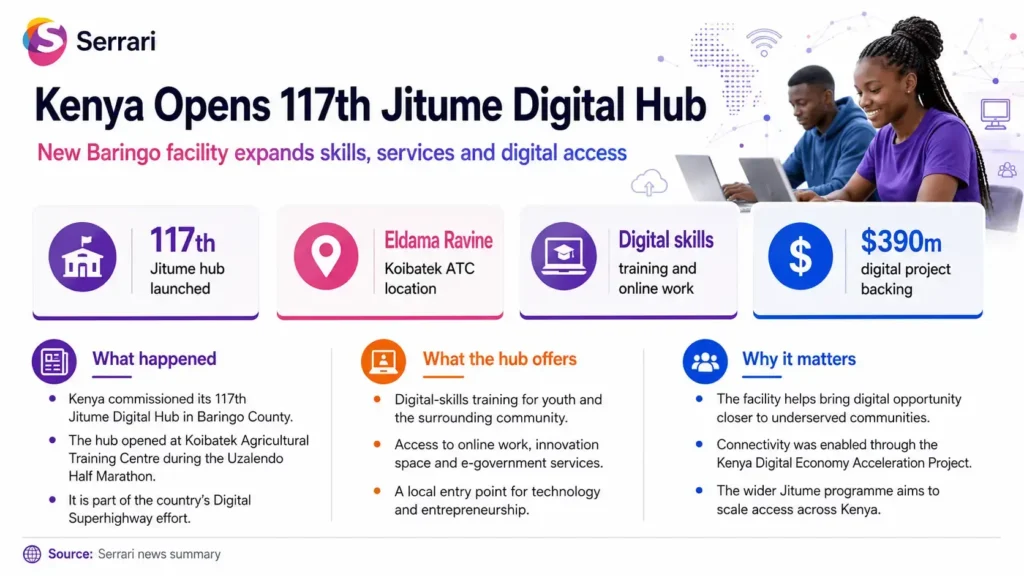
Kenya has commissioned its 117th Jitume Digital Hub at the Koibatek Agricultural Training Centre in Eldama Ravine, Baringo County. The facility is intended to give young people and surrounding communities access to computers, internet connectivity, digital training, online work opportunities, innovation spaces and government services.
The hub was launched during the 2026 Uzalendo Half Marathon and forms part of the government’s wider effort to reduce gaps in digital infrastructure and skills. Its long-term impact will depend on reliable connectivity, regular training, effective management and whether users can translate newly acquired skills into jobs, businesses and improved access to public services.
Key Overview
- The facility is the 117th hub commissioned under the Jitume Digital Programme.
- It is located at Koibatek Agricultural Training Centre in Eldama Ravine.
- The hub was launched during the Uzalendo Half Marathon on July 18, 2026.
- Technopolis Development Authority established the facility under the Jitume programme.
- The ICT Authority connected it through the Kenya Digital Economy Acceleration Project.
- Services are expected to include digital-skills training, online work, innovation support and access to government platforms.
- The programme’s broader ambition is to establish Jitume hubs across Kenya’s wards and expand youth access to digital jobs.
New Hub Extends Digital Services Into Baringo
The new facility was commissioned at Koibatek Agricultural Training Centre during the Uzalendo Half Marathon, whose race route concluded at the centre’s grounds in Eldama Ravine.
The launch was led by Geoffrey Kiringa Ruku, Cabinet Secretary for Public Service, Human Capital Development and Special Programmes, alongside John Kipchumba Tanui, Principal Secretary for ICT and the Digital Economy. Technopolis Development Authority, formerly known as Konza Technopolis Development Authority, confirmed that the facility marked the 117th Jitume Digital Hub.
The location gives residents an access point for digital services without requiring them to travel to larger urban centres. For young people in particular, the hub is expected to provide equipment and connectivity that may otherwise be unaffordable at household level.
Jitume Links Skills Training With Online Work
The Jitume Digital Enablement Programme is designed to combine access to infrastructure with practical skills and employment pathways. According to the ICT ministry, the programme aims to expand access to digital skills, online work and innovation opportunities for young people across the country.
Potential training areas include digital literacy, content creation, data entry, coding, online freelancing and other technology-enabled services. Users may also access government platforms, conduct research and collaborate on local business or community projects.
The programme is therefore intended to move beyond providing computers alone. Its effectiveness depends on linking training to real market demand, mentorship and platforms where participants can earn income or develop businesses.
Technopolis Development Authority describes Jitume as a nationwide skills and job-linkage platform supporting Kenya’s knowledge economy. Earlier programme documents set an ambition to establish 1,450 hubs across the country’s wards and create pathways to large-scale digital employment.
Context is everything. Stay ahead of shifting trends with today’s marketSee where money is flowing—clearly and in real time.
Track Money Market Funds, Treasury Bills, Treasury Bonds, Green Bonds, and Fixed Deposits, alongside global and African indexes, key economic indicators, and the evolving Crypto and stablecoin landscape—all withinSerrari’s Market Index.
updates, and uncover emerging opportunities using the Serrari Group Market Index and Marketplace. Then, take control of your own financial future by exploring our Money & Life Reset Transformation Blueprint ™ to build stronger habits, create better systems, and design a path toward lasting wealth.
Connectivity Comes Through a Wider National Project
The ICT Authority connected the Koibatek facility through the Kenya Digital Economy Acceleration Project. The World Bank-backed programme was approved with $390 million for its first phase.
That phase, running from 2023 to 2028, focuses on expanding high-speed internet, improving selected digital government and education services, and strengthening skills needed for the regional digital economy. It also seeks to extend connectivity into rural and underserved areas where commercial investment may be limited.
A current project implementation document identifies digital infrastructure, government services and skills development as central components. The project is intended to operate across all 47 counties.
Connecting community hubs to this wider programme helps align physical facilities with national broadband, public-service and skills initiatives. It can also reduce the risk of individual centres operating as isolated computer rooms without links to broader training and service-delivery systems.
Baringo Could Gain From Better Digital Access
For Baringo residents, the hub could reduce barriers to online education, job searches, freelancing, business registration and government services. Entrepreneurs may use the centre to research markets, communicate with customers and access digital platforms, while students and jobseekers can build skills that are increasingly required across different industries.
The hub may also create opportunities linked to the local economy. Digital tools can support agricultural marketing, tourism promotion, e-commerce, record keeping and access to information for farmers and small businesses.
However, opening the facility is only the first stage. Sustainable impact will require dependable internet, maintained equipment, trained facilitators, secure operating hours and programmes tailored to users with different levels of experience.
Clear reporting on usage, training completion, job linkages and income outcomes would help determine whether the centre is delivering measurable benefits. Without those systems, the number of commissioned hubs may reveal more about infrastructure rollout than about economic results.
Digital Inclusion Requires Lasting Local Participation
The Koibatek launch expands the geographical reach of the Jitume programme and gives Baringo another entry point into Kenya’s growing digital economy. It also reflects the government’s strategy of locating technology facilities closer to communities rather than concentrating opportunity in major cities.
The next test is whether residents use the hub consistently and whether government agencies, training providers and private-sector partners can maintain a pipeline from access to skills, and from skills to employment or enterprise.
If that connection is sustained, the 117th hub could become more than a public computer facility. It could serve as a local platform for learning, digital public services, entrepreneurship and participation in online markets.
Sources
TechAfrica News / Technopolis Development Authority / Ministry of Information, Communications and the Digital Economy / World Bank / ICT Authority
Your financial future isn’t something you wait for—it’s something you build.
The real question is: when do you begin?
Move beyond simply staying informed.
Navigate the markets with clarity—track trends through the Serrari Group Market Index, uncover opportunities in the Serrari Marketplace, and build practical knowledge with our Curated Wealth Builder Platform.
Stay connected to what truly matters.
Get daily insights on macro trends and financial movements across Kenya, Africa, and global markets—delivered through the Serrari Newsletter.
Growth opens doors.
Advance your career through professional programs including ACCA, HESI A2, ATI TEAS 7 , HESI EXIT , NCLEX – RN and NCLEX – PN, Financial Literacy!🌟—designed to move you forward with confidence.
See where money is flowing—clearly and in real time.
Track Money Market Funds, Treasury Bills, Treasury Bonds, Green Bonds, and Fixed Deposits, alongside global and African indexes, key economic indicators, and the evolving Crypto and stablecoin landscape—all within Serrari’s Market Index.