
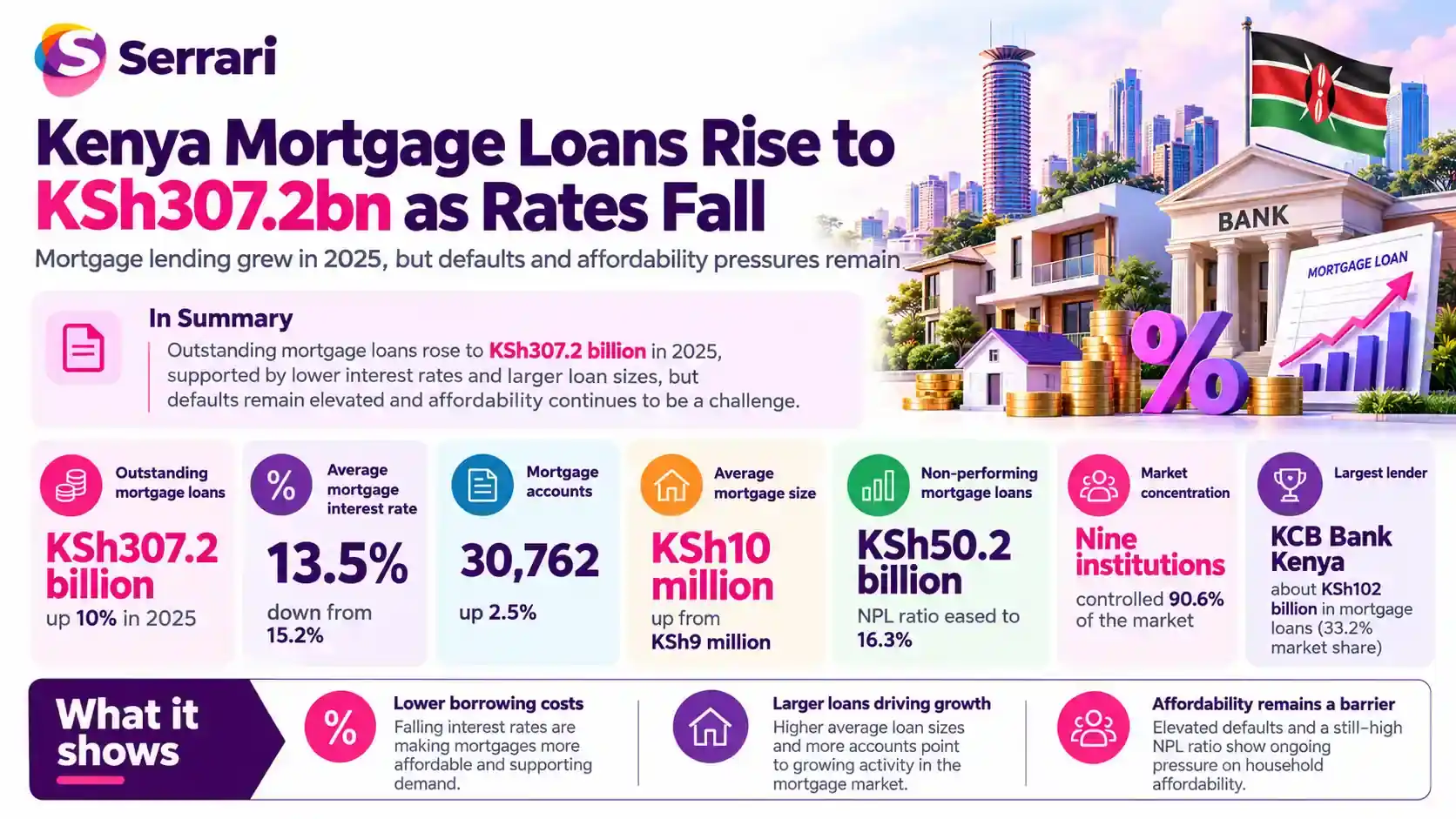
Kenya’s residential mortgage market expanded strongly in 2025, with outstanding mortgage loans rising 10% to KSh307.2 billion from KSh279.3 billion a year earlier.
The growth came as average mortgage interest rates declined and banks increased the use of fixed-rate loans. However, stress remained visible in the market, with the value of non-performing mortgage loans rising to KSh50.2 billion and affordability challenges continuing to limit broader access to home financing.
Key Overview
- Outstanding mortgage loans rose 10% to KSh307.2 billion in 2025.
- The average mortgage interest rate fell to 13.5% from 15.2% in 2024.
- Mortgage accounts increased only 2.5% to 30,762, showing that much of the market growth came from larger loan values.
- The average mortgage size increased to KSh10 million from KSh9 million.
- Non-performing mortgage loans rose to KSh50.2 billion, although the NPL ratio eased slightly to 16.3%.
- Nine institutions controlled 90.6% of the mortgage market, underlining the sector’s high concentration.
Mortgage Lending Expands as Borrowing Costs Ease
Kenya’s mortgage market recorded one of its strongest recent expansions in 2025, with the value of outstanding mortgage loans rising to KSh307.2 billion.
That represented an increase of KSh27.9 billion from KSh279.3 billion in December 2024. The increase was mainly driven by new mortgage loans issued during the year.
Borrowing conditions also improved. The average mortgage interest rate fell to 13.5% from 15.2% in 2024, while the range of mortgage rates narrowed to between 7.5% and 19.6%, compared with 8.2% to 20.4% a year earlier.
Banks also shifted more lending toward fixed-rate mortgages. Fixed-rate facilities accounted for 24.3% of mortgage loans in December 2025, up sharply from 14.1% a year earlier, while variable-rate loans declined to 75.6% from 85.9%.
Bigger Loans Drive Most of the Market Growth
The number of mortgage accounts grew much more slowly than the total value of lending.
Mortgage accounts increased by just 746, or 2.5%, to 30,762 in December 2025 from 30,016 a year earlier. At the same time, the average mortgage loan size increased to KSh10 million from KSh9 million.
This suggests that the expansion in the mortgage book was driven more by higher loan values than by a significant increase in the number of households taking mortgages.
Average loan maturity also lengthened to 11.5 years from 11.1 years, with mortgage tenors ranging from 5.7 years to 18 years. Longer repayment periods can reduce monthly instalments, although borrowers may still face substantial total interest costs over the life of a loan.
Context is everything. Stay ahead of shifting trends with today’s market updates, and uncover emerging opportunities using the Serrari Group Market Index and Marketplace. Then, take control of your own financial future by exploring our Money & Life Reset Transformation Blueprint ™ to build stronger habits, create better systems, and design a path toward lasting wealth.
Mortgage Defaults Remain a Major Risk
Despite lower average interest rates, mortgage asset quality remained under pressure.
The value of non-performing mortgage loans increased to KSh50.2 billion from KSh46.0 billion in 2024.
The mortgage NPL ratio nevertheless eased slightly to 16.3% from 16.5%, largely because the overall mortgage book expanded faster than bad loans. The ratio remained slightly above the banking industry’s overall gross non-performing loan ratio of 16.0% at the end of 2025.
The number of mortgage accounts classified as non-performing also rose sharply to 8,916 from 4,332, showing that repayment stress affected a much larger number of accounts even as the headline NPL ratio edged lower.
KCB Retains a Dominant Market Position
Kenya’s mortgage market remains heavily concentrated among a small group of lenders.
Nine institutions accounted for 90.6% of all mortgage lending in December 2025. Seven large banks controlled 77.4% of the market, while two medium-sized lenders accounted for another 13.2%.
KCB Bank Kenya remained the largest mortgage lender, with its mortgage portfolio rising to about KSh102 billion from KSh91.5 billion a year earlier. Its market share increased to 33.2%.
Absa and Stanbic followed with mortgage books of about KSh33.6 billion and KSh33.4 billion respectively.
Affordability Still Limits Wider Mortgage Access
Lower mortgage rates have improved financing conditions, but structural obstacles continue to restrict market growth.
Banks identified low household incomes, high property prices and limited access to affordable long-term finance among the biggest barriers facing the mortgage market. High land prices, property registration difficulties and transaction costs such as legal fees, valuation fees and stamp duty also remain major constraints.
The data therefore presents a mixed picture. Kenya’s mortgage market is expanding and borrowing costs have eased, but the relatively small increase in mortgage accounts shows that home financing remains inaccessible to many households.
Further growth will depend not only on lower interest rates but also on improving housing affordability, household incomes and access to longer-term funding.
Sources: Central Bank of Kenya / Standard Media / Sacco Review
Your financial future isn’t something you wait for—it’s something you build.
The real question is: when do you begin?
Move beyond simply staying informed.
Navigate the markets with clarity—track trends through the Serrari Group Market Index, uncover opportunities in the Serrari Marketplace, and build practical knowledge with our Curated Wealth Builder Platform.
Stay connected to what truly matters.
Get daily insights on macro trends and financial movements across Kenya, Africa, and global markets—delivered through the Serrari Newsletter.
Growth opens doors.
Advance your career through professional programs including ACCA, HESI A2, ATI TEAS 7 , HESI EXIT , NCLEX – RN and NCLEX – PN, Financial Literacy!🌟—designed to move you forward with confidence.
See where money is flowing—clearly and in real time.
Track Money Market Funds, Treasury Bills, Treasury Bonds, Green Bonds, and Fixed Deposits, alongside global and African indexes, key economic indicators, and the evolving Crypto and stablecoin landscape—all within Serrari’s Market Index.