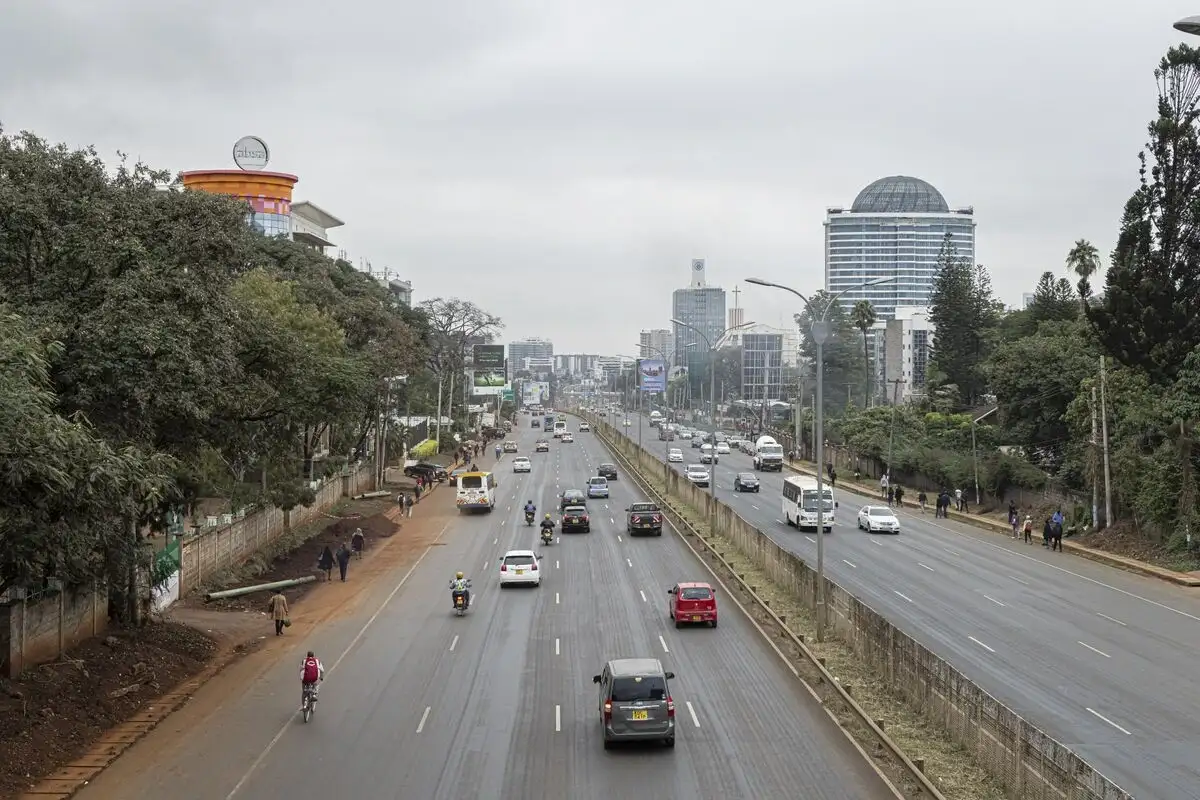
Kenya is exploring alternative ways to finance road maintenance as growing electric vehicle (EV) adoption is expected to reduce revenue from the Road Maintenance Levy Fund (RMLF). The current levy of KES 25 per litre is collected on petrol and diesel, meaning vehicles that do not use these fuels contribute less through the existing system despite using the road network.
The National Electric Mobility Policy projects that, without alternative funding mechanisms, the road maintenance financing gap could exceed KES 17 billion by 2033 and reach approximately KES 90 billion by 2043. The government is studying options including annual road licence fees, insurance-linked levies and distance-based road-use charges. These remain proposals, with no final structure or implementation date announced.
Key Takeaways
- Kenya is reviewing road maintenance funding as EV adoption reduces reliance on petrol and diesel.
- The current Road Maintenance Levy is KES 25 per litre of fuel.
- Policy projections indicate a potential funding gap exceeding KES 17 billion by 2033 and around KES 90 billion by 2043 without alternatives.
- Options under consideration include annual road licence fees, insurance-linked levies and distance-based charging.
- No replacement system has been approved, and the government is still studying the implications of EV uptake.
Why Kenya Is Rethinking Road Funding
Kenya’s road maintenance system is largely financed through the Road Maintenance Levy Fund, which collects KES 25 for every litre of petrol and diesel sold. The levy is included in the pump price, linking road funding to fuel purchases.
That model becomes less reliable as more motorists switch to electric vehicles. EVs use roads but do not buy petrol or diesel, so they do not contribute to the levy in the same way as conventional vehicles. As adoption grows, the connection between road use and fuel consumption weakens.
On 3 November 2026, the State Department for Roads confirmed that the government was exploring alternative financing mechanisms in response to this challenge. Kenya has over 35,000 electric vehicles, according to the source reports, and the number is expected to increase.
The issue is not simply that EVs are becoming more common. It is that the existing funding mechanism is tied to a type of energy consumption that EVs avoid. Unless the system changes, road maintenance revenue could become increasingly misaligned with the vehicles using the network.
The Projected Funding Gap
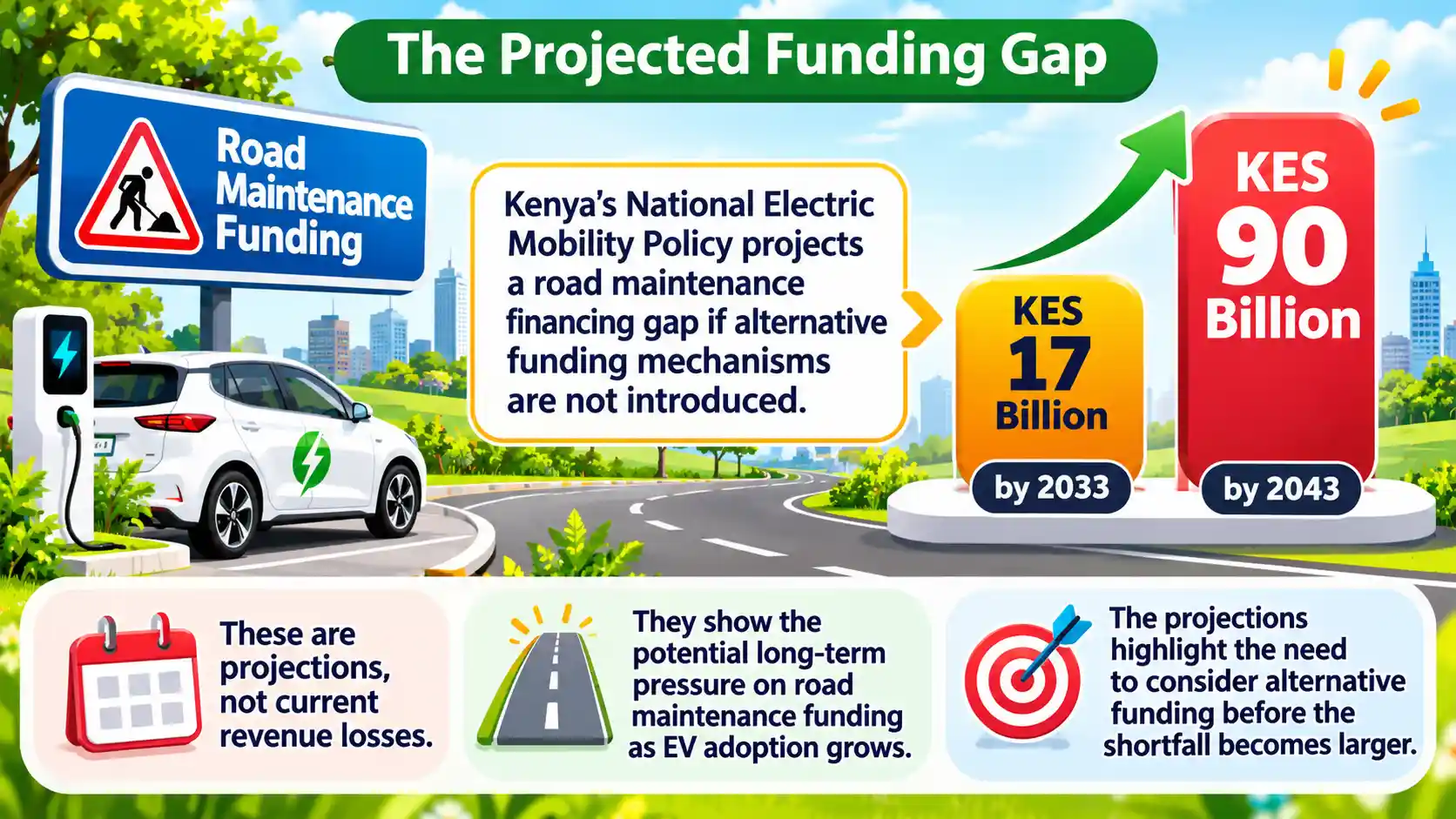
The National Electric Mobility Policy estimates that Kenya could face a road maintenance financing gap of more than KES 17 billion by 2033 and approximately KES 90 billion by 2043 if alternative funding mechanisms are not introduced.
These figures are projections, not current revenue losses. They illustrate the potential long-term pressure on road maintenance funding if EV adoption continues while the levy system remains unchanged.
The projections also highlight the timing of the policy challenge. The government is considering alternatives before the potential shortfall becomes substantially larger, rather than waiting until the existing funding model is under greater strain.
Funding Models Under Consideration
Kenya Roads Board has previously identified several possible approaches to broadening road maintenance funding. The options remain under consideration and have not been adopted.
Annual Road Licence Fees
Reinstating an annual road licence fee could provide a funding stream that is not directly dependent on fuel consumption. Such a fee could potentially apply to vehicles regardless of whether they use petrol, diesel or electricity.
However, the source reports do not specify how a fee would be calculated, which vehicles would be covered, or how the proceeds would be allocated.
Insurance-Linked Levies
Another option is to link a road contribution to vehicle insurance. The Kenya Roads Board has previously suggested that an insurance-related contribution could help support infrastructure repair, including damage associated with road crashes.
The potential design of such a levy—including its rate, collection process and coverage—has not been announced.
Distance-Based Road-Use Charging
A distance-based charging would connect road funding more directly to how much a vehicle travels. In January 2026, the Kenya Roads Board indicated that such a model could account for EVs that use roads without purchasing fuel.
This approach could reduce the dependence of road funding on fuel consumption. However, the available reports do not establish how distance would be measured, what rates might apply, or whether the system would cover all vehicles or only selected categories.
Context is everything. Stay ahead of shifting trends with today’s market updates, and uncover emerging opportunities using the Serrari Group Market Index and Marketplace. Then, take control of your own financial future by exploring our Money & Life Reset Transformation Blueprint ™ to build stronger habits, create better systems, and design a path toward lasting wealth.
Road Funding Pressures Extend Beyond EV Adoption
The EV-related funding challenge is emerging alongside broader pressures in Kenya’s road sector.
As of June 2026, gross pending contractor bills stood at KES 98.17 billion. The reports also state that KES 208.6 billion had been disbursed through a securitisation framework for road development and contractor obligations.
These figures relate to wider road-sector financing and obligations; they should not be interpreted as losses from the fuel levy or as amounts caused by EV adoption. They nevertheless show why the sustainability and reliability of road funding are important policy concerns.
The government is studying EV impacts with the World Resources Institute as it considers how the road financing system may need to evolve.
The Bigger Picture: Connecting Road Funding to Road Use
Kenya’s review reflects a broader policy question: how should governments fund public infrastructure when the technology used by the public changes?
A fuel-based levy is relatively straightforward when most vehicles rely on petrol or diesel. But as electric mobility expands, the levy may collect less from a growing share of road users. Alternative approaches could shift the basis of contributions from fuel purchases toward vehicle ownership, insurance or actual road use.
Each option involves trade-offs. Annual fees may be simpler to administer but may not reflect how much a vehicle uses the roads. Insurance-linked charges could use an existing payment channel, but their design would determine how fairly costs are distributed. Distance-based charging could more closely reflect road use, while requiring a reliable measurement and collection system.
The government has not yet selected a model, so the eventual policy and its implications for motorists remain uncertain.
Outlook
Kenya is still at the exploratory stage of reforming road maintenance financing. The government has confirmed that it is considering alternatives, but it has not announced a final mechanism, charge amount or implementation timeline.
The key issue to watch is whether the eventual framework can maintain stable road maintenance funding while treating different vehicle technologies fairly. With EV adoption expected to grow and policy projections pointing to a widening funding gap, the decisions made now could shape how Kenya finances its road network over the coming decades.
FAQs
Why is Kenya considering alternative road maintenance funding?
Because the current Road Maintenance Levy depends on petrol and diesel consumption. As more vehicles become electric, a growing share of road users may contribute less through the existing levy.
How much is Kenya’s current Road Maintenance Levy?
The levy is KES 25 per litre of petrol and diesel and is included in the pump price.
How large could the road maintenance funding gap become?
The National Electric Mobility Policy projects a potential gap of more than KES 17 billion by 2033 and approximately KES 90 billion by 2043 if alternatives are not introduced.
What funding alternatives are being considered?
Options previously identified include annual road licence fees, insurance-linked levies and distance-based road-use charges. None has been confirmed as the final replacement.
Has Kenya approved a new road-use charge for EVs?
No. The government is exploring options, and no final structure, charge or implementation date has been announced.
Your financial future isn’t something you wait for—it’s something you build.
The real question is: when do you begin?
Move beyond simply staying informed.
Navigate the markets with clarity—track trends through the Serrari Group Market Index, uncover opportunities in the Serrari Marketplace, and build practical knowledge with our Curated Wealth Builder Platform.
Stay connected to what truly matters.
Get daily insights on macro trends and financial movements across Kenya, Africa, and global markets—delivered through the Serrari Newsletter.
Growth opens doors.
Advance your career through professional programs including ACCA, HESI A2, ATI TEAS 7 , HESI EXIT , NCLEX – RN and NCLEX – PN, Financial Literacy!🌟—designed to move you forward with confidence.
See where money is flowing—clearly and in real time.
Track Money Market Funds, Treasury Bills, Treasury Bonds, Green Bonds, and Fixed Deposits, alongside global and African indexes, key economic indicators, and the evolving Crypto and stablecoin landscape—all within Serrari’s Market Index.