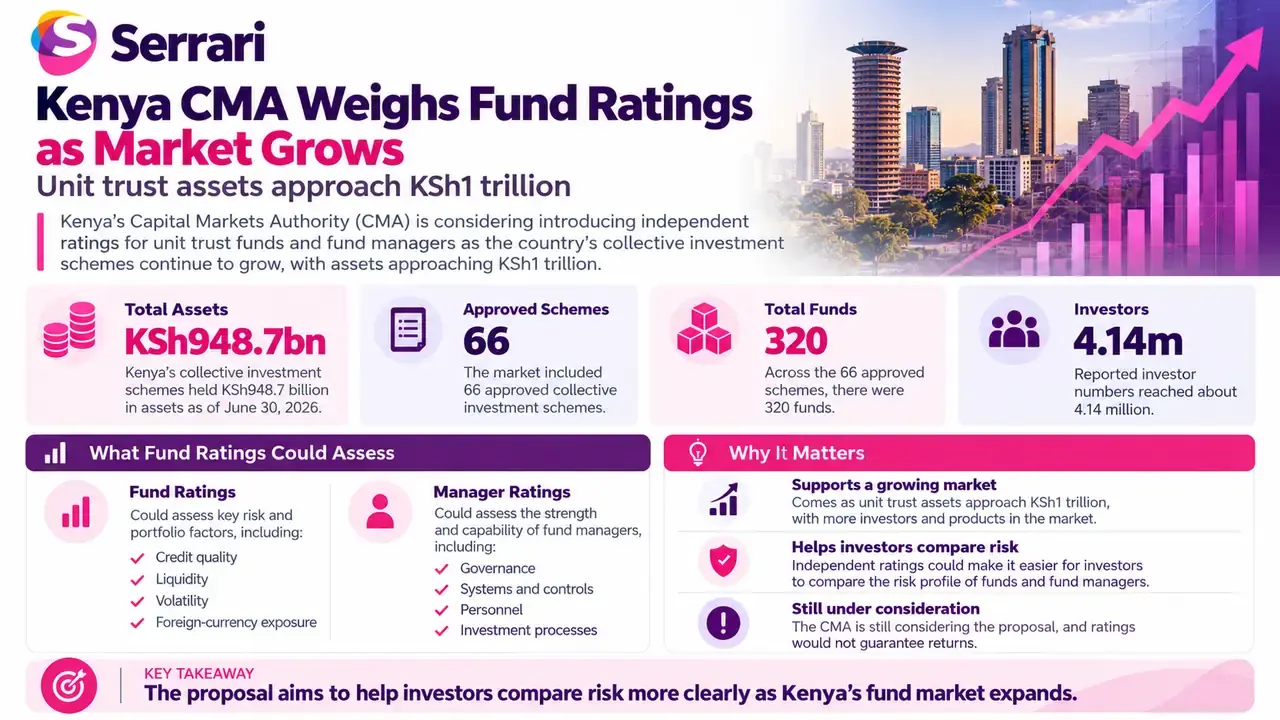
Kenya’s Capital Markets Authority (CMA) is considering independent risk ratings for unit trust funds and their managers as the collective investment schemes market approaches KSh1 trillion in assets. The ratings proposal under consideration aims to help investors understand what lies behind advertised investment returns, particularly when comparing money market funds and more complex products.
As of June 30, 2026, the industry managed KSh948.7 billion, spread across 66 approved schemes and 320 funds, with approximately 4.14 million reported investors. These figures describe the market at the end of June, not a confirmed KSh1 trillion milestone. No mandatory rating requirement has yet been announced.
Key Overview
- Industry size: Unit trusts held KSh948.7 billion in assets at the end of June 2026, up from KSh851.7 billion in March.
- Investor participation: About 4.14 million investors were reported across the collective investment schemes market.
- Funds covered: The 320 funds span money market, fixed-income, special, equity and balanced investments; they are not all money market funds.
- Proposed assessments: Fund ratings could examine credit quality, liquidity and currency exposure, while manager ratings would assess investment processes and governance.
- Current position: Ratings are being considered as an additional safeguard; they would not guarantee an investor’s capital or returns.
Why Kenya Is Considering Unit Trust Ratings
CMA chief executive Wycliffe Shamiah has highlighted frequent investor questions about whether particular funds are safe and whether the information disclosed by managers can be trusted. The regulator has also raised concerns about marketing claims involving unrealistic returns, making independent analysis a possible addition to existing disclosure requirements.
A fund advertising a higher yield is not necessarily less risky or more suitable than its competitors. Investors also need to understand where the fund invests, how quickly investments can be converted to cash and whether losses could occur under difficult market conditions. The proposed ratings could help turn those technical considerations into more accessible comparisons.
What Would Fund and Manager Ratings Measure?
Fund ratings would focus on the investment portfolio itself. Relevant factors include the creditworthiness of borrowers, exposure to particular issuers, fluctuations in returns, foreign-currency movements and the ability to meet withdrawal requests. For specialised funds, assessments may also consider concentrated investments, borrowing and the cash flows supporting underlying assets.
Investment manager ratings would instead examine the organisation responsible for making decisions. These reviews could cover staff expertise, internal controls, investment procedures, risk management and corporate governance. A capable manager and a relatively risky fund are not mutually exclusive, so the two ratings would answer different questions.
Industry representatives have supported ratings as a complement to professional due diligence, rather than a replacement for fund managers’ responsibilities or regulatory supervision.
Context is everything. Stay ahead of shifting trends with today’s market updates, and uncover emerging opportunities using the Serrari Group Market Index and Marketplace. Then, take control of your own financial future by exploring our Money & Life Reset Transformation Blueprint ™ to build stronger habits, create better systems, and design a path toward lasting wealth.
Rapid Growth Makes Clearer Risk Information Important
The June 2026 industry breakdown shows money market funds holding approximately KSh459.9 billion, equivalent to 48.5% of collective investment scheme assets. Special funds held around KSh252.8 billion, or 26.6%, while fixed-income funds accounted for about KSh228.1 billion, or 24.0%.
The figures illustrate why investors need more than a single yield ranking. A conventional money market fund holding short-term debt has a different risk profile from a special fund with offshore investments, concentrated positions or exposure to market volatility. Even within the same category, fees, portfolio composition and redemption arrangements can differ.
Industry assets increased by approximately 11.4% during the second quarter of 2026. As more Kenyans access professionally managed funds, clear explanations of potential losses and withdrawal restrictions become increasingly important.
Will Ratings Be Mandatory for Kenyan Funds?
A final framework has not been published, leaving open whether assessments would be compulsory or voluntary and which funds would be covered. The regulator is examining international approaches: Nigeria uses external ratings in parts of its fund industry, while the United States relies substantially on portfolio-quality and risk-management requirements. U.S. money market rules removed compulsory reliance on external credit ratings in favour of credit-risk assessments by funds themselves.
Any Kenyan framework would also need to address rating costs, independence, frequency of review and how results are communicated to retail investors. A favourable rating would not insure deposits, guarantee returns or eliminate investment losses. Until concrete rules are issued, investors should continue evaluating a fund’s licence status, disclosures, fees, investment portfolio and withdrawal terms rather than relying on advertised yield alone.
Sources: Business Daily / TechTrendsKE / Cytonn Research / U.S. Securities and Exchange Commission
Your financial future isn’t something you wait for—it’s something you build.
The real question is: when do you begin?
Move beyond simply staying informed.
Navigate the markets with clarity—track trends through the Serrari Group Market Index, uncover opportunities in the Serrari Marketplace, and build practical knowledge with our Curated Wealth Builder Platform.
Stay connected to what truly matters.
Get daily insights on macro trends and financial movements across Kenya, Africa, and global markets—delivered through the Serrari Newsletter.
Growth opens doors.
Advance your career through professional programs including ACCA, HESI A2, ATI TEAS 7 , HESI EXIT , NCLEX – RN and NCLEX – PN, Financial Literacy!🌟—designed to move you forward with confidence.
See where money is flowing—clearly and in real time.
Track Money Market Funds, Treasury Bills, Treasury Bonds, Green Bonds, and Fixed Deposits, alongside global and African indexes, key economic indicators, and the evolving Crypto and stablecoin landscape—all within Serrari’s Market Index.