Kenya’s Cabinet has approved a fuel transit agreement allowing Rwanda to import 40,000 metric tonnes of petroleum products through the Port of Mombasa and Kenya’s pipeline network. The deal is expected to enhance Rwanda’s energy security while reinforcing Kenya’s position as East Africa’s leading petroleum transit hub.
Key Overview
- Kenya approved Rwanda’s fuel transit through Mombasa and its pipeline network.
- The agreement covers 40,000 metric tonnes (about 52 million liters) of fuel.
- Rwanda’s first shipment is expected between September 4 and 6, 2026.
- The deal strengthens regional trade and energy security.
- Rwanda’s annual petroleum imports through the Northern Corridor are expected to exceed 500,000 cubic meters.
Kenya Clears Fuel Transit Deal for Rwanda
Kenya’s Cabinet has approved an agreement allowing Rwanda to transport 40,000 metric tonnes of fuel through the Port of Mombasa and Kenya’s petroleum pipeline network, reinforcing regional trade and cross-border energy cooperation.
The decision was announced by Prime Cabinet Secretary and Cabinet Secretary for Foreign and Diaspora Affairs Musalia Mudavadi following bilateral talks with Rwanda’s Minister of Foreign Affairs and International Cooperation, Olivier Jean Nduhungirehe, in Addis Ababa.
The arrangement will enable Rwanda, a landlocked country, to channel a significant share of its fuel imports through Mombasa before the products are transported inland using Kenya’s pipeline infrastructure.
Boosting Regional Energy Security
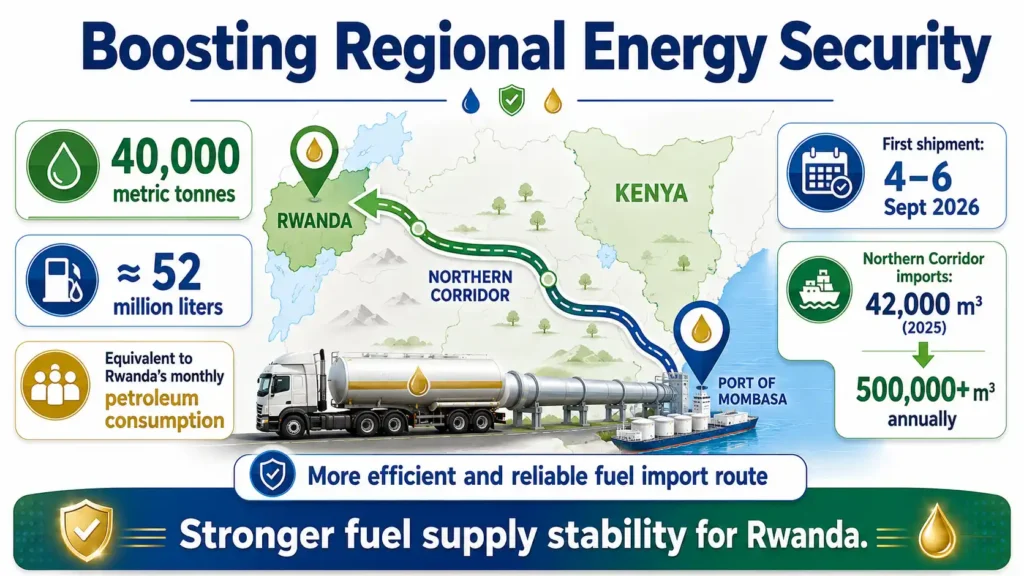
The agreement is expected to strengthen Rwanda’s fuel supply by providing a more efficient and reliable import route through the Northern Corridor.
According to Rwanda’s Foreign Minister, the approved shipment of approximately 52 million litres of fuel is equivalent to the country’s monthly petroleum consumption, helping improve supply stability and reduce the risk of fuel shortages.
The first shipment under the agreement, identified as RNEC 001/2026, is scheduled to arrive at the Port of Mombasa between September 4 and September 6, 2026.
Under the new framework, Rwanda’s annual petroleum imports through the Northern Corridor are expected to increase significantly from around 42,000 cubic metres in 2025 to more than 500,000 cubic metres.
Strengthening Kenya’s Role as a Regional Hub
The approval further reinforces Kenya’s position as East Africa’s leading petroleum transit hub by increasing the utilization of the Port of Mombasa and the country’s pipeline infrastructure.
Mudavadi said the Cabinet’s decision reflects Kenya’s commitment to promoting regional integration, expanding trade and strengthening economic cooperation with neighboring countries.
By facilitating fuel transit to Rwanda, Kenya expects to enhance the efficiency of its logistics infrastructure while supporting regional economic growth through increased cross-border commerce.
Context is everything. Stay ahead of shifting trends with today’s market updates, and uncover emerging opportunities using the Serrari Group Market Index and Marketplace. Then, take control of your own financial future by exploring our Money & Life Reset Transformation Blueprint ™ to build stronger habits, create better systems, and design a path toward lasting wealth.
Supporting Regional Integration
The agreement forms part of broader efforts by Kenya and Rwanda to deepen bilateral relations and strengthen regional collaboration.
Beyond energy cooperation, the two governments reaffirmed their commitment to expanding partnerships in areas of mutual economic and diplomatic interest.
Mudavadi also sought Rwanda’s support for Kenya’s candidates seeking election to the International Court of Justice (ICJ) and the International Criminal Court (ICC), highlighting Nairobi’s continued efforts to strengthen African representation in international institutions.
Economic Benefits for Both Countries
For Rwanda, the arrangement provides greater certainty over fuel imports, an important consideration for a landlocked economy that depends heavily on regional transport corridors to receive petroleum products and other essential goods. A more reliable supply route is expected to improve fuel availability, reduce the risk of supply disruptions and support key sectors of the economy that rely on stable energy access, including transportation, manufacturing and agriculture.
For Kenya, increased fuel transit volumes are expected to boost activity at the Port of Mombasa, improve utilization of the national pipeline system and reinforce the country’s position as East Africa’s leading logistics and energy distribution hub. Higher cargo throughput could also generate additional revenue for port operations, pipeline services and related transport businesses while strengthening Kenya’s role in facilitating regional trade. The agreement further supports the broader objectives of the East African Community (EAC) by improving regional connectivity, promoting cross-border commerce and enhancing energy security among member states through the efficient use of shared infrastructure.
Outlook
The fuel transit agreement represents another milestone in the growing economic partnership between Kenya and Rwanda and underscores the strategic importance of regional infrastructure in driving trade and development. As fuel volumes transported through the Northern Corridor continue to increase, Kenya is well positioned to strengthen its role as East Africa’s primary petroleum gateway while Rwanda benefits from a more secure, efficient and cost-effective fuel supply chain. The arrangement also demonstrates how regional cooperation can improve energy security, optimize existing transport infrastructure and support long-term economic integration within the East African Community. If successfully implemented, the framework could serve as a model for similar cross-border energy and logistics partnerships with other landlocked countries, further cementing Kenya’s status as the region’s preferred trade and energy transit hub.
Frequently Asked Questions (FAQs)
1. How much fuel will Rwanda import through Kenya?
The agreement covers 40,000 metric tonnes, equivalent to approximately 52 million liters of fuel.
2. When will the first shipment arrive?
The first consignment is expected to arrive at the Port of Mombasa between September 4 and September 6, 2026.
3. Why is the agreement important for Rwanda?
It provides a more reliable fuel import route, improving energy security for a landlocked country that relies on regional transport corridors.
4. How does Kenya benefit from the deal?
The agreement increases the use of the Port of Mombasa and Kenya’s pipeline infrastructure, strengthening the country’s position as East Africa’s leading petroleum transit hub.
Sources: The Eastleigh Voice, The Star, AE News, The Kenyan Diaspora Media, Capital FM Kenya
Your financial future isn’t something you wait for—it’s something you build.
The real question is: when do you begin?
Move beyond simply staying informed.
Navigate the markets with clarity—track trends through the Serrari Group Market Index, uncover opportunities in the Serrari Marketplace, and build practical knowledge with our Curated Wealth Builder Platform.
Stay connected to what truly matters.
Get daily insights on macro trends and financial movements across Kenya, Africa, and global markets—delivered through the Serrari Newsletter.
Growth opens doors.
Advance your career through professional programs including ACCA, HESI A2, ATI TEAS 7 , HESI EXIT , NCLEX – RN and NCLEX – PN, Financial Literacy!🌟—designed to move you forward with confidence.
See where money is flowing—clearly and in real time.
Track Money Market Funds, Treasury Bills, Treasury Bonds, Green Bonds, and Fixed Deposits, alongside global and African indexes, key economic indicators, and the evolving Crypto and stablecoin landscape—all within Serrari’s Market Index.