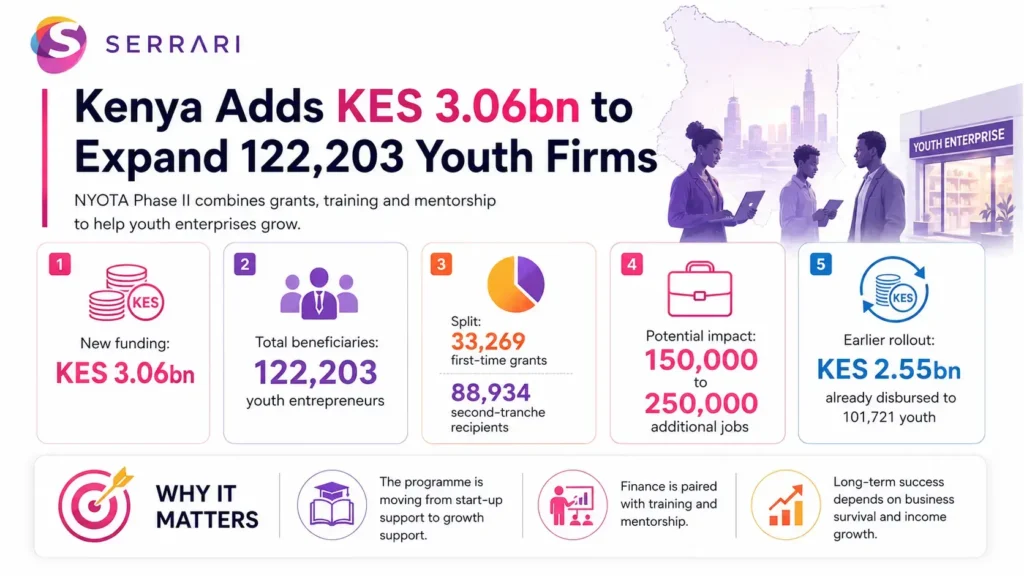
Kenya and the World Bank are preparing to inject an additional KES 3.06 billion into 122,203 youth entrepreneurs under the second phase of the National Youth Opportunities Towards Advancement programme.
The new NYOTA funding round will combine support for first-time beneficiaries with a second tranche for businesses already operating under the programme, shifting more attention from business creation toward enterprise growth and job expansion.
Key Overview
- KES 3.06 billion is earmarked for 122,203 young entrepreneurs under NYOTA Phase II.
- 33,269 beneficiaries are expected to receive first-time business grants.
- 88,934 continuing entrepreneurs are set to receive a second tranche.
- The programme follows earlier nationwide disbursements to more than 100,000 young people.
- Officials estimate the expanded businesses could create 150,000 to 250,000 additional jobs.
- NYOTA combines finance with training, mentorship and links to further funding.
Phase II Shifts Focus From Start-Ups to Growth
The latest phase represents a change in emphasis for the youth enterprise programme.
Of the 122,203 entrepreneurs expected to benefit, 33,269 are first-time recipients, while 88,934 are continuing participants who will receive additional funding to strengthen businesses already launched under NYOTA.
That structure means most of the new capital will support enterprises that have already passed through the programme rather than only financing new start-ups.
The approach reflects a common challenge in youth entrepreneurship programmes: getting a business started is only the first step, while survival, growth and job creation often require follow-on capital and continued support.
Officials say the national rollout will begin in the North Eastern region before expanding to other parts of the country, including Western Kenya, the Rift Valley and the Coast.
Earlier Funding Reached More Than 100,000 Youth
The new allocation builds on a large first nationwide cohort.
According to the programme’s official update, NYOTA had already disbursed KES 2.55 billion in start-up capital to 101,721 young beneficiaries across all 47 counties.
Participants were expected to receive funding in stages, with structured mentorship and business development support attached to the grants.
The programme says beneficiaries operate businesses ranging from food kiosks, grocery shops and salons to fishing enterprises, mechanical workshops and boda boda operations.
Before the latest phase, more than 91,000 participants had completed business development training, while over 90,000 had gone through structured mentorship programmes.
Officials also reported that 96% of beneficiaries had established operating businesses by the end of the first mentorship cycle, although the long-term durability and profitability of those firms will remain the more important measure of success.
Context is everything. Stay ahead of shifting trends with today’s market updates, and uncover emerging opportunities using the Serrari Group Market Index and Marketplace. Then, take control of your own financial future by exploring our Money & Life Reset Transformation Blueprint ™ to build stronger habits, create better systems, and design a path toward lasting wealth.
Job Creation Target Raises the Stakes
The expanded programme is expected to support more than the entrepreneurs receiving grants directly.
Officials estimate that business growth under the second phase could help create between 150,000 and 250,000 additional jobs.
That target is ambitious but not without precedent. An earlier World Bank-supported youth programme in Kenya combined training, entrepreneurship support and work experience and created 155,000 direct and indirect jobs.
The same assessment found that beneficiaries of the earlier Kenya Youth Employment and Opportunities Project recorded stronger employment and earnings outcomes after participation.
NYOTA is designed as a larger successor programme, combining business grants with employability support, on-the-job experience, savings measures and links to other financing channels.
Finance Alone Will Not Determine Success
The KES 3.06 billion injection addresses one of the biggest barriers facing young entrepreneurs: access to capital.
But the effectiveness of the programme will depend on whether recipients can turn relatively small grants into durable businesses with stable revenues.
Kenya’s employment challenge is not only the absence of work. A large share of young people depend on informal jobs that often offer low and unstable incomes. The World Bank has noted that many young Kenyans remain concentrated in informal, low-quality employment, making business productivity and survival as important as the number of enterprises created.
That is why training and mentorship matter. The programme plans to combine financing with business development services and links to institutions such as the Youth Enterprise Development Fund, Uwezo Fund and Kenya Industrial Estates.
Officials also plan to reduce barriers involving permits and licences and introduce a unique identity for NYOTA entrepreneurs to improve access to targeted government support.
The Real Test Will Be Business Survival
The scale of Phase II makes NYOTA one of Kenya’s largest current youth enterprise interventions.
The immediate numbers are substantial: KES 3.06 billion, more than 122,000 entrepreneurs and a potential quarter-million additional jobs.
The longer-term test, however, will be whether those businesses survive after the grants are spent, increase incomes and create lasting employment.
If follow-on financing, mentorship and market access work together effectively, the programme could strengthen thousands of small enterprises. If not, the headline disbursement figures may prove easier to achieve than sustainable job creation.
Sources used: Kenyans.co.ke / NYOTA Project / World Bank
Your financial future isn’t something you wait for—it’s something you build.
The real question is: when do you begin?
Move beyond simply staying informed.
Navigate the markets with clarity—track trends through the Serrari Group Market Index, uncover opportunities in the Serrari Marketplace, and build practical knowledge with our Curated Wealth Builder Platform.
Stay connected to what truly matters.
Get daily insights on macro trends and financial movements across Kenya, Africa, and global markets—delivered through the Serrari Newsletter.
Growth opens doors.
Advance your career through professional programs including ACCA, HESI A2, ATI TEAS 7 , HESI EXIT , NCLEX – RN and NCLEX – PN, Financial Literacy!🌟—designed to move you forward with confidence.
See where money is flowing—clearly and in real time.
Track Money Market Funds, Treasury Bills, Treasury Bonds, Green Bonds, and Fixed Deposits, alongside global and African indexes, key economic indicators, and the evolving Crypto and stablecoin landscape—all within Serrari’s Market Index.