The Amazon bond sale will raise at least $25 billion through an eight-part issuance as the technology giant continues funding its massive artificial intelligence expansion. The transaction highlights growing reliance on the corporate bond market for debt financing, with investment-grade bonds supporting one of the largest AI infrastructure investment programmes in the technology sector.
Key Overview
- Amazon plans a $25 billion bond sale.
- Eight bond tranches will be issued.
- Proceeds support AI infrastructure spending.
- Capital expenditure targets $200 billion.
- Bonds mature between 2029 and 2066.
- Demand remained below previous offerings.
- Big Tech increasingly relies on debt financing.
- Investment-grade issuance remains active.
Amazon Bond Sale Tops $25 Billion as AI Spending Accelerates
Amazon is returning to global debt markets with another major Amazon bond sale, seeking to raise at least $25 billion through an eight-part issuance as it accelerates investment in artificial intelligence infrastructure. The offering adds to an already record-breaking year of fundraising for the technology giant, reflecting how leading technology companies are increasingly relying on the corporate bond market to finance enormous AI-related capital expenditure.
The latest issuance comes as Amazon significantly expands investment in data centres, advanced chips, cloud computing infrastructure, and generative AI technologies.
Amazon Returns to Corporate Bond Market
According to sources familiar with the transaction, Amazon plans to raise at least $25 billion through eight separate bond tranches with maturities ranging from 2029 to 2066.
The offering includes both fixed-rate and floating-rate notes, providing flexibility for different categories of bond investors while allowing Amazon to diversify its financing across multiple maturities.
Barclays, Goldman Sachs, JPMorgan Chase, and Morgan Stanley are acting as joint book-running managers for the transaction.
The latest issuance follows a series of sizable debt offerings by Amazon throughout the year, making it one of the most active investment-grade borrowers in global capital markets.
Context is everything. Stay ahead of shifting trends with today’s market updates, and uncover emerging opportunities using the Serrari Group Market Index and Marketplace. Then, take control of your own financial future by exploring our Money & Life Reset Transformation Blueprint ™ to build stronger habits, create better systems, and design a path toward lasting wealth.
AI Investment Continues Driving Debt Financing
The Amazon bond sale is closely tied to the company’s aggressive investment strategy in artificial intelligence.
Amazon expects total capital expenditure to reach approximately US$200 billion during 2026, up substantially from US$131 billion in 2025.
Most of the spending is being directed toward expanding Amazon Web Services (AWS), constructing new data centres, purchasing advanced semiconductor chips, and building the computing infrastructure required to support next-generation AI applications.
Chief Executive Officer Andy Jassy has repeatedly described artificial intelligence as a “once-in-a-lifetime opportunity,” arguing that today’s heavy investment will generate long-term competitive advantages across Amazon’s cloud computing and digital services businesses.
Amazon’s Debt Issuance Reaches Record Levels
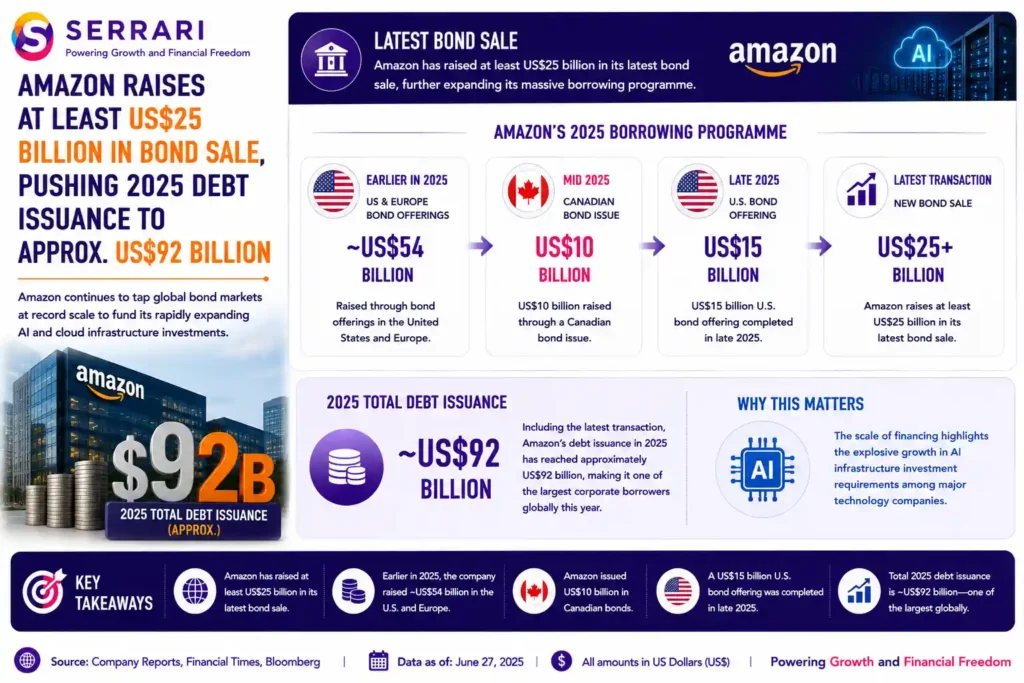
The latest transaction significantly expands Amazon’s already substantial borrowing programme.
Earlier this year, the company raised approximately US$54 billion through bond offerings in the United States and Europe, followed by a US$10 billion Canadian bond issue and a US$15 billion U.S. offering completed in late 2025.
Including the latest transaction, Amazon’s debt issuance this year has reached approximately US$92 billion, making it one of the largest corporate borrowers globally.
The scale of financing illustrates how rapidly AI infrastructure investment requirements have grown among major technology companies.
Bond Investors Show More Cautious Demand
Although the offering attracted significant investor interest, demand proved somewhat weaker than previous Amazon debt sales.
Peak orders reportedly reached around US$62 billion, representing approximately 2.5 times the size of the offering. While still heavily oversubscribed, this was lower than the roughly 3.2 times subscription level achieved during Amazon’s earlier bond sale this year.
To attract investors, Amazon offered slightly higher yields on several of its longer-dated bonds, providing an additional 18 to 21 basis points above initial pricing expectations.
The more moderate demand suggests some investors are becoming increasingly selective as technology companies continue issuing large volumes of new debt.
Corporate Bond Market Funds Big Tech Expansion
Amazon is far from alone in accessing capital markets to finance AI expansion.
Major technology companies including Nvidia, Oracle, Meta, and Alphabet have all raised substantial amounts through debt or equity offerings during the past year.
Combined AI investment by Amazon, Alphabet, Microsoft, and Meta is projected to exceed US$700 billion during 2026, making artificial intelligence one of the largest investment cycles ever undertaken by the technology sector.
The growing dependence on debt financing reflects the enormous capital required to build AI infrastructure capable of supporting future computing demand.
AI Spending Pressures Cash Flow
While Amazon continues generating strong operating cash flow, its accelerating investment programme has significantly reduced free cash flow.
During the first quarter of 2026, capital expenditure reached approximately US$43.2 billion, largely directed toward AWS infrastructure and generative AI projects.
Operating cash flow increased approximately 30% year-over-year to US$148.5 billion, demonstrating the strength of Amazon’s underlying business.
However, heavy investment in property, equipment, and computing infrastructure reduced trailing twelve-month free cash flow to approximately US$1.2 billion, compared with US$25.9 billion a year earlier.
The bond issuance helps finance these investments without placing excessive pressure on the company’s existing cash resources.
Investment-Grade Bonds Remain Attractive
Despite slightly softer investor demand, Amazon continues benefiting from its strong credit profile within the fixed income market.
Its investment-grade bonds remain attractive to institutional investors seeking exposure to high-quality corporate issuers with substantial operating cash flow and diversified global businesses.
The issuance also demonstrates that global capital markets remain willing to finance large-scale corporate investment programmes despite rising borrowing volumes across the technology sector.
As AI infrastructure investment continues expanding, investment-grade debt markets are expected to remain an important source of financing for major technology companies.
Conclusion
The latest Amazon bond sale underscores how artificial intelligence is reshaping both the technology industry and the corporate bond market. By raising at least US$25 billion through investment-grade bonds, Amazon continues positioning itself for long-term leadership in AI while relying on debt financing to support one of the largest infrastructure investment programmes in corporate history.
Although investor demand showed signs of moderation compared with previous offerings, the successful transaction highlights the continued ability of leading technology companies to access global capital markets as AI spending accelerates.
FAQs
1. Why is Amazon raising $25 billion through a bond sale?
Amazon is raising at least US$25 billion to help finance its rapidly expanding artificial intelligence infrastructure. The proceeds will support investment in data centres, cloud computing capacity, semiconductor chips, and other technology required to strengthen Amazon Web Services and its broader AI strategy while preserving financial flexibility.
2. What types of bonds are included in the Amazon bond sale?
The offering consists of eight tranches that include both fixed-rate and floating-rate investment-grade bonds. The securities mature between 2029 and 2066, giving institutional investors a range of duration options while allowing Amazon to diversify its long-term financing across multiple maturities.
3. Why are technology companies issuing more corporate bonds?
Technology companies are increasingly issuing corporate bonds because AI infrastructure requires enormous upfront capital investment. Rather than relying entirely on internal cash generation, companies such as Amazon, Meta, Oracle, Nvidia, and Alphabet are using debt financing to fund data centres, advanced computing equipment, and cloud infrastructure needed for artificial intelligence development.
4. What does the Amazon bond sale indicate about the corporate bond market?
The transaction demonstrates that investment-grade corporate bond markets continue providing substantial funding for high-quality issuers despite rising borrowing volumes. While investor demand was slightly weaker than Amazon’s previous offerings, the successful issuance shows that institutional investors remain willing to finance large-scale corporate investment programmes backed by strong operating cash flow and established credit profiles.
Your financial future isn’t something you wait for—it’s something you build.
The real question is: when do you begin?
Move beyond simply staying informed.
Navigate the markets with clarity—track trends through the Serrari Group Market Index, uncover opportunities in the Serrari Marketplace, and build practical knowledge with our Curated Wealth Builder Platform.
Stay connected to what truly matters.
Get daily insights on macro trends and financial movements across Kenya, Africa, and global markets—delivered through the Serrari Newsletter.
Growth opens doors.
Advance your career through professional programs including ACCA, HESI A2, ATI TEAS 7 , HESI EXIT , NCLEX – RN and NCLEX – PN, Financial Literacy!🌟—designed to move you forward with confidence.
See where money is flowing—clearly and in real time.
Track Money Market Funds, Treasury Bills, Treasury Bonds, Green Bonds, and Fixed Deposits, alongside global and African indexes, key economic indicators, and the evolving Crypto and stablecoin landscape—all within Serrari’s Market Index.