The Importance of Balancing Your Investment Portfolio
Diversify Wisely, Rebalance Regularly, Stay Financially Disciplined
Balancing and diversifying your investment portfolio is how disciplined Kenyan investors manage risk and grow wealth consistently. This guide covers every dimension of portfolio balance — from asset allocation and rebalancing mechanics to behavioural traps and cost-efficient strategies.
What You'll Learn
- A balanced portfolio spreads risk across asset classes, sectors, and geographies
- Portfolio drift is normal and inevitable — annual rebalancing corrects it
- Conservative, moderate, and aggressive profiles need different allocation mixes
- Dollar-cost averaging in Kenya reduces the risk of investing at a market peak
- Rebalancing costs on the NSE can be minimised by directing new contributions first
- Behavioural discipline matters as much as having the right asset allocation
Why Your Portfolio Will Always Need Balancing

The fundamental truth of investing is that no asset class performs well all the time. Equities outperform in bull markets but can lose 30-50% of their value in corrections. Government bonds provide stability but lose real value during high-inflation periods. Money Market Funds offer liquidity and consistent returns but cap your long-term growth potential. Real estate builds generational wealth but locks up capital for years.
This is not a problem to solve — it is a feature of markets to be managed. Because different assets respond differently to the same economic conditions, holding a mix of them produces a portfolio whose overall volatility is lower than any individual component. When NSE equities fall 25%, your government bonds and MMFs continue generating returns. When fixed-income yields compress during low-rate environments, your equity holdings compensate with capital growth.
Markets in Kenya move in response to: inflation and CBK policy rate decisions, economic growth cycles, government fiscal policy and budget announcements, company earnings and sectoral performance, global commodity prices (oil, coffee, tea), exchange rate movements, and regional political stability. You cannot predict which factor will dominate in any given month or year. But you CAN control how exposed you are to any single factor — and that is precisely what a balanced portfolio achieves.
The key insight is that balancing is not a defensive posture for cautious investors. It is the optimal strategy for ALL investors who have a time horizon longer than 3-5 years. Even aggressive, growth-focused Kenyan investors benefit from maintaining some fixed-income and money market exposure as a rebalancing reservoir — dry powder to deploy into equities when they are undervalued during corrections.
For the foundational understanding of investment instruments that a balanced portfolio draws from, see Understanding Investment Portfolios and Understanding Investments.
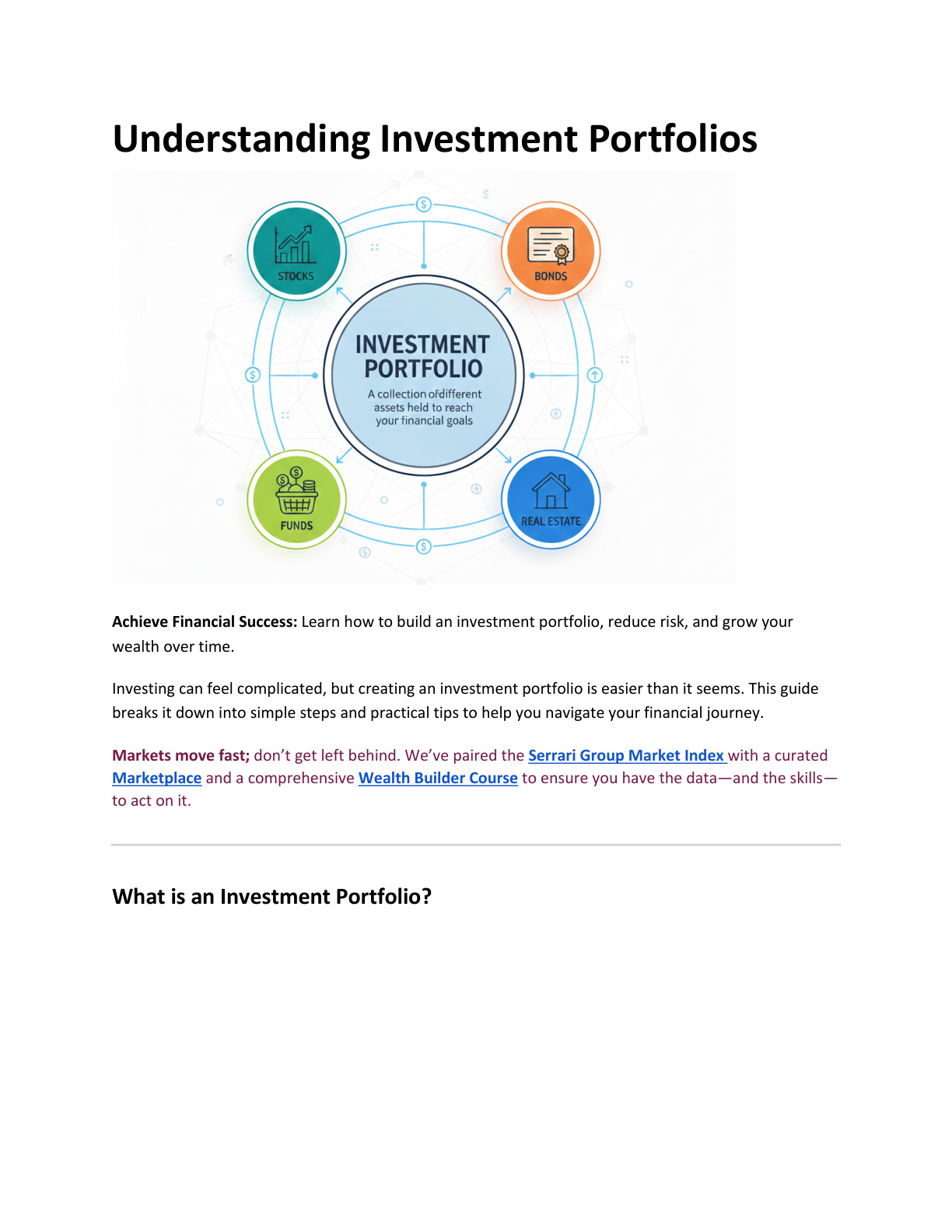
What Is a Balanced Portfolio — The Full Definition

A balanced portfolio is a deliberately constructed collection of assets whose proportions are chosen to match a specific investor's goals, risk tolerance, time horizon, and income needs. The word "balanced" does not mean 50/50 between equities and bonds — it means the portfolio is correctly calibrated for its purpose.
The four core elements of a balanced portfolio: (1) Growth assets that provide capital appreciation over time — primarily equities (NSE-listed shares, equity unit trusts, REITs) and real estate. These are higher-volatility instruments that reward patience over multi-year holding periods. (2) Income assets that generate regular cash flow — government bonds, corporate bonds, SACCO dividends, and infrastructure bonds. These anchor the portfolio and provide returns even when growth assets are in decline. (3) Liquidity assets that preserve capital and provide instant access — Money Market Funds and short-term T-bills. These are the portfolio's emergency stabiliser and rebalancing reservoir. (4) Alternative assets that provide diversification beyond traditional instruments — direct real estate, private equity, or dollar-denominated offshore holdings.
The balance between these four elements depends entirely on the investor's situation. A 28-year-old Nairobi professional with a 35-year investment horizon, no dependants, and a solid emergency fund is correctly "balanced" with 70-80% in growth assets. A 55-year-old approaching retirement with school fees obligations is correctly "balanced" with 30-40% in growth assets and 60-70% in income and liquidity assets. Both portfolios are "balanced" — not because they share the same allocation, but because both allocations are appropriate for their specific circumstances.
What makes a portfolio UNBALANCED: too much concentration in a single asset, company, sector, or geography; allocations that do not reflect the investor's actual time horizon; a mismatch between the portfolio's volatility and the investor's emotional capacity to withstand drawdowns; or neglect of rebalancing that allows drift far beyond the original design.
Apply the 50/30/20 Rule to ensure your monthly investment contributions are structurally consistent. Track your current allocation across all assets with the Net Worth Calculator.
The Three Investor Profiles in Kenya

Understanding which investor profile fits your current situation is the foundation of all portfolio balance decisions. Most Kenyan investors fall into one of three broad profiles, and the right allocation changes as your life circumstances evolve.
The Conservative Investor prioritises capital preservation and steady income over growth. Typical profile: investor approaching retirement (within 10 years), investor with heavy near-term financial obligations (mortgage payments, children in school, dependant parents), or first-time investor building confidence before taking more risk. Suggested Kenyan allocation: 60-70% income assets (T-bonds, SACCO deposits, infrastructure bonds), 15-25% liquidity assets (MMFs, 91-day T-bills), 10-15% growth assets (stable dividend-paying NSE shares, balanced unit trusts). Expected returns follow current rates: see latest T-bill auction, current bond rates and today's MMF yields. Emotional characteristic: prioritises sleeping well over maximising returns.
The Balanced Investor seeks a middle ground between growth and preservation. Typical profile: mid-career professional (age 35-50), investor with a 10-20 year horizon, investor with moderate risk tolerance and stable income. Suggested Kenyan allocation: 40-50% growth assets (NSE equities, equity unit trusts), 30-35% income assets (T-bonds, SACCO, corporate bonds), 15-25% liquidity assets (MMFs). Expected returns: 12-16% annually. Emotional characteristic: comfortable with moderate volatility but avoids extreme swings.
The Growth Investor prioritises long-term capital appreciation and accepts higher short-term volatility. Typical profile: young professional (age 20-35) with a 20-40 year investment horizon, investor with no immediate capital needs, experienced investor with deep market knowledge and high emotional resilience. Suggested Kenyan allocation: 65-80% growth assets (NSE equities, equity unit trusts, REITs), 10-20% income assets (medium-term bonds), 5-15% liquidity assets (MMFs). Expected returns: 14-20% annually (long-term, accounting for cyclical downturns). Emotional characteristic: views market corrections as buying opportunities, not crises.
Important: these profiles are starting points, not permanent classifications. Most investors should shift gradually from Growth toward Balanced and then Conservative as they age and as financial obligations increase.
Plan your allocation against your specific financial goals using the Savings Goal Tool. For deeper context on portfolio construction, read Understanding Investment Portfolios.
Why Portfolios Drift — The Mathematics of Imbalance

Portfolio drift is the natural, inevitable consequence of assets growing at different rates over time. Understanding the mathematics of drift is essential for appreciating why regular rebalancing is not optional — it is structural maintenance.
Consider a balanced Kenyan portfolio starting at KSh 1,000,000: 50% equities (KSh 500,000), 30% bonds (KSh 300,000), 20% MMF (KSh 200,000). After one year: equities deliver a strong 25% return → KSh 625,000; bonds deliver 14% → KSh 342,000; MMF delivers 12% → KSh 224,000. Total portfolio: KSh 1,191,000. New allocation: equities 52.5%, bonds 28.7%, MMF 18.8%. The portfolio has drifted 2.5 percentage points from the equity target of 50%.
After two more years of similar performance, equities could reach 58-62% of the portfolio — 8-12 percentage points above target. At this point, the investor is carrying far more equity risk than they originally intended. If the NSE corrects 30% at this juncture, the equity portion falls from 60% to 42% of the new (lower) total portfolio value. The investor takes a far larger absolute loss than they would have if they had rebalanced at the 52.5% mark.
Drift happens faster than most investors expect. The NSE NASI can move 20-35% in a single year. During Kenya's equity bull phases (2010-2014, 2017, 2020-2021), unmanaged portfolios shifted dramatically toward equities within 18-24 months of initial construction. Investors who never rebalanced found themselves 70-80% in equities by the time the subsequent correction arrived.
The second consequence of drift is opportunity cost. As equities outperform and grow to dominate the portfolio, the fixed-income and MMF components shrink in relative terms. When the next equity correction arrives — and it always does — the investor has proportionally less capital in the "stability" assets that would have cushioned the blow and provided funds for opportunistic equity purchases at lower prices.
Track your portfolio allocation changes over time with the Net Worth Calculator. For the complete investment framework, revisit Understanding Investments.
What Is Rebalancing and When to Do It

Rebalancing is the act of restoring your portfolio to its target allocation after drift has moved it away from the intended mix. It is the discipline that keeps your portfolio aligned with your goals through every market cycle. Mechanically, rebalancing involves selling a portion of assets that have grown above their target weight and using the proceeds to buy assets that have fallen below their target weight. This is the systematic implementation of the classic investment principle: buy low, sell high.
The two primary rebalancing triggers for Kenyan investors are: (1) Calendar-based rebalancing: review and rebalance the portfolio at a fixed interval — annually is the standard recommendation. Monthly or quarterly rebalancing increases transaction costs without meaningfully improving outcomes. Annual rebalancing captures most of the risk management benefit at minimal cost. (2) Threshold-based rebalancing: rebalance whenever any asset class drifts more than 5 percentage points from its target. If equities are targeted at 50% and reach 55% or fall to 45%, rebalance regardless of calendar timing. This approach is more responsive but requires active monitoring.
A hybrid approach combining both works well for most Kenyan investors: conduct an annual portfolio review and rebalance if any asset has drifted more than 3-5 percentage points from target. Between annual reviews, monitor quarterly and trigger an emergency rebalance only if drift exceeds 10 percentage points.
What rebalancing is NOT: (a) It is not market timing — you are not trying to predict when markets will rise or fall. You are mechanically restoring proportions. (b) It is not panic selling — rebalancing in a market downturn means BUYING more equities (they have fallen below target), not selling them. Many investors mistakenly "rebalance" by selling beaten-down assets, which is the opposite of the correct action. (c) It is not a daily task — frequent rebalancing in a market like Kenya's, where equity transaction costs are 1.6-2.1%, destroys returns through excessive fees.
Understanding Investment Portfolios covers the full portfolio construction context for rebalancing decisions. The 50/30/20 Rule in Kenya helps you budget ongoing investment contributions that can be used for partial rebalancing.
The Seven Pillars of Sound Portfolio Balancing
A well-balanced portfolio does not emerge from a single decision — it is built and maintained on seven interconnected disciplines that compound in effect over time.
Pillar 1 — Goal Clarity: Every allocation decision flows from a clearly defined goal. Without knowing whether you are investing for retirement in 30 years, a plot in 7 years, or school fees in 3 years, there is no rational basis for choosing between equities and T-bills. Segment your portfolio by goal and manage each segment separately. Mixing long-term and short-term goals in a single undifferentiated pool creates systematic misalignment.
Pillar 2 — Risk Calibration: Match volatility to time horizon and emotional capacity. A mathematically optimal allocation that causes panic-selling in a correction is not actually optimal — it produces actual losses, not just theoretical risk. The right allocation is one you will maintain through a 30-40% equity drawdown.
Pillar 3 — True Diversification: Diversification means holding assets with LOW correlation to each other — not just holding many different things. Owning 10 Kenyan bank stocks is NOT diversification. It is concentration in a single sector disguised as variety. True diversification crosses asset classes, sectors, and geographies.
Pillar 4 — Cost Consciousness: Every fee charged by fund managers, brokers, and intermediaries reduces your net return. A 2% annual management fee on a KSh 1M portfolio costs KSh 20,000 per year — KSh 200,000 over a decade. Over 25 years with compounding, the fee drag on a growing portfolio can cost millions of shillings. Minimise fees without sacrificing diversification.
Pillar 5 — Liquidity Awareness: Know the liquidity of every instrument you hold. NSE equities are liquid (tradeable daily during market hours). Infrastructure bonds have limited secondary market liquidity. Direct real estate can take 6-18 months to liquidate. Ensure your portfolio always holds sufficient liquid assets to cover 12 months of expenses plus near-term goal withdrawals.
Pillar 6 — Regular Review: Review your portfolio at a minimum of once per year. Assess: current allocation vs target, performance vs benchmarks, whether your goals have changed, whether your risk tolerance has changed, and whether new investment opportunities have emerged.
Pillar 7 — Behavioural Discipline: The greatest threat to a well-constructed portfolio is not market volatility — it is the investor's own emotional responses to volatility. Establishing rules (I will rebalance annually; I will not sell equities during corrections greater than 20%; I will invest a fixed amount monthly regardless of market direction) and committing to them in advance is more valuable than any tactical allocation decision.
Understanding Investments provides the knowledge foundation for applying all seven pillars. Complement your investment strategy with a strong savings foundation at Understanding Savings.
Diversification Across Asset Classes
Asset class diversification is the first and most fundamental layer of portfolio balance. In the Kenyan context, the key asset classes and their portfolio roles are well-defined but widely misunderstood by retail investors.
NSE Equities provide the highest long-term growth potential in a Kenya-based portfolio. The NSE has delivered average annual returns of 8-15% over 20-year periods despite significant short-term volatility. Equity returns come from two sources: dividends (typically 3-8% annually for established companies) and capital appreciation. Equities are the engine of long-term wealth creation and should form the core of any portfolio with a time horizon exceeding 5 years. NSE equity gains are also CGT-exempt, making them tax-efficient.
Government Securities provide guaranteed income and capital preservation. T-bills (91-day, 182-day, 364-day) (latest auction rates) are backed by the full faith of the Kenyan government. Treasury Bonds (2-25 year tenors) pay a fixed coupon set at issue (bond rates). Infrastructure Bonds offer WHT exemptions on coupon income. Government securities are the ballast in a balanced portfolio — they continue generating returns during equity market turbulence.
Money Market Funds deliver consistent short-term returns (today's MMF yields) with daily liquidity and minimal volatility. Their role in a balanced portfolio is threefold: emergency reserves, rebalancing reservoir, and temporary home for capital awaiting better entry points. MMFs should not be used as a permanent substitute for equity exposure over long time horizons.
REITs provide real estate exposure without the illiquidity, management burden, and large capital requirement of direct property investment. The Stanlib Fahari I-REIT and Acorn D-REIT on the NSE pay dividends from rental income and provide genuine real estate sector diversification from KSh 2,000 per unit.
SACCO deposits and shares offer 8-12% annual returns in a regulated, government-supervised structure. They are particularly valuable for moderate-risk allocations, offering returns significantly above bank savings rates with a strong member-ownership model.
The Difference Between Savings, Investments, and Insurance clarifies where each asset class sits in your overall financial structure. For the full investment instruments landscape, see Understanding Investments.
Diversification Across Sectors and Industries
Within the equity component of your portfolio, sector diversification prevents sector-specific risks from disproportionately damaging your returns. This is a dimension of diversification that many NSE investors overlook, inadvertently building portfolios heavily concentrated in banking stocks.
The NSE equity market can be broadly divided into: Banking and Financial Services (Equity Group, KCB, NCBA, Co-operative Bank, Stanbic, Standard Chartered — representing over 40% of NSE market cap), Consumer Goods and Manufacturing (EABL, BAT, Bamburi Cement, Crown Paints, Unga Group), Telecommunications (Safaricom — the single largest company on the NSE by market cap and a sector unto itself), Energy and Utilities (KenolKobil, Total Energies, Kengen), Agriculture (Kakuzi, Williamson Tea, Rea Vipingo), Insurance (Jubilee Holdings, CIC Group, Britam), and Real Estate (REITs).
Sector concentration risk in Kenya is particularly acute because of the economy's structure. Banking stocks dominate the NSE and are all similarly exposed to: interest rate changes (CBK monetary policy), credit quality (non-performing loans during economic downturns), and foreign exchange losses (Kenya's banks carry significant currency risk). During the 2020 COVID-19 economic shock, banking stocks fell 30-50% in a compressed period — investors concentrated in financials suffered far larger losses than those with sector-diversified portfolios.
A practical sector diversification target for a KSh 500,000 NSE equity portfolio: banking/financial (25-30%), Safaricom/telecom (15-20%), consumer goods and manufacturing (15-20%), energy (10-15%), agriculture (5-10%), insurance (5-10%), REITs (5-10%). This distribution ensures no single sector event accounts for more than 30% of equity portfolio losses.
The Nairobi Securities Exchange also lists regional African companies and cross-listed instruments (including East African Breweries' Tanzania subsidiary), providing further sector and geographic variation within a Kenyan brokerage account.
Understanding Investment Portfolios covers the full framework for NSE portfolio construction. Track your sector concentration with the Net Worth Calculator.
Geographic and Currency Diversification for Kenyans
Geographic concentration risk affects every Kenyan investor who holds exclusively Kenya-denominated, Kenya-located assets. When the Kenyan economy contracts — due to drought, political instability, global commodity price shifts, or currency depreciation — all domestic assets tend to fall simultaneously: NSE share prices decline, rental yields compress, SACCO loan books deteriorate, and the KES weakens against major currencies. An investor with 100% Kenya-denominated assets faces correlated losses across their entire portfolio at precisely the worst moment.
The KES/USD exchange rate history illustrates this vividly. The Kenyan shilling depreciated from approximately KSh 85 per USD in 2010 to KSh 150+ per USD in 2023 — a depreciation of over 75% over 13 years. For a Kenyan holding KES-denominated assets whose value grew at 10% annually in nominal terms, the USD-equivalent value of their wealth was growing at just 4-5% annually after currency erosion. Kenyans whose asset allocations included some USD-denominated exposure retained their international purchasing power.
Available geographic and currency diversification instruments for Kenyan retail investors: (1) International unit trusts offered by CIC, Old Mutual, Sanlam, and Britam — investing in global equity markets (S&P 500, MSCI All World, African regional indices) through KES-denominated subscriptions. Returns are typically quoted in USD or GBP, providing implicit currency diversification. (2) USD-denominated bank fixed deposits — several Kenyan banks offer USD term deposits from $500-1,000, earning 2-5% annually in USD, which is lower than KES rates but protects against KES depreciation. (3) Diaspora bonds and offshore investment platforms — platforms like Zidisha, Pezesha, and some licensed capital market intermediaries allow Kenyans to access offshore investments within regulatory frameworks.
The recommended geographic diversification target for a Kenyan investor: 10-20% of the total portfolio in non-KES assets, adjusted upward for investors with significant international payment obligations (school fees abroad, travel, USD-denominated loans).
Understanding Investments covers international investment instruments available to Kenyans. The 50/30/20 Rule in Kenya helps integrate international allocations into monthly budget planning.
Temporal Diversification — Dollar-Cost Averaging in Kenya
Temporal diversification — more commonly called dollar-cost averaging (DCA) or, in the Kenyan context, shilling-cost averaging — is the practice of investing a fixed amount at regular intervals regardless of current market prices. Rather than attempting to invest a lump sum at the "right time," DCA spreads purchases across multiple price points, automatically buying more units when prices are low and fewer when prices are high.
The mathematics of DCA are compelling. Imagine investing KSh 5,000 per month into a unit trust over 12 months where prices fluctuate: Month 1 (price KSh 100): 50 units purchased; Month 4 (price KSh 80 — market correction): 62.5 units purchased; Month 8 (price KSh 70 — further decline): 71.4 units purchased; Month 12 (price KSh 110 — recovery): 45.5 units purchased. Total invested: KSh 60,000. Total units: approximately 700 (varies by monthly prices). Average cost per unit: KSh 85.7. Current value at KSh 110: KSh 77,000 — a 28% return versus a 10% return if you had invested all KSh 60,000 at the start at KSh 100.
DCA is the natural investment strategy for salaried Kenyans. Setting up an automatic monthly transfer from your bank account (or M-PESA) to your unit trust, MMF, or NSE stockbroker account on the day your salary is received is the most powerful wealth-building habit available to a Kenyan investor. It removes the need to make market timing decisions, enforces contribution discipline regardless of market sentiment, and takes advantage of price volatility rather than being harmed by it.
For NSE equity investors, DCA is implemented by purchasing a fixed amount of shares each month rather than waiting for an ideal entry price. This requires a CDSC account and a standing instruction to your stockbroker for monthly purchases of a specific company or basket of companies.
The key discipline: do not stop DCA contributions during market downturns. The months when "the market is crashing" and every instinct says to stop investing are precisely the months when DCA produces its best unit cost basis. The investors who continued or increased contributions during the 2020 COVID crash on the NSE (which bottomed in March 2020) captured the full recovery and generated outsized returns by late 2021.
Understanding Savings covers the savings automation habits that complement investment DCA. Use the Savings Goal Tool to project your DCA outcomes over your investment horizon.
How to Rebalance Without High Transaction Costs
The primary objection Kenyan investors raise against regular rebalancing is transaction cost. NSE equity trades carry a combined cost of approximately 1.6-2.1% per trade (broker commission + stamp duty + CDSC fees). For a portfolio being rebalanced by selling equities and buying bonds — two separate transactions — the round-trip cost can be 3-4% of the transaction value. Applied to a large rebalancing trade, this is not negligible.
There are four cost-efficient approaches to rebalancing that minimise this drag:
Approach 1 — New Contribution Rebalancing: Before selling any existing positions, first direct new monthly contributions toward underweight asset classes. If equities are 5% above target, invest the next 2-3 months of contributions entirely into fixed-income and MMF until the target is restored. This approach achieves partial rebalancing at zero selling cost. It is the most cost-efficient first step and handles most drift situations for investors making regular contributions.
Approach 2 — Dividend and Coupon Rebalancing: Rather than reinvesting dividends and bond coupon payments automatically, use them to purchase underweight assets. NSE dividends are typically paid February-June. A portfolio receiving KSh 30,000-50,000 in annual dividends can meaningfully rebalance fixed-income or MMF positions using this cash flow without selling any equity positions.
Approach 3 — Threshold-Triggered Rebalancing: Only sell existing positions when drift exceeds 5-10 percentage points from target. Minor drift (1-3 percentage points) handled through new contributions and reinvestment is far more cost-efficient than frequent small trades. Reserve full rebalancing trades for significant threshold breaches.
Approach 4 — Tax-Year-End Rebalancing: For investors with gains in NSE equities (CGT-exempt) and losses in other instruments, year-end rebalancing can sometimes coordinate with tax planning. Consult a certified financial planner or tax advisor for portfolios above KSh 2M.
Understanding Investment Portfolios covers the full rebalancing mechanics. Track all positions and costs with the Net Worth Calculator.
Behavioural Barriers to Rebalancing
The biggest obstacle to portfolio rebalancing is not knowledge — most investors understand they should do it. The obstacle is psychology. Selling investments that have recently performed well (which rebalancing requires) feels deeply counterintuitive, and the emotional barriers are real and well-documented in behavioural finance research.
Loss aversion is the most powerful barrier. Investors feel the pain of losses roughly twice as intensely as the pleasure of equivalent gains. Rebalancing during a market correction means buying more of the asset that is currently falling — which triggers the loss-aversion reflex even though the rational analysis supports the purchase. The result: investors who "rebalance" only by selling fallen assets and buying rising assets are doing the opposite of what portfolio theory prescribes.
Recency bias causes investors to extrapolate recent performance indefinitely. After 2-3 years of strong NSE equity returns, the equity allocation has grown substantially. Rebalancing requires selling some of those equities — but recency bias makes investors believe the rally will continue indefinitely, making selling feel like a mistake. The same bias works in reverse: after a prolonged equity correction, buying more equities for rebalancing purposes feels wrong because recency bias says equities will keep falling.
Disposition effect — the tendency to sell winners too early and hold losers too long — distorts rebalancing decisions. Investors who have an NSE stock trading at a large gain feel a strong urge to take profits, even if that stock is still below its portfolio target weight. Conversely, they resist selling stocks trading at a loss even if those stocks are above target weight.
Overcoming these biases requires: (1) Writing down your rebalancing rules BEFORE you need them — in a market where you are calm, not reactive. (2) Automating rebalancing where possible — many unit trust platforms allow target allocation settings that auto-rebalance on contributions. (3) Using an accountability structure — a financial adviser, a trusted investment partner, or a SACCO investment committee that holds you to your stated allocation. (4) Separating the rebalancing decision from the performance judgment — rebalancing is a structural maintenance task, not an assessment of which investment is "better."
Understanding Investments reinforces the disciplined approach to investment decisions. Protect your investment capacity — the financial safety net that prevents forced panic-selling — at How to Build an Emergency Fund in Kenya.
Building a Balanced Portfolio on a Kenyan Salary
The mechanics of portfolio balance are the same regardless of the total investment amount — but the practical implementation for a Kenyan investor working within salary constraints requires a phased approach.
Phase 1 — Foundation (0-6 months, focus: emergency fund): Before building an investment portfolio, establish a 3-6 month emergency fund in a liquid MMF or high-yield savings account. Without this foundation, any portfolio disruption (job loss, medical emergency, vehicle breakdown) forces you to liquidate investments at potentially the worst time, at transaction cost, and possibly at a capital loss.
Phase 2 — Starter Portfolio (6-24 months, KSh 50,000-200,000 target): Begin with a simple two-asset allocation. 60% in a balanced unit trust (automatically diversified by the fund manager), 40% in a Money Market Fund (liquidity anchor). Automate monthly contributions on salary day. At this stage, rebalancing is handled passively by your unit trust manager — you do not need to trade individual stocks.
Phase 3 — Building Phase (2-5 years, KSh 200,000-1,000,000 range): Add a direct NSE equity component. Open a CDS account. Begin purchasing 3-5 large-cap Kenyan stocks across different sectors. Introduce government T-bonds for income allocation. Target allocation: 40-50% equities (split between direct NSE and equity unit trusts), 25-30% bonds and SACCO, 20-25% MMF.
Phase 4 — Optimisation Phase (5+ years, KSh 1M+): Introduce geographic diversification (international unit trusts), sector-specific strategies, REIT exposure, and potentially alternative investments (private equity, direct real estate). Annual rebalancing with threshold monitoring. Professional financial planning consultation at this stage offers significant return on investment.
A concrete example for a Nairobi professional earning KSh 150,000 net per month: using the 50/30/20 rule, KSh 30,000 (20%) is available for savings and investments. Allocation: KSh 10,000 to MMF (emergency fund building / liquidity), KSh 12,000 to balanced unit trust (growth), KSh 5,000 to SACCO (income / community savings), KSh 3,000 to NSE equities via stockbroker standing order. Over 10 years at 12% average return, this KSh 30,000 per month grows to approximately KSh 6.9M.
Apply the 50/30/20 Rule to structure your investment allocation. Project your portfolio growth with the Savings Goal Tool.
Key Takeaways
Portfolio balancing is not a luxury for wealthy investors — it is the fundamental discipline that separates Kenyan investors who build lasting wealth from those who simply hold investments. The critical insights from this guide:
Balance is calibrated, not standardised. The right portfolio allocation for your situation depends on your age, goals, risk tolerance, time horizon, and income stability. A conservative allocation is optimal for a retiree; it is suboptimal and potentially harmful for a 28-year-old with a 35-year horizon. Understand your profile and build accordingly.
Diversification works on multiple levels. Effective diversification crosses asset classes (equities, bonds, MMF, real estate), sectors (banking, telecom, consumer, energy), geographies (Kenya, East Africa, global), and currencies (KES, USD). Each additional diversification layer reduces correlation risk and smooths returns.
Drift is inevitable — rebalancing is the response. Every portfolio will drift from its target allocation as assets grow at different rates. Annual review and threshold-triggered rebalancing restores the intended risk profile and enforces buy-low sell-high discipline systematically.
Cost-efficient rebalancing preserves returns. Use new contributions and reinvested dividends for partial rebalancing before selling existing positions. Reserve full rebalancing trades for significant threshold breaches (5+ percentage points). NSE transaction costs of 1.6-2.1% make excessive trading expensive.
Behaviour is the real risk. More portfolios are damaged by panic-selling during corrections, FOMO-driven concentration, and failure to rebalance than by choosing the wrong stocks. Write your rebalancing rules when calm and automate implementation where possible.
Start now, rebalance annually, and stay consistent. Time in the market — combined with disciplined balance — is the most powerful wealth-building force available to a Kenyan investor.
Understanding Investment Portfolios provides the structural foundation this guide builds on. For the complete personal finance context, see The Difference Between Savings, Investments, and Insurance.
Frequently Asked Questions
How often should I rebalance my Kenyan portfolio? Annual rebalancing is the evidence-based standard for most retail investors. More frequent rebalancing increases transaction costs without proportionally improving risk management. The exception is threshold breaches — if any asset class drifts more than 5-10 percentage points from target between annual reviews, rebalance at that point regardless of timing.
Does rebalancing always mean selling equities? No. During equity bull markets, rebalancing typically means selling some equities (which have grown above target) and buying bonds or MMF. During equity bear markets, rebalancing means BUYING more equities (which have fallen below target) using proceeds from fixed-income positions. Rebalancing is directionally determined by drift, not by a preference for any particular asset class.
What is the minimum portfolio size for rebalancing to be worthwhile? Any portfolio above KSh 100,000 benefits from formal rebalancing discipline. Below this threshold, direct all new contributions toward underweight assets — this achieves rebalancing without any selling costs. Transaction-cost rebalancing (actually selling and buying) becomes most cost-efficient at portfolio sizes above KSh 500,000.
Can I balance my portfolio using only unit trusts? Yes, and for many investors this is the optimal approach. A balanced unit trust (such as those offered by CIC, Old Mutual, or Britam) automatically maintains a target allocation between equities and fixed income according to the fund mandate. The fund manager handles rebalancing internally at fund level. Investors simply make regular contributions and monitor fund performance versus benchmark.
How do I know if my portfolio is "well-balanced"? A well-balanced portfolio: (1) has a clear target allocation aligned to your goals and risk tolerance, (2) does not have any single asset, company, or sector representing more than 30-40% of total value, (3) includes at least 10-15% in liquid instruments (MMF or T-bills) at all times, (4) is reviewed at least annually and rebalanced when drift exceeds 5 percentage points, and (5) can withstand a 30% equity correction without requiring you to sell core positions.
Is it possible to over-diversify? Yes. Holding 50 individual NSE stocks, 12 different unit trusts, and 8 different bond tenors creates complexity without meaningfully reducing risk further. Beyond 10-15 equity positions and 3-5 different instruments per asset class, additional diversification produces diminishing returns while increasing monitoring and rebalancing complexity. Simplicity that you will actually maintain is superior to complexity you will neglect.
Understanding Investment Portfolios is the essential companion guide for all portfolio balancing decisions. Track your portfolio allocation and net worth with the Net Worth Calculator.