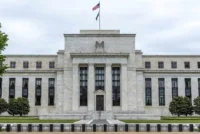
US Treasury yields increased after strong employment data showed resilience in the labor market, with 178,000 jobs added and unemployment easing to 4.3%. The 10-year yield rose to around 4.35% on the day, while shorter and longer maturities also climbed. However, yields declined over the week, highlighting a market caught between economic strength and expectations of stable interest rates.
A Market Reacting to Strength, Not Weakness
US Treasury yields moved higher at the end of the week, driven by stronger-than-expected labor market data that reshaped expectations around interest rates.
At the center of this reaction was the benchmark 10-year Treasury yield, which rose by 3.3 basis points to approximately 4.347%, or about 4.35% in market terms. This increase occurred during a shortened trading session and pushed yields further away from the two-week lows reached earlier in the week.
At first glance, this upward move might suggest a straightforward narrative—strong economic data leading to higher yields.
But the full picture is more complex.
Despite the daily increase, yields actually declined over the course of the week. The 10-year yield fell by roughly 9 to 9.4 basis points overall, marking its largest weekly drop since late February.
This creates an apparent contradiction.
Yields are rising in response to strong data, yet trending downward over a broader timeframe.
Understanding this tension is key to interpreting what the market is signaling.
Markets move fast; don’t get left behind. We’ve paired the Serrari Group Market Index with a curated Marketplace and a comprehensive Wealth Builder Course to ensure you have the data—and the skills—to act on it.
The Jobs Data That Changed Expectations
The catalyst for the move in yields was a stronger-than-expected labor market report.
The US economy added 178,000 nonfarm jobs in March. This figure significantly exceeded market expectations, which had been closer to 60,000 jobs. In fact, the reported number was nearly three times higher than forecasts, indicating a labor market that remains resilient despite broader economic uncertainty.
This data becomes even more notable when viewed in context.
February had previously shown a loss of 133,000 jobs, though this figure was later revised. The rebound in March suggests that the earlier weakness may not reflect a sustained downturn.
At the same time, the unemployment rate edged down slightly from 4.4% to 4.3%.
This combination of job growth and declining unemployment reinforces the perception of a stable labor market.
However, there was one moderating factor.
Wage growth showed signs of slowing, which introduces nuance into the overall picture. While job creation remains strong, slower wage growth could signal easing inflationary pressure.
This mixed data set complicates the interpretation of the labor market’s strength.
Why Strong Data Pushes Yields Higher
To understand why yields rose, it is necessary to examine how markets interpret economic strength.
Stronger-than-expected job growth suggests that the economy is performing well. In isolation, this is positive.
However, in the context of monetary policy, strong economic data can delay interest rate cuts.
If the Federal Reserve believes the economy remains robust, it has less incentive to reduce rates. This expectation leads investors to adjust their positioning.
Treasury yields, particularly on shorter maturities, are highly sensitive to interest rate expectations.
As a result, stronger data often leads to higher yields—not because conditions are worsening, but because monetary easing becomes less likely.
This dynamic explains why yields moved higher following the jobs report.
A Closer Look Across the Yield Curve
The movement in yields was not limited to the 10-year benchmark.
Shorter-term yields also increased. The two-year Treasury yield, which closely reflects expectations around Federal Reserve policy, rose by 5.2 basis points to 3.85%.
This is particularly important.
The two-year yield is often seen as the most direct indicator of where markets expect interest rates to go in the near term. Its increase suggests that investors are adjusting their expectations toward a longer period of stable or elevated rates.
Yet even here, the broader trend tells a different story.
Despite the daily rise, the two-year yield declined by approximately 6 basis points over the week.
This mirrors the pattern seen in the 10-year yield.
Longer-term yields followed a similar trajectory. The 30-year Treasury yield increased by 2.4 basis points to 4.914% on the day, but still recorded a weekly decline of about 7 basis points.
Across the yield curve, the same pattern emerges.
Daily increases driven by strong data are occurring within a broader context of declining yields.
The Assumption Behind Market Reactions
There is a common assumption underlying these movements.
That stronger economic data should consistently lead to higher yields.
While this is often true in the short term, it does not always hold over longer periods.
Markets are forward-looking. They do not react only to current data, but to what that data implies about future conditions.
The weekly decline in yields suggests that investors may still expect economic conditions to soften over time, even if current data remains strong.
This creates a disconnect between short-term reactions and longer-term expectations.
Context is everything. While you follow today’s updates, use the Serrari Group Market Index and Marketplace to spot emerging shifts. Need to sharpen your edge? Our Wealth Builder Course turns these insights into a professional-grade strategy.
A Market Balancing Two Narratives
What we are seeing is not a contradiction, but a balancing act.
On one side, strong labor market data supports the idea of a resilient economy.
On the other, the broader decline in yields suggests caution.
Investors are weighing two competing narratives.
The first is that economic strength will persist, keeping interest rates elevated.
The second is that underlying conditions may eventually weaken, leading to lower rates.
The coexistence of these narratives is what creates the observed market behavior.
Risks and Challenges
This environment introduces several risks.
One of the most immediate is misinterpretation. Strong data can lead to short-term optimism, but if underlying conditions shift, that optimism may prove temporary.
There is also the risk of policy misalignment. If the Federal Reserve maintains higher rates for longer than expected, it could place pressure on economic growth.
Conversely, if rates are reduced too quickly, inflationary pressures could re-emerge.
Another challenge lies in market volatility.
When expectations are uncertain, small changes in data can lead to significant movements in yields. This can create instability across financial markets, affecting equities, currencies, and credit conditions.
There is also the broader issue of global impact.
US Treasury yields serve as a benchmark for global financial markets. Changes in yields can influence capital flows, exchange rates, and borrowing costs worldwide.
Why This Matters
The movement in Treasury yields is not just a technical market development.
It reflects broader expectations about the economy, inflation, and monetary policy.
For investors, yields influence asset allocation decisions. Higher yields can make bonds more attractive relative to equities.
For businesses, yields affect borrowing costs. Changes in yields can influence investment decisions and financial planning.
For policymakers, yields provide insight into market expectations and economic sentiment.
In this sense, Treasury yields act as a signal—a reflection of how markets interpret current conditions and future prospects.
A Critical Perspective
It is important to question the reliability of these signals.
Markets are not always accurate in their expectations.
They can overreact to short-term data or misinterpret longer-term trends.
The strong reaction to the jobs report may reflect immediate sentiment rather than a fully considered view of economic conditions.
Similarly, the weekly decline in yields may reflect positioning rather than a clear consensus.
This highlights the importance of looking beyond headline movements.
Looking Ahead
The direction of Treasury yields will depend on how future data aligns with current expectations.
If the labor market continues to show strength, yields may remain elevated.
If signs of economic slowdown emerge, yields could decline further.
The Federal Reserve’s response will also play a critical role.
Markets will be closely watching for signals on interest rate policy, particularly in light of mixed economic indicators.
Conclusion
The recent movement in US Treasury yields reflects a market navigating complexity.
Strong labor market data has pushed yields higher in the short term, reinforcing expectations of stable interest rates.
At the same time, broader weekly declines suggest underlying caution.
This dual dynamic highlights the uncertainty that currently defines the market.
Rather than signaling a clear direction, yields are reflecting a balance of competing forces.
Understanding that balance is essential.
Because in markets, it is often not the data itself that matters most—but how that data is interpreted.
Your financial future isn’t something you wait for, it’s something you build.
The real question is: when do you begin?
Move beyond simply staying informed.
Navigate the markets with clarity—track trends through the Serrari Group Market Index, uncover opportunities in the Serrari Marketplace, and build practical knowledge with our Curated Wealth Builder Course.
Stay connected to what truly matters.
Get daily insights on macro trends and financial movements across Kenya, Africa, and global markets—delivered through the Serrari Newsletter.
Growth opens doors.
Advance your career through professional programs including ACCA, HESI A2, ATI TEAS 7 , HESI EXIT , NCLEX – RN and NCLEX – PN, Financial Literacy!🌟—designed to move you forward with confidence.
See where money is flowing—clearly and in real time.
Track Money Market Funds, Treasury Bills, Treasury Bonds, Green Bonds, and Fixed Deposits, alongside global and African indexes, key economic indicators, and the evolving Crypto and stablecoin landscape—all within Serrari’s Market Index.