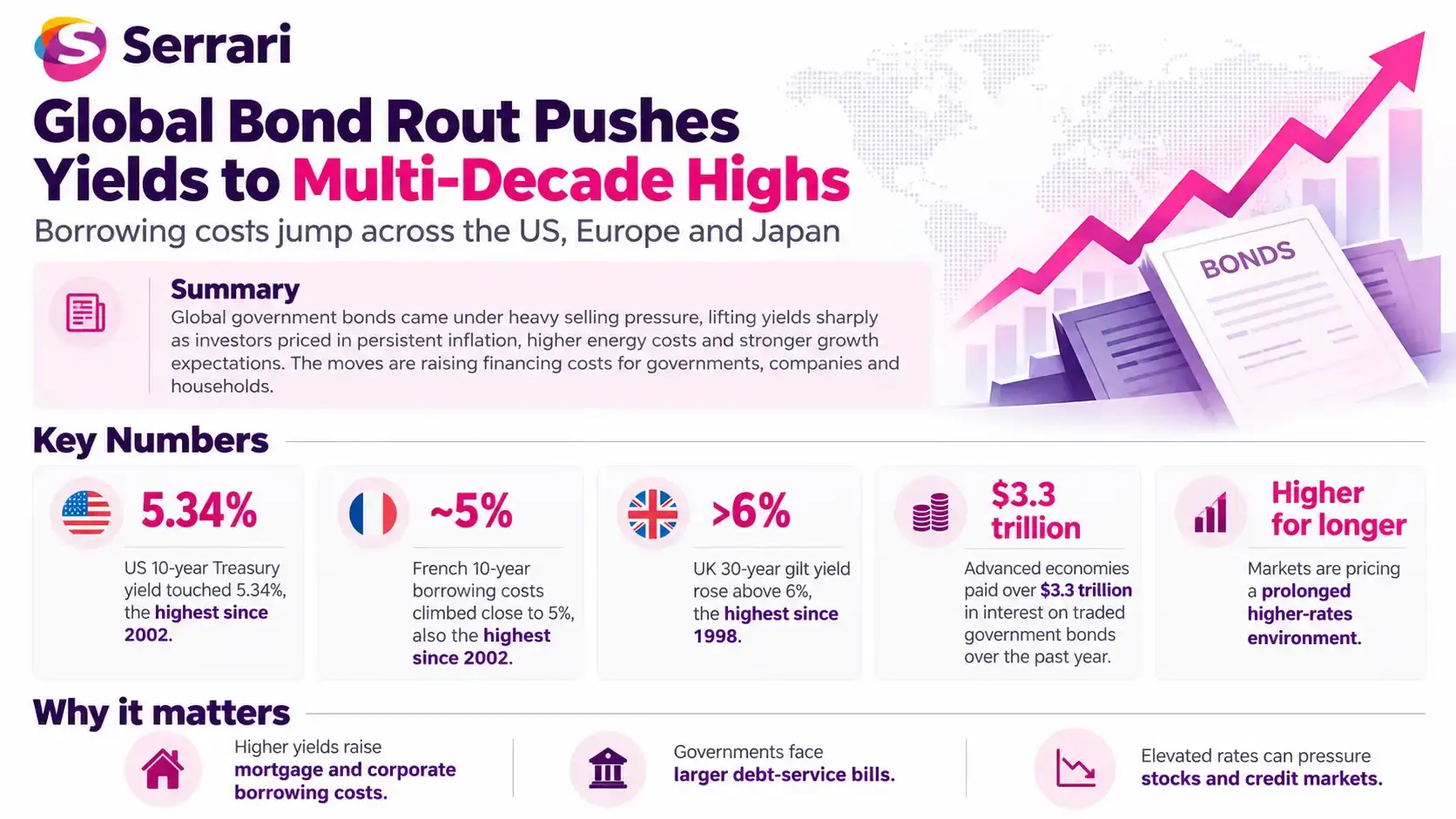
Global government bond markets have suffered another sharp selloff, driving long-term borrowing costs across major economies to levels not seen in decades. The benchmark US 10-year Treasury yield briefly climbed to 5.34%, its highest since 2002, as investors reassessed inflation, energy prices, government borrowing and the enormous capital needs of the artificial intelligence boom.
The move is not confined to the United States. France, Britain and Japan are all facing sharply higher sovereign yields, raising concerns over government debt-service costs, mortgages, corporate financing and how much further central banks may need to tighten monetary policy.
Key Overview
- The US 10-year Treasury yield reached 5.34%, its highest level in 24 years.
- Rising energy prices and persistent inflation have pushed investors to demand higher yields.
- Heavy investment in AI and data centres is increasing demand for capital across global markets.
- France’s 10-year borrowing cost approached 5%, reaching its highest level since 2002.
- Britain’s 30-year government bond yield moved above 6%, its highest since 1998.
- Advanced economies paid more than $3.3 trillion in interest on internationally traded government bonds over the past year.
- Markets have significantly reduced expectations for near-term interest-rate cuts.
Why Global Bond Yields Are Surging
Bond prices and yields move in opposite directions. When investors sell bonds, prices decline and yields rise. The current selloff has been particularly severe because several inflationary and fiscal pressures are hitting markets simultaneously.
The US 10-year Treasury yield climbed as high as 5.34%, before bargain buying helped it retreat toward 5.26%. The September quarter had already produced the largest quarterly increase in the benchmark yield this century.
Higher energy prices have revived inflation concerns just as central banks were trying to bring price growth sustainably under control. Investors are therefore demanding greater compensation for holding long-duration government debt.
At the same time, the rapid expansion of artificial intelligence infrastructure is changing the demand for capital. Data centres, semiconductor capacity, energy infrastructure and other AI-related projects require enormous amounts of financing. This creates additional competition for investment capital and can contribute to upward pressure on long-term borrowing costs.
The consequences extend well beyond financial markets. Higher government bond yields influence mortgages, corporate loans, infrastructure financing and the discount rates investors use when valuing stocks and other assets.
France Becomes a Major Focus for Bond Investors
France has emerged as one of the most closely watched sovereign debt markets in Europe.
French 10-year borrowing costs climbed toward the psychologically important 5% level, reaching their highest since 2002. The spread between French and German government borrowing costs has also widened sharply, reflecting the additional premium investors are demanding to hold French debt.
The pressure comes as the government attempts to restore confidence in its finances. France’s 2027 budget financing requirement is projected at €339.7 billion, with €340 billion of medium- and long-term debt issuance planned to meet much of that requirement.
That creates a difficult balancing act. Fiscal tightening may reassure bond investors, but aggressive spending reductions can weaken economic activity and encounter political resistance. Failure to improve the fiscal outlook, however, could keep borrowing costs elevated.
Context is everything. Stay ahead of shifting trends with today’s market updates, and uncover emerging opportunities using the Serrari Group Market Index and Marketplace. Then, take control of your own financial future by exploring our Money & Life Reset Transformation Blueprint ™ to build stronger habits, create better systems, and design a path toward lasting wealth.
Debt-Servicing Costs Are Becoming a Global Problem
The selloff highlights a much broader challenge: governments accumulated large debts when interest rates were historically low, but they must increasingly refinance that debt at much higher rates.
Recent estimates show that global debt surpassed $365 trillion during the first half of 2026. Even where debt-to-GDP ratios have stabilised or declined, refinancing costs are becoming more expensive.
Advanced economies paid more than $3.3 trillion in interest on internationally traded government bonds during the past year. That exceeded estimated annual global expenditure on artificial intelligence of $2.6 trillion, defence spending of $3.1 trillion and clean-energy investment of $2.3 trillion.
The comparison illustrates how quickly interest costs can consume fiscal capacity that governments might otherwise use for infrastructure, healthcare, defence, technology or social programmes.
Britain and Japan Feel the Pressure
Britain has also been caught in the global repricing of government debt. The country’s 30-year government bond yield moved above 6%, reaching its highest level since 1998.
The impact is already filtering into the real economy. Higher government borrowing costs influence swap rates and mortgage pricing, increasing repayment pressure on households refinancing fixed-rate mortgages.
Japan faces a different but equally significant transition. After decades of exceptionally low inflation and interest rates, persistent inflation has pushed Japanese government bond yields steadily higher. Sovereign yields recorded an unprecedented fifth consecutive quarter of double-digit increases, signalling a fundamental shift in a market long accustomed to ultra-low borrowing costs.
Higher Rates for Longer Changes the Investment Landscape
The bond selloff is forcing investors to reconsider assumptions that dominated markets when inflation appeared to be easing and rate cuts seemed close.
Expectations for US monetary easing have been sharply reversed. Following a recent rate increase, markets moved to price at least three additional Federal Reserve hikes before mid-2027, although those expectations can change quickly as employment, inflation and energy-price data evolve.
For investors, higher bond yields create competition for equities because relatively safer government securities now offer returns that were unavailable for much of the previous decade. For borrowers, however, the environment is considerably tougher.
The central question is increasingly not simply how high interest rates will rise, but how long governments, companies and households can comfortably operate in a world where the cost of capital remains structurally higher.
Sources: Reuters / Institute of International Finance / Agence France Trésor
Your financial future isn’t something you wait for—it’s something you build.
The real question is: when do you begin?
Move beyond simply staying informed.
Navigate the markets with clarity—track trends through the Serrari Group Market Index, uncover opportunities in the Serrari Marketplace, and build practical knowledge with our Curated Wealth Builder Platform.
Stay connected to what truly matters.
Get daily insights on macro trends and financial movements across Kenya, Africa, and global markets—delivered through the Serrari Newsletter.
Growth opens doors.
Advance your career through professional programs including ACCA, HESI A2, ATI TEAS 7 , HESI EXIT , NCLEX – RN and NCLEX – PN, Financial Literacy!🌟—designed to move you forward with confidence.
See where money is flowing—clearly and in real time.
Track Money Market Funds, Treasury Bills, Treasury Bonds, Green Bonds, and Fixed Deposits, alongside global and African indexes, key economic indicators, and the evolving Crypto and stablecoin landscape—all within Serrari’s Market Index.