
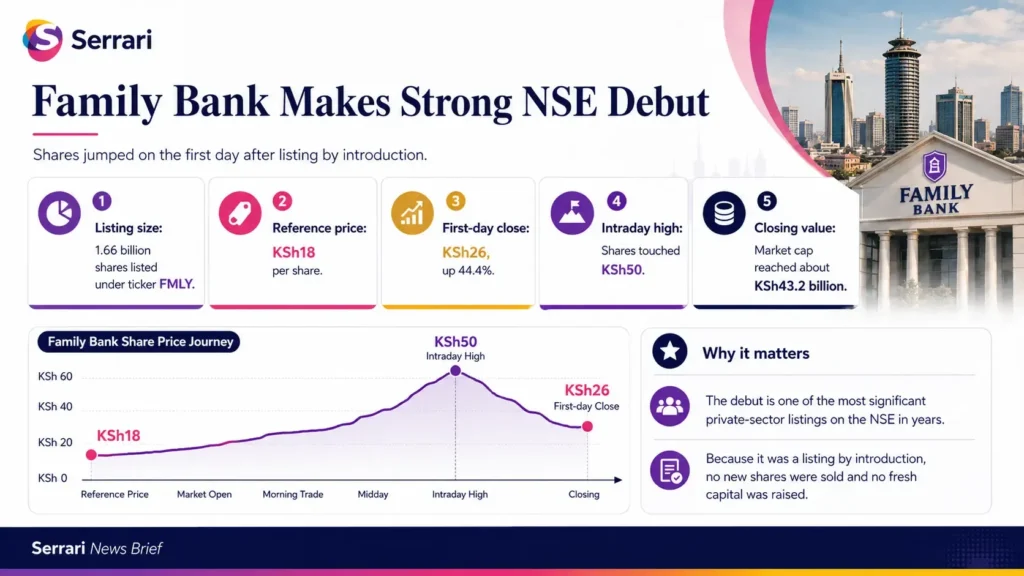
Family Bank made a strong entrance onto the Nairobi Securities Exchange on June 23, 2026, with its shares closing 44.4% above the KSh18 reference price after a volatile first trading session.
LIVENSE market summarySee NSE data →The lender listed 1.66 billion ordinary shares on the Main Investment Market Segment under the ticker FMLY. Because the transaction was a listing by introduction rather than an initial public offering, existing shares became publicly tradable without the bank issuing new equity or raising fresh capital.
Key Overview
- Family Bank listed approximately 1.66 billion ordinary shares at KSh18, giving it an initial market value of about KSh29.9 billion.
- The counter closed at KSh26 after touching KSh50, delivering a 44.4% first-day gain.
- Trading volume reached 1,865,856 shares, lifting the closing market capitalisation to roughly KSh43.2 billion.
- The transaction was completed by introduction, meaning no new shares were sold and no fresh capital was raised.
- Family Bank became one of the most significant private-sector additions to the NSE since Co-operative Bank listed in 2008.
Shares Rally in a Volatile First Session
Trading opened from a KSh18 reference price, implying a starting valuation of approximately KSh29.9 billion. Strong initial demand pushed the stock sharply higher, with the counter reaching an intraday peak of KSh50 before retreating.
Family Bank eventually closed at KSh26, representing a 44.4% gain. At that price, the lender was valued at around KSh43.2 billion.
A total of 1,865,856 shares changed hands during the session. The wide gap between the reference price, intraday high and close illustrated how limited supply can intensify price movements in a newly admitted counter.
The listing also brought formal price discovery to shares that had previously traded outside the exchange. Existing shareholders can now transact through the NSE’s regulated infrastructure, potentially increasing liquidity and widening investor participation.
Listing by Introduction Avoids Dilution
Family Bank’s market entry was not an IPO. A listing by introduction allows a company’s existing shares to begin trading on an exchange without a public sale of newly issued stock.
The bank therefore received no fresh proceeds from the listing. Instead, the transaction offers greater liquidity, transparent valuation, increased visibility and potential access to a broader investor base.
Family Bank obtained formal regulatory approval before trading began, completing a process backed by shareholders in 2025.
Because no additional shares were created, existing investors were not diluted. However, future liquidity will depend on how many long-term shareholders choose to sell their holdings.
Context is everything. Stay ahead of shifting trends with today’s market updates, and uncover emerging opportunities using the Serrari Group Market Index and Marketplace. Then, take control of your own financial future by exploring our Money & Life Reset Transformation Blueprint ™ to build stronger habits, create better systems, and design a path toward lasting wealth.
From Building Society to Listed Bank
Family Bank traces its origins to Family Finance Building Society, founded by Titus Kiondo Muya in 1984. It converted into a commercial bank in 2007 and has since grown into one of Kenya’s leading mid-tier lenders.
Its development has often been compared with Equity Group, which also began as a building society in 1984 before later converting into a bank and listing on the NSE.
Family Bank entered the public market after reporting continued balance-sheet growth. Its listing documents showed total assets of KSh230.2 billion in the first quarter of 2026.
LIVENSE market summarySee NSE data →The lender also reported a KSh5.3 billion net profit for 2025, up from KSh3.46 billion a year earlier. Those stronger earnings helped support its public-market valuation.
Debut Breaks a Long Private-Sector Listing Drought
Family Bank’s admission is among the largest private-sector listings on the NSE in more than 15 years. The last comparable domestic bank listing was Co-operative Bank of Kenya in December 2008.
Kenya’s exchange has struggled to attract sizeable new equity listings despite growth in the country’s private sector. Family Bank’s debut could therefore provide a model for mature private businesses seeking liquidity and transparent market valuation.
Before trading began, the lender was expected to enter the market at a KSh29.9 billion valuation. Its first-day close placed it above several established listed companies and highlighted investor appetite for a substantial new banking counter.
Public Listing Opens a New Growth Phase
Managing Director and Chief Executive Nancy Njau described the listing as the start of a new chapter rather than the final destination.
Family Bank serves more than 1.3 million customers and operates a nationwide branch network. Its priorities include continued digital investment, physical expansion and longer-term regional growth.
Public-market status will bring greater investor scrutiny and continuous disclosure requirements. It could also make future equity or debt raising easier, although any new transaction would require separate approvals.
The durability of the first-day rally will now depend on liquidity, earnings growth and execution. Investors will be watching whether Family Bank can justify its higher valuation while delivering on its expansion strategy as a listed institution.
Sources: Family Bank / Nairobi Securities Exchange / Business Today Kenya / Kenyan Wall Street / Business Daily Africa / The Star
Your financial future isn’t something you wait for—it’s something you build.
The real question is: when do you begin?
Move beyond simply staying informed.
Navigate the markets with clarity—track trends through the Serrari Group Market Index, uncover opportunities in the Serrari Marketplace, and build practical knowledge with our Curated Wealth Builder Platform.
Stay connected to what truly matters.
Get daily insights on macro trends and financial movements across Kenya, Africa, and global markets—delivered through the Serrari Newsletter.
Growth opens doors.
Advance your career through professional programs including ACCA, HESI A2, ATI TEAS 7 , HESI EXIT , NCLEX – RN and NCLEX – PN, Financial Literacy!🌟—designed to move you forward with confidence.
See where money is flowing—clearly and in real time.
Track Money Market Funds, Treasury Bills, Treasury Bonds, Green Bonds, and Fixed Deposits, alongside global and African indexes, key economic indicators, and the evolving Crypto and stablecoin landscape—all within Serrari’s Market Index.