Ghana is moving closer to completing its post-default debt restructuring through a mandatory exchange of US$117.8 million in health-sector-linked bonds issued by Saderea Designated Activity Company.
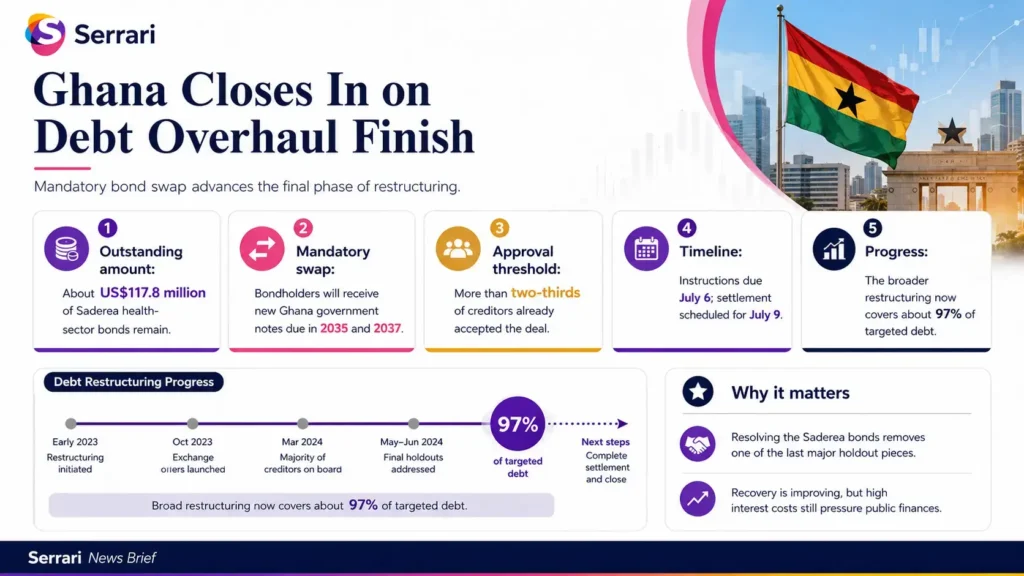
Creditors controlling more than two-thirds of the outstanding bonds have accepted the transaction, reaching the legal threshold required to bind all holders. Investors will receive Ghanaian government notes maturing in 2035 and 2037, with instructions due by July 6 and settlement scheduled for July 9.
Key Overview
- Approximately US$117.77 million remains outstanding on Saderea’s 12.5% senior secured amortising bonds.
- Investors will receive government notes due in 2035 and 2037 under the agreed restructuring terms.
- A creditor group representing more than two-thirds of the bonds has approved the deal, allowing the terms to be imposed on all holders.
- Bondholders have until July 6 to submit instructions, with settlement planned for July 9.
- S&P Global Ratings estimates that Ghana has completed or agreed terms covering about 97% of the debt included in its restructuring perimeter.
Mandatory Swap Targets One of the Final Debt Holdouts
The Saderea bonds were issued in 2014 through an Irish special-purpose vehicle and were linked to promissory notes used to finance health-sector infrastructure in Ghana.
The original transaction involved US$253.19 million of 12.5% senior secured amortising bonds. After repayments and amortisation, US$117.77 million remains outstanding.
Under the restructuring, investors will exchange their existing securities for Ghanaian sovereign bonds. For every US$1,000 in Saderea principal, the proposed terms provide US$986 of Ghana’s step-up coupon amortising notes due in 2035 and US$330 of 1.5% amortising notes due in 2037.
The combined face value exceeds the remaining principal because the package also reflects treatment of accrued obligations and the concessions made by creditors during Ghana’s wider 2024 Eurobond exchange.
Because holders representing more than the required two-thirds threshold have already approved the transaction, the restructuring can be enforced across the entire bondholder group. This prevents a small number of holdout investors from blocking completion.
Deal Brings Ghana Closer to Closing Its Debt Overhaul
Ghana defaulted on most of its external debt in December 2022 after losing access to international capital markets and facing severe pressure on its currency, public finances and foreign reserves.
The government subsequently launched a broad restructuring of domestic and external obligations under the G20 Common Framework. It completed a domestic debt exchange in 2023 and restructured about US$13 billion of international bonds in 2024.
S&P said Ghana has now completed, or reached agreements in principle covering, close to 97% of the debt targeted for restructuring. The Saderea transaction represents one of the remaining commercial obligations still requiring final settlement.
Completing the exchange would reduce uncertainty over Ghana’s residual defaulted claims and strengthen the government’s efforts to normalise relations with international creditors.
Context is everything. Stay ahead of shifting trends with today’s market updates, and uncover emerging opportunities using the Serrari Group Market Index and Marketplace. Then, take control of your own financial future by exploring our Money & Life Reset Transformation Blueprint ™ to build stronger habits, create better systems, and design a path toward lasting wealth.
Economic Recovery Supports Improving Credit Profile
Ghana’s economy has shown signs of recovery since the 2022 crisis. Strong gold exports, a current account surplus and higher foreign-exchange reserves have improved the country’s external position.
In March 2026, S&P affirmed Ghana’s B- sovereign rating with a stable outlook. The agency cited stronger reserve accumulation and improved balance-of-payments conditions.
Fitch later upgraded Ghana to B with a positive outlook in May, pointing to falling public debt and improved fiscal performance.
The government has also resumed full cash coupon payments under its domestic debt exchange programme. In February, Ghana paid 10 billion cedis in interest, equivalent to roughly US$910 million, marking its sixth coupon settlement since the restructuring began.
These developments have helped rebuild investor confidence, although Ghana has not yet fully returned to normal access to international bond markets.
High Interest Costs Remain a Major Fiscal Risk
Despite the progress, Ghana’s debt burden continues to constrain public finances. S&P expects government interest payments to average approximately 20% of revenue over the next four years.
That leaves less fiscal space for infrastructure, healthcare, education and other development priorities. It also means the country remains vulnerable to weaker commodity prices, slower export growth or renewed currency pressure.
Fiscal discipline will be particularly important ahead of future elections. Rating agencies have repeatedly warned that election-year spending and policy slippage could slow debt reduction and weaken Ghana’s credit outlook.
The restructuring has lowered near-term debt-service pressure, but it has not eliminated the need for sustained primary surpluses and careful expenditure control.
Final Settlement Could Mark a Turning Point
Bondholders must provide exchange instructions by July 6, with settlement expected on July 9. Once completed, the Saderea swap would remove another significant unresolved claim from Ghana’s post-default restructuring.
The transaction will not by itself restore full market access, but it would demonstrate progress toward resolving nearly all the debt covered by the government’s restructuring programme.
Ghana’s longer-term recovery will now depend less on negotiating old obligations and more on maintaining fiscal discipline, expanding exports and rebuilding investor confidence.
The country has set an ambition to regain an investment-grade credit rating within three years. Achieving that target will require continued debt reduction, stable reserves and stronger protection against the fiscal slippage that contributed to the original crisis.
Sources: Reuters / Ghana Ministry of Finance / S&P Global Ratings / Fitch Ratings / Zawya
Your financial future isn’t something you wait for—it’s something you build.
The real question is: when do you begin?
Move beyond simply staying informed.
Navigate the markets with clarity—track trends through the Serrari Group Market Index, uncover opportunities in the Serrari Marketplace, and build practical knowledge with our Curated Wealth Builder Platform.
Stay connected to what truly matters.
Get daily insights on macro trends and financial movements across Kenya, Africa, and global markets—delivered through the Serrari Newsletter.
Growth opens doors.
Advance your career through professional programs including ACCA, HESI A2, ATI TEAS 7 , HESI EXIT , NCLEX – RN and NCLEX – PN, Financial Literacy!🌟—designed to move you forward with confidence.
See where money is flowing—clearly and in real time.
Track Money Market Funds, Treasury Bills, Treasury Bonds, Green Bonds, and Fixed Deposits, alongside global and African indexes, key economic indicators, and the evolving Crypto and stablecoin landscape—all within Serrari’s Market Index.