Malaysia is seeking to deepen strategic cooperation with the United Arab Emirates in petroleum, gas, petrochemicals, logistics, renewable energy and high-value industrial development.
The Ministry of Investment, Trade and Industry said the relationship could expand beyond crude imports into refining, storage, clean energy investment and regional distribution. The opportunity has gained attention following the UAE’s withdrawal from OPEC and OPEC+ on May 1, 2026, which gives Abu Dhabi greater flexibility over future production and commercial partnerships.
Key Overview
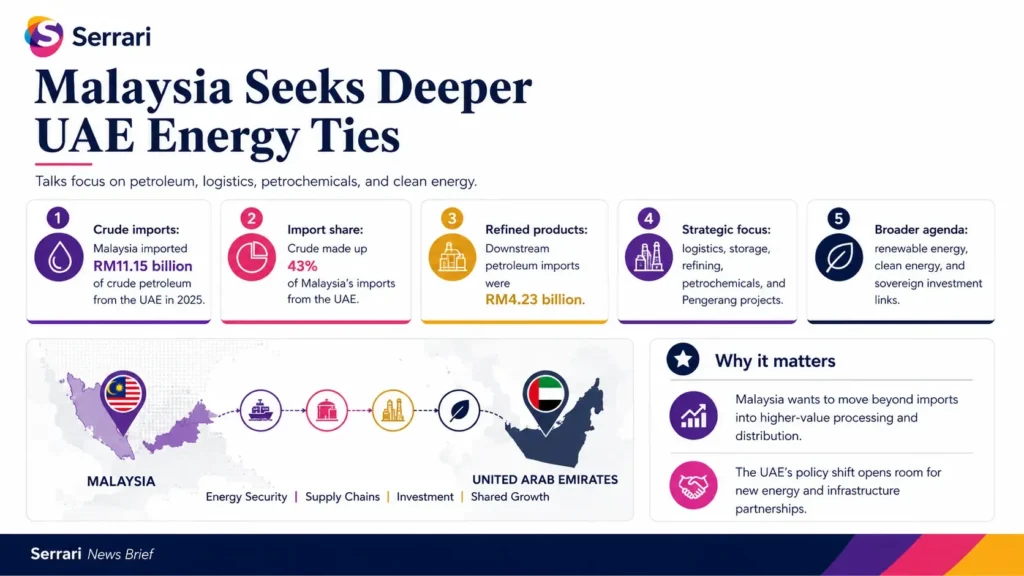
- Malaysia imported RM11.15 billion of crude petroleum from the UAE in 2025, equal to 43% of its total imports from the Gulf state.
- Downstream petroleum imports were valued at RM4.23 billion, or 10.4% of Malaysia’s imports from the UAE.
- Malaysian crude exports to the UAE reached RM729.82 million, while downstream petroleum exports were worth RM88.35 million.
- The UAE’s exit from OPEC and OPEC+ became effective on May 1, 2026.
- Malaysia is targeting investment in storage, logistics, refining, petrochemicals, renewable energy and the Pengerang Integrated Petroleum Complex.
Petroleum Trade Remains Central to Bilateral Ties
Petroleum dominates Malaysia’s import relationship with the UAE. According to the ministry, crude accounted for 43% of total Malaysian imports from the country in 2025, while refined petroleum products contributed another 10.4%.
This trade mix leaves Malaysia with a bilateral petroleum deficit, but the government argues that the imports support a wider industrial value chain. Imported UAE crude is used as feedstock for Malaysia’s downstream petroleum sector, which exported RM103.55 billion worth of products globally and generated a positive worldwide trade balance of RM6.8 billion.
Malaysia’s own petroleum exports to the UAE remain much smaller. Crude shipments were valued at RM729.82 million, representing 4.4% of total Malaysian exports to the UAE, while downstream products contributed RM88.35 million, or 0.5%.
The figures show that Malaysia’s economic interest is not simply to reduce imports. Its larger objective is to capture more value through processing, storage, logistics and re-export activity.
UAE’s OPEC Exit Creates New Commercial Space
The UAE formally left OPEC and OPEC+ on May 1 after nearly six decades of membership. The move removed the country from collective production limits and gave it greater freedom to pursue its own output and investment strategy.
Abu Dhabi described the withdrawal as a sovereign strategic decision, rather than a political break with other Gulf producers. The policy shift is expected to support plans to increase production capacity and expand the international reach of the UAE’s petroleum industry.
For Malaysia, that creates potential opportunities in crude supply, storage, refining and distribution. The ministry said the country could position itself as a regional partner for UAE petroleum products, particularly within Asian markets.
The UAE’s greater production flexibility could also encourage longer-term supply contracts and infrastructure investment, although future projects will still depend on commercial viability, demand conditions and geopolitical stability.
Context is everything. Stay ahead of shifting trends with today’s market updates, and uncover emerging opportunities using the Serrari Group Market Index and Marketplace. Then, take control of your own financial future by exploring our Money & Life Reset Transformation Blueprint ™ to build stronger habits, create better systems, and design a path toward lasting wealth.
Pengerang Could Anchor New Investment
Malaysia is seeking UAE investment in crude storage facilities, petroleum logistics, integrated refining and high-value petrochemical projects.
A major focus is the Pengerang Integrated Petroleum Complex in Johor, one of Malaysia’s most important downstream energy hubs. The complex combines refining, petrochemical production, storage and marine infrastructure, making it a potential platform for UAE companies seeking greater access to Southeast Asian markets.
The Malaysian Investment Development Authority is expected to promote these opportunities to UAE investors, including sovereign wealth funds and energy companies. Investment in Pengerang could strengthen Malaysia’s role as a refining and distribution centre while supporting local employment, technology transfer and industrial development.
The strategy also aligns with the Malaysia-UAE Comprehensive Economic Partnership Agreement, which entered into force on October 1, 2025. The agreement is intended to reduce trade barriers, strengthen supply chains and expand investment across both economies.
Clean Energy Broadens the Partnership
The government also wants the relationship to extend beyond hydrocarbons. Potential areas include renewable energy, clean technology, energy transition projects and collaboration with major UAE investment institutions such as the Abu Dhabi Investment Authority and Mubadala.
This broader approach reflects the UAE’s dual strategy of expanding oil production while investing heavily in low-carbon energy and international infrastructure.
Malaysia could benefit from UAE capital in solar power, energy storage, green manufacturing and other transition-related sectors. Such investment would complement the country’s petroleum value chain while supporting diversification into higher-growth industries.
The partnership may therefore develop along two parallel tracks: deeper cooperation in conventional energy and faster investment in clean energy and industrial transition.
Trade Relationship Moves Into a New Phase
Malaysia and the UAE already have a substantial commercial relationship, but the latest policy direction points toward more integrated cooperation.
The immediate focus is likely to remain petroleum because of the scale of existing trade. However, the larger opportunity lies in connecting crude supply with Malaysian refining capacity, storage infrastructure, petrochemical production and regional logistics.
If new investment materialises, Malaysia could strengthen its position as an Asian processing and distribution hub while the UAE gains broader access to Southeast Asian markets.
The success of the strategy will depend on whether both countries convert political interest into bankable projects, long-term supply arrangements and commercially sustainable investment.
Sources: Ministry of Investment, Trade and Industry Malaysia / Bernama / The Edge Malaysia / Reuters / UAE Ministry of Economy and Tourism
Your financial future isn’t something you wait for—it’s something you build.
The real question is: when do you begin?
Move beyond simply staying informed.
Navigate the markets with clarity—track trends through the Serrari Group Market Index, uncover opportunities in the Serrari Marketplace, and build practical knowledge with our Curated Wealth Builder Platform.
Stay connected to what truly matters.
Get daily insights on macro trends and financial movements across Kenya, Africa, and global markets—delivered through the Serrari Newsletter.
Growth opens doors.
Advance your career through professional programs including ACCA, HESI A2, ATI TEAS 7 , HESI EXIT , NCLEX – RN and NCLEX – PN, Financial Literacy!🌟—designed to move you forward with confidence.
See where money is flowing—clearly and in real time.
Track Money Market Funds, Treasury Bills, Treasury Bonds, Green Bonds, and Fixed Deposits, alongside global and African indexes, key economic indicators, and the evolving Crypto and stablecoin landscape—all within Serrari’s Market Index.