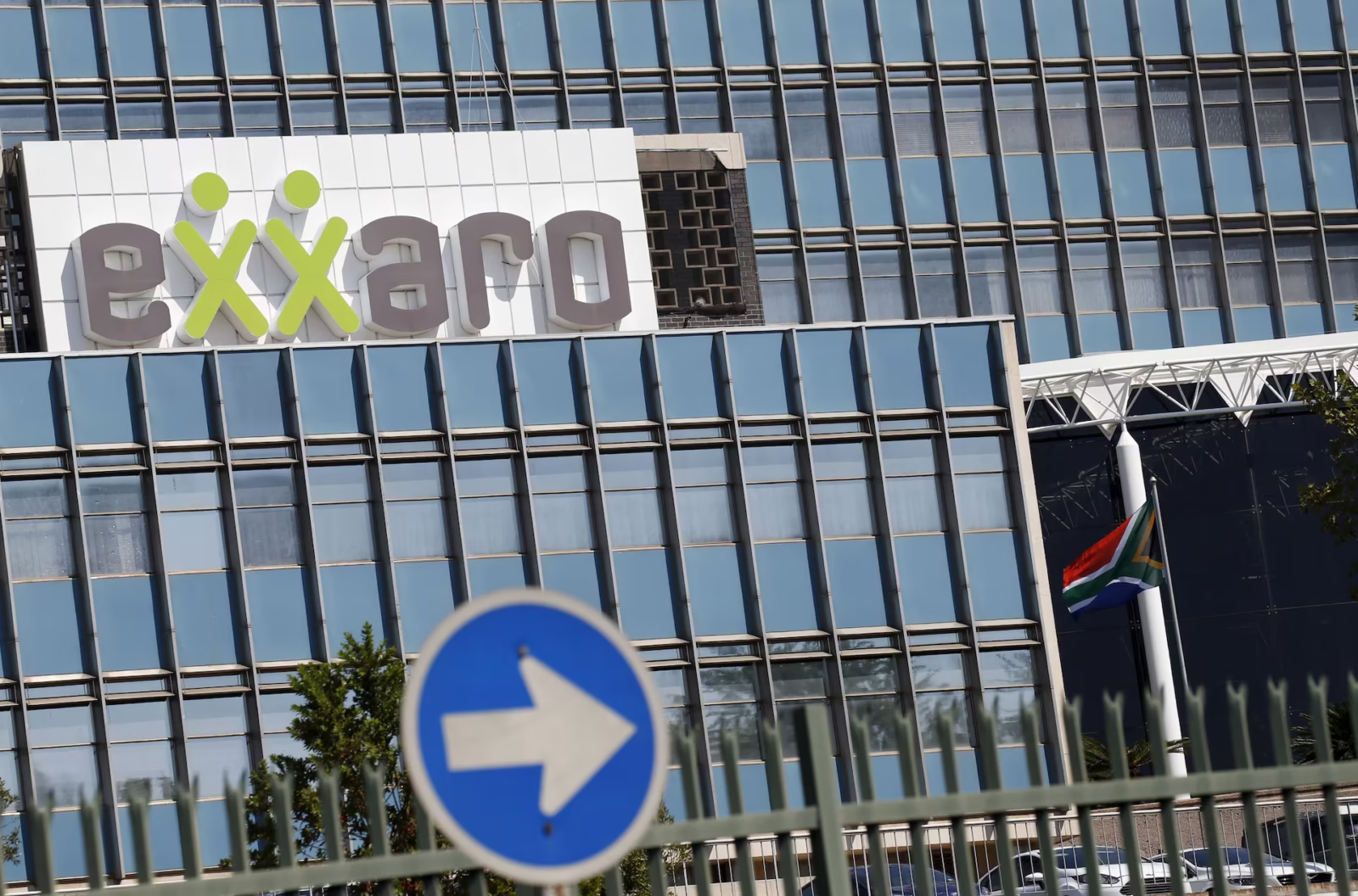
South Africa’s Exxaro Resources is positioning itself to capitalise on a shifting global energy landscape, forecasting that its coal exports could climb by as much as 12% this year as the war between the United States, Israel, and Iran sends shockwaves through global energy markets and revives demand for thermal coal as an alternative fuel source.
In its full-year results for the 12 months to December 2025, released on March 19, the Johannesburg-listed miner said coal exports could reach 8 million metric tons in 2026, up from 7.1 million tons shipped last year. The optimistic forecast rests on two pillars: a material improvement in South Africa’s long-troubled freight rail corridor, and a geopolitical environment that is pushing buyers back toward coal at a time when liquefied natural gas and oil supplies face unprecedented disruption.
Exxaro CEO Ben Magara told investors during a results presentation that the company is well placed to increase volumes into a strengthening price environment. He noted that exports from the Grootegeluk mine could exceed 10 million tonnes over the longer term as Transnet’s performance continues to improve, though near-term guidance remains at between 7.3 million and 8 million tonnes. Total coal production for the year is guided at between 39.4 million and 42.8 million tonnes.
Markets move fast; don’t get left behind. We’ve paired the Serrari Group Market Index with a curated Marketplace and a comprehensive Wealth Builder Course to ensure you have the data—and the skills—to act on it.
A War That Reshapes Energy Markets
The backdrop to Exxaro’s bullish export outlook is the escalating conflict in the Middle East. Since the United States and Israel launched coordinated strikes on Iran on February 28, Iran has effectively closed the Strait of Hormuz — the narrow waterway through which approximately 20% of the world’s oil supply and a significant share of global LNG exports normally transit. The disruption has been catastrophic for energy markets.
Oil prices surged to within touching distance of $120 per barrel in the days following the outbreak of hostilities, with the International Energy Agency describing the supply disruption as the largest in the history of the global oil market. QatarEnergy, which provides roughly 20% of the world’s LNG supply, declared force majeure on its export contracts after operations at the massive Ras Laffan facility were halted. The cascading effects have rippled far beyond oil and gas, pushing buyers of electricity-generating fuel to look for alternatives — and coal is the most immediately available option.
Exxaro warned in its results statement that the conflict poses a material threat to global energy security. “Any prolonged or broader regional destabilisation would disrupt energy security and bulk shipping, tightening global oil and liquefied natural gas supply,” the company said. “This would likely increase reliance on alternative fuels, supporting higher thermal coal demand and prices.”
That dynamic is already visible in the numbers. The benchmark price for South African coal exports, the API4 index — which reflects the free-on-board price of coal shipped from Richards Bay — has climbed to $118 per ton, a sharp increase from the $90-per-ton average that Exxaro realised across 2025. Futures prices have been touching $120 to $125 per ton, according to Magara, as the market prices in prolonged disruption to Gulf energy supplies.
Analysts at Bloomberg Intelligence said that if the Iran war continues to disrupt LNG supplies for several more weeks, coal prices could rise to between $165 and $185 per ton — levels that would deliver a significant windfall to South African producers. Benchmark Newcastle coal, the global thermal coal reference, has risen more than 10% since the start of the conflict.
Fuel Switching in Action
The mechanism driving coal demand higher is straightforward: when LNG becomes scarce and expensive, power utilities and industrial consumers with flexible generation capacity switch to coal. India is the clearest example of this dynamic playing out in real time. The country normally relies on LNG for 6 to 10% of its electricity generation, increasing during peak demand months from April to June. With Gulf LNG supplies disrupted and Asian spot gas prices having more than doubled, India’s maritime coal imports rose approximately 9% to 19 million tonnes in February alone, demonstrating the substitution effect in action.
Japan, which depends on the Middle East for about 90% of its crude oil imports, is another key market feeling the pressure. Exxaro’s Magara noted that Japanese buyers are now keen to lock in long-term, high-premium coal contracts. “I think the perception and concern is that this will not be over, even if the guns stop today,” Magara said in an interview with Miningmx. “The global players are beginning to want to create real long-term agreements. Japan, which is a very reliable customer, is very keen to get a high-premium coal contract over a longer period, because they want energy security.”
Exxaro ships coal to India, Japan, Pakistan, Europe, and Africa. Asia receives almost 80% of South Africa’s coal exports, with India and Pakistan the primary destinations. The company’s position as a supplier of high-quality thermal coal from low-cost mines in the Waterberg basin, where it controls 9 billion tonnes of reserves and operates Grootegeluk — the world’s largest beneficiation complex — gives it a competitive edge in a tightening market.
On the JSE, coal stocks have responded to the shifting landscape. Thungela Resources has seen its share price gain approximately 57% since the start of the Iran war, adding about R9 billion to its market capitalisation. The broader sentiment toward coal, once treated as a pariah asset by financial institutions, has shifted noticeably. As RBCT CEO Alan Waller noted earlier this year, even insurers who had previously resisted underwriting coal operations are now taking a softer view toward the industry.
The Transnet Recovery Story
Exxaro’s ability to capitalise on rising demand depends critically on the performance of Transnet Freight Rail, the state-owned logistics operator whose chronic underperformance has been the single biggest constraint on South African coal exports for the better part of a decade.
The scale of the decline is stark. Richards Bay Coal Terminal, the privately owned export facility with capacity to handle 91 million tonnes annually, saw exports collapse from a record 76.47 million tonnes in 2017 to just 47.2 million tonnes in 2023 — a 30-year low driven by locomotive shortages, infrastructure decay, cable theft, and institutional dysfunction at Transnet. The damage cost South Africa’s mining sector tens of billions of rands in lost revenue annually.
But the trajectory has begun to turn. Under new management appointed in 2024, Transnet has implemented a turnaround plan that is now showing measurable results. RBCT posted an 11% increase in export volumes in 2025 to 57.66 million tonnes, the highest in four years. Cable theft — once one of the top two “volume eaters” on the coal corridor — was reduced by 50% in 2025, dropping from 180km of stolen cables in 2024 to 59km, thanks to the deployment of drones, intelligence teams, and improved coordination between security providers and Transnet.
By late 2025, Transnet Freight Rail was delivering an average of 23 trains per day to Richards Bay, with January 2026 maintaining an annualised run rate of 60 million tonnes even during planned maintenance. Theo Johnson, Transnet’s general manager for the coal business unit, said the target for the year is between 60 million and 65 million tonnes. Brake-related delays, which had previously pushed tipping times to 14 minutes per train, were cut to an average of six minutes by December following joint interventions with Transnet Engineering.
Exxaro has been an active participant in these improvements. Along with other major miners, the company has been helping Transnet raise its minerals hauling capacity, and has signalled its willingness to invest capital in freight rail public-private partnerships. The improved rail performance was a key enabler of Exxaro’s 2% rise in exports during 2025, with a particularly strong second half after disruptions caused by heavy rainfall in the first quarter.
Context is everything. While you follow today’s updates, use the Serrari Market Index and Marketplace to spot emerging shifts. Need to sharpen your edge? Our Wealth Builder Course turns these insights into a professional-grade strategy.
Financial Resilience in a Weak Price Year
Exxaro’s 2025 financial results demonstrated resilience in what was a challenging price environment. Export coal prices averaged just $90 per ton for the year, down 14% from the prior period. Revenue rose 3% to R41.8 billion, supported by slightly higher production and exports, but profit declined 7% to R7.1 billion as the weaker pricing took its toll.
However, disciplined cost management helped the company maintain EBITDA at R10.2 billion, a marginal 2% decline, while headline earnings per share rose 8% to R32.47 — up from R30.16 in the prior year. The company’s strong marketing capabilities and defensive portfolio structure were credited with offsetting much of the price weakness.
Shareholders were rewarded with a final dividend of R10 per share, up 15% from the previous payout, bringing total dividends for the year to R18.43 per share, or R6.3 billion in total shareholder returns. The dividend increase was notable given the lower profit, underscoring management’s confidence in the company’s balance sheet and forward outlook.
Diversification Beyond Coal
While coal remains the bedrock of Exxaro’s earnings, the company is actively diversifying. In February 2026, Exxaro completed the acquisition of manganese assets from Ntsimbintle Holdings, gaining control of the Tshipi Borwa mine — one of the world’s largest manganese producers, delivering approximately 3.5 million tonnes per year from the Kalahari Manganese Field. The R11.67 billion deal positions Exxaro as a globally significant manganese producer, with the metal being a key input for steel alloys and gaining traction in clean energy battery chemistries.
On the renewable energy front, the company has doubled its capacity from 200MW to 500MW and was selected as a preferred bidder for the 240MW Corona solar project in the Free State under South Africa’s Renewable Energy Independent Power Producer Procurement Programme. Magara said that by the end of 2027, all announced projects would take the company to 900MW of renewable capacity — a meaningful contributor to earnings.
The dual strategy reflects a deliberate balancing act. Magara told Business Day that even beyond 2050, coal remains a significant contributor to the global energy mix because it provides baseload power, both domestically and internationally. “We are one of the lowest-cost producers globally, able to withstand low prices and benefit from high prices when they come,” he said.
A Double-Edged Sword for South Africa
The Iran war presents South Africa with a complex economic equation. On one hand, the conflict is delivering a windfall for the country’s coal miners through higher prices and stronger demand. On the other, South Africa is a net oil importer, and rising crude prices are already feeding through into higher fuel costs and inflation pressure.
The Department of Mineral and Petroleum Resources published fuel price adjustments for March showing petrol increases of 20 cents per litre and diesel rises of between 62 and 65 cents, citing higher shipping rates and geopolitical uncertainty caused by the Iran conflict. North-West University economist Raymond Parsons warned that “South Africa must not underestimate the potential negative economic and business implications” of the crisis.
Magara himself acknowledged the broader risks. Higher oil prices could weaken South Africa’s trade balance and put additional pressure on inflation and economic growth, he said. For the mining industry specifically, a sustained conflict would increase costs for sulphuric acid, lubricants, fertilisers, and other inputs derived from oil refining — a sympathetic inflation effect that would ripple across agriculture, mining, and the chemical industry.
The African Energy Chamber noted that the oil shock adds downside growth and upside inflation risks for Africa’s emerging markets, with rising fuel, fertiliser, and freight costs threatening to re-accelerate inflation across the continent.
Looking Ahead
For Exxaro, the near-term outlook is undeniably favourable. The combination of a surging coal price, improving rail logistics, and growing demand from energy-insecure Asian buyers creates conditions for a strong 2026. Investec analysts noted that the overall environment for the coal business “remains challenging but export prices are likely to benefit from current events in the Middle East.”
Yet the company is not banking solely on the conflict. Its long-term strategy — anchored in low-cost coal production, renewable energy expansion, and diversification into manganese and other minerals — is designed to ensure resilience across commodity cycles and geopolitical shifts. Whether the Strait of Hormuz reopens next week or remains contested for months, Exxaro is positioning itself to deliver on both sides of the energy equation: powering the world’s immediate needs while building for a lower-carbon future.
As Magara put it: “Energy security is a real game-changer.”
Your financial future isn’t something you wait for—it’s something you build.
The real question is: when do you begin?
Move beyond simply staying informed.
Navigate the markets with clarity—track trends through the Serrari Group Market Index, uncover opportunities in the Serrari Marketplace, and build practical knowledge with our Curated Wealth Builder Course.
Stay connected to what truly matters.
Get daily insights on macro trends and financial movements across Kenya, Africa, and global markets—delivered through the Serrari Newsletter.
Growth opens doors.
Advance your career through professional programs including ACCA, HESI A2, ATI TEAS 7 , HESI EXIT , NCLEX – RN and NCLEX – PN, Financial Literacy!🌟—designed to move you forward with confidence.
See where money is flowing—clearly and in real time.
Track Money Market Funds, Treasury Bills, Treasury Bonds, Green Bonds, and Fixed Deposits, alongside global and African indexes, key economic indicators, and the evolving Crypto and stablecoin landscape—all within Serrari’s Market Index.