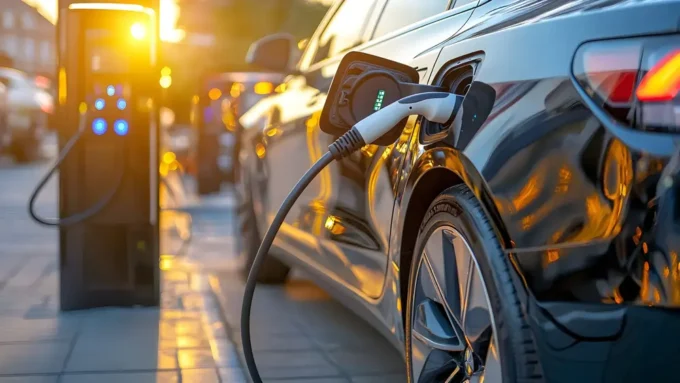
Electric vehicle (EV) prices are declining, with average prices dropping to $54,508, narrowing the gap with gas cars to $5,800.
However, this shift is being driven by aggressive incentives—averaging 14.6% per vehicle (~$8,000)—raising concerns about long-term profitability for automakers.
The trend highlights a critical tension in the EV market: growing affordability vs shrinking margins.
Key Overview
- EV prices fell 2.8% YoY to $54,508
- Gap with gas cars narrowed to ~$5,800
- Average car price: $49,275
- EV incentives hit 14.6% (~$8,000 per vehicle)
- Overall market incentives: 7.2%
- SUVs & trucks dominate demand ($66K–$80K range)
- Compact cars under $28K losing relevance
- Tesla & Mercedes prices declining
- Porsche & Cadillac prices rising
- Automakers sacrificing margins to drive EV adoption
EV Prices Are Falling, But at a Cost
Electric vehicle prices are finally moving in the direction many consumers have been waiting for—but the story behind the numbers is far more complex than a simple decline in cost.
Average EV prices dropped 2.8% year-over-year to $54,508, marking the third consecutive monthly decline and bringing electric vehicles closer in price to traditional internal combustion engine (ICE) cars.
This has narrowed the price gap between EVs and gas-powered vehicles to approximately $5,800, the smallest difference ever recorded, signaling a meaningful shift in affordability dynamics across the automotive market.
For consumers, this represents a significant step toward making EV ownership more accessible—but for automakers, it comes with substantial financial trade-offs.
Rather than being driven primarily by reductions in manufacturing costs or breakthroughs in battery efficiency, much of this price decline is the result of deliberate pricing strategies aimed at stimulating demand. Automakers are actively lowering effective prices through incentives and discounts to encourage adoption and maintain sales momentum.
In other words, affordability is improving—but it is being engineered through pricing strategies rather than achieved through structural cost transformation.
This distinction is critical, as it highlights the underlying tension in the EV market: while prices are falling, the economic sustainability of those reductions remains uncertain.
Markets move fast; don’t get left behind. We’ve paired the Serrari Group Market Index with a curated Marketplace and a comprehensive Wealth Builder Platform to ensure you have the data—and the skills—to act on it.
Incentives Surge as Automakers Push Sales
To make EVs more attractive in an increasingly competitive market, automakers are relying heavily on incentives, which have now reached 14.6% of the average transaction price—equivalent to nearly $8,000 per vehicle.
This effectively means that automakers are absorbing significant financial losses per unit in order to sustain demand and remain competitive.
These incentive levels are notably higher than the broader market average of 7.2%, underscoring the additional effort required to move EV inventory compared to traditional vehicles.
Even when compared to previous months, incentive levels have continued to edge upward, suggesting that pricing pressure is not only persistent but potentially intensifying.
Rising incentives indicate that demand, while growing, still requires active financial support to maintain momentum.
This trend also reflects the broader competitive landscape, where automakers are under pressure to meet EV sales targets, comply with regulatory requirements, and compete with both established and emerging players.
The push to make EVs more affordable is being driven by financial concessions rather than fundamental cost reductions—raising questions about long-term profitability.
The Price Gap With Gas Cars Is Shrinking
While EV prices are trending downward, traditional gas-powered vehicles are not following the same path.
The average transaction price for new vehicles in the U.S. reached $49,275, up 3.5% year-over-year, indicating that ICE vehicle prices remain stable or are gradually increasing.
This divergence is accelerating the convergence between EV and ICE vehicle pricing, bringing the two closer than ever before.
At the same time, the average manufacturer’s suggested retail price (MSRP) has remained above $50,000 for 12 consecutive months, reflecting a broader trend of persistently high vehicle costs across the automotive market.
This environment of elevated pricing makes the relative decline in EV costs even more significant, as it enhances their competitiveness without requiring dramatic changes in consumer budgets.
For consumers, the narrowing price gap—combined with potential savings on fuel and maintenance—makes EVs increasingly attractive, particularly for those with high driving mileage or long-term ownership horizons.
The economic case for EV adoption is strengthening, not just because EVs are cheaper, but because the relative cost advantage over time is becoming clearer.
However, the sustainability of this trend will depend on whether automakers can eventually reduce production costs enough to maintain competitive pricing without relying on heavy incentives.
Consumer Demand Still Favors Bigger Vehicles
Despite the steady decline in EV prices, consumer preferences remain firmly rooted in larger, more traditional vehicle categories—highlighting a disconnect between affordability trends and actual purchasing behavior.
Full-size pickup trucks are currently averaging around $66,000, while full-size SUVs are approaching $80,000, reflecting sustained demand for vehicles that offer space, power, and versatility.
This continued preference for larger vehicles suggests that pricing alone is not the primary driver of consumer decision-making.
Instead, factors such as lifestyle needs, perceived utility, and long-standing brand loyalty continue to play a significant role. For many buyers, especially in markets like the United States, larger vehicles are associated with practicality, status, and performance—attributes that are not easily replaced by smaller or more efficient alternatives.
Consumer priorities are still heavily influenced by utility and lifestyle considerations, rather than purely economic factors.
At the other end of the market, compact cars—priced below $28,000—have seen only modest price growth and are gradually losing relevance.
This trend indicates that even as affordability pressures persist, buyers are willing to stretch budgets for vehicles that better meet their expectations in terms of size and capability.
The declining relevance of compact cars underscores a broader shift toward higher-value, feature-rich vehicles.
Ultimately, this pattern highlights a key constraint in the transition to electric mobility:
Changing consumer behavior may prove more challenging than reducing vehicle prices.
Mixed Performance Across Automakers
The current pricing environment is creating divergent outcomes across automakers, reflecting differences in strategy, market positioning, and response to competitive pressures.
Luxury brands such as Porsche have seen prices rise sharply—up 12.4% to $128,447—while Cadillac recorded an 11.6% increase to $84,139.
These increases suggest that demand in the high-end segment remains relatively resilient, even in the face of broader economic pressures.
In contrast, other automakers are taking a more aggressive approach to pricing in order to remain competitive.
- Mercedes-Benz prices fell 3.4% to $75,886
- Tesla prices declined 2.6% to $53,142
This divergence reflects fundamentally different strategies—some brands are protecting premium positioning, while others are prioritizing volume growth through price reductions.
For companies like Tesla, price cuts are part of a broader effort to maintain market share and stimulate demand in an increasingly competitive EV landscape.
Pricing has become a key competitive lever, particularly in the rapidly evolving electric vehicle segment.
Context is everything. While you follow today’s updates, use the Serrari Group Market Index and Marketplace to spot emerging shifts. Need to sharpen your edge? Our Wealth Builder Platform turns these insights into a professional-grade strategy.
Profitability vs Growth: The Core Tension
The current pricing dynamics highlight a fundamental challenge facing the EV market: the need to balance rapid growth with long-term profitability.
Automakers are under increasing pressure to accelerate EV adoption, driven by regulatory requirements, climate targets, and intensifying competition. However, achieving these goals often requires significant financial trade-offs in the short term.
Growth in EV adoption is being achieved, but at the expense of margins.
The reliance on heavy incentives and price reductions illustrates how difficult it is to scale EV adoption while maintaining profitability. Unlike traditional vehicles, where cost structures are well established, EVs still face challenges related to battery costs, supply chains, and production scaling.
The transition to electric mobility is proving to be as much a financial challenge as it is a technological one.
While incentives can effectively stimulate demand and accelerate adoption in the short term, they are not a sustainable long-term strategy if they continue to erode margins.
Sustained growth will ultimately depend on reducing production costs rather than relying on discounts.
This creates a delicate balancing act for automakers:
They must continue to invest heavily in EV development and expansion while simultaneously managing profitability and shareholder expectations.
The future of the EV market will depend on whether automakers can align affordability with sustainable business models.
What This Means for the EV Market
The current dynamics suggest that the EV market is entering a critical transitional phase, where growth, affordability, and profitability are being actively reshaped.
On one hand, falling prices and the shrinking gap with internal combustion engine (ICE) vehicles are making electric vehicles more accessible than ever before. The reduction in upfront cost is lowering one of the biggest barriers to adoption, opening the market to a broader range of consumers.
This shift marks an important milestone in the mainstream adoption of electric vehicles.
On the other hand, the heavy reliance on incentives to achieve these price reductions raises important questions about the sustainability of this trend. Much of the affordability being experienced today is not the result of structural cost improvements, but rather strategic financial concessions by automakers.
Affordability is improving—but it is being subsidized rather than organically achieved.
This creates a delicate balance for the industry. Automakers must maintain strong sales momentum to justify ongoing investments in EV technology, while also managing the financial impact of reduced margins.
The current market reflects a tension between short-term growth and long-term financial sustainability.
If incentives remain the primary driver of affordability, the industry may face challenges in sustaining profitability as competition intensifies and pricing pressure persists.
Outlook: Can EV Growth Be Sustained?
Looking ahead, the trajectory of EV pricing and adoption will depend on several interconnected factors, ranging from technological advancements to market dynamics and policy support.
In the short term, incentives are likely to remain elevated as automakers continue to push inventory, meet regulatory targets, and stimulate demand in an increasingly competitive environment.
Short-term growth in EV adoption is expected to remain closely tied to aggressive pricing strategies.
Over the medium term, however, the focus will need to shift toward structural cost reductions. This includes achieving economies of scale in production, improving battery technology, and optimizing supply chains to lower manufacturing costs.
Cost reduction—not incentives—will be the key driver of sustainable growth in the EV market.
Advancements in battery efficiency, raw material sourcing, and production processes will play a critical role in determining whether EVs can achieve true cost competitiveness with ICE vehicles.
In the long term, the market is expected to reach a tipping point where price parity between EVs and traditional vehicles becomes the norm, reducing or eliminating the need for heavy discounts and incentives.
At that stage, EV adoption will be driven by intrinsic value rather than financial incentives.
Ultimately, the future of the EV market will depend on whether automakers can successfully transition from incentive-driven affordability to cost-driven competitiveness.
The defining challenge for the industry is clear: achieving widespread adoption without compromising profitability.
Your financial future isn’t something you wait for—it’s something you build.
The real question is: when do you begin?
Move beyond simply staying informed.
Navigate the markets with clarity—track trends through the Serrari Group Market Index, uncover opportunities in the Serrari Marketplace, and build practical knowledge with our Curated Wealth Builder Platform.
Stay connected to what truly matters.
Get daily insights on macro trends and financial movements across Kenya, Africa, and global markets—delivered through the Serrari Newsletter.
Growth opens doors.
Advance your career through professional programs including ACCA, HESI A2, ATI TEAS 7 , HESI EXIT , NCLEX – RN and NCLEX – PN, Financial Literacy!🌟—designed to move you forward with confidence.
See where money is flowing—clearly and in real time.
Track Money Market Funds, Treasury Bills, Treasury Bonds, Green Bonds, and Fixed Deposits, alongside global and African indexes, key economic indicators, and the evolving Crypto and stablecoin landscape—all within Serrari’s Market Index.