















The global energy transition is not collapsing, but it is becoming more uneven. According to the World Economic Forum’s Energy Transition Index 2026, progress across 120 countries has broadly stalled, with overall scores rising by just 0.03 percent. The report warns that the foundations needed for future gains are weakening as geopolitical shocks, infrastructure bottlenecks, high financing costs and rising electricity demand strain energy systems.
The findings come as disruption around the Strait of Hormuz has sharpened global concerns about energy security. The WEF says the crisis has exposed vulnerabilities already visible before the conflict, including supply concentration, import dependence and insufficient grid capacity. For governments, the lesson is clear: the next phase of the transition will depend not only on deploying renewables, but also on building resilient systems that can absorb shocks.
Key Overview
- The 2026 index uses 44 indicators across 120 countries to measure energy system performance and transition readiness.
- Overall transition progress was broadly flat, while transition readiness declined for the first time in more than a decade.
- Energy security was the only system performance dimension to deteriorate, falling 0.9 percent.
- Clean energy investment reached record levels, but capital remains concentrated in a small group of markets.
- Saudi Arabia stood out in MENA, with its ETI score rising 1.5 percent to 57.4 as renewables and storage investment accelerated.
- The WEF identifies three priorities: resilience, faster grid expansion and stronger investment frameworks.
Energy transition momentum is losing balance
The latest index shows a transition under pressure rather than in retreat. The WEF’s official press release says geopolitical tensions, supply disruption and rising demand are fragmenting global progress. While equity and sustainability improved, these gains were offset by weaker energy security and a decline in readiness.
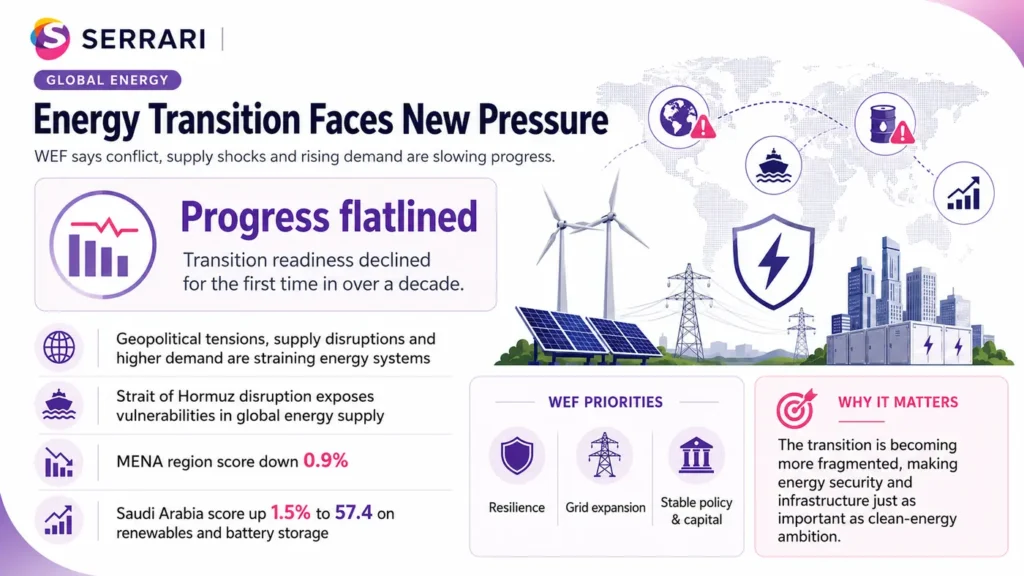
This matters because readiness measures whether countries have the policy, financing, infrastructure, innovation and human capital needed to sustain progress. In 2026, the WEF found that four of five readiness dimensions weakened. Finance and investment recorded the sharpest fall, while regulation, political commitment and innovation also declined.
The result is a widening gap between ambition and delivery. Renewable energy deployment continues, but grids, permits, policy certainty and financing conditions are not keeping pace. The report notes that more than 2,500 gigawatts of projects are stuck in grid connection queues worldwide, highlighting how physical infrastructure is becoming one of the biggest constraints on the transition.
War and supply shocks are reshaping energy security
The war-linked disruption around the Strait of Hormuz has become a major reminder that energy security is now broader than oil and gas flows. In a WEF analysis of the US-Iran crisis, the organization argues that energy security now includes grids, critical minerals, finance, technology supply chains and regional cooperation.
This is why the 2026 report places resilience at the center of transition strategy. Import-dependent economies are more exposed to price shocks, while emerging markets face tighter fiscal space and higher financing costs. The WEF says emerging economies are expected to drive most future demand growth, yet they continue to face financing costs two to three times higher than advanced economies.
The pressure is also rising from demand. Global electricity use is increasing due to electrification, cooling needs, digital infrastructure and artificial intelligence. Without faster grid expansion and more diversified supply chains, countries could deploy clean power but fail to integrate it effectively.
Context is everything. Stay ahead of shifting trends with today’s market updates, and uncover emerging opportunities using the Serrari Group Market Index and Marketplace. Then, take control of your own financial future by exploring our Money & Life Reset Transformation Blueprint ™ to build stronger habits, create better systems, and design a path toward lasting wealth.
Saudi Arabia gains as MENA slows
The Middle East and North Africa region recorded a decline, with the WEF pointing to weaker policy commitment and infrastructure investment. Saudi Arabia, however, moved against the regional trend. According to the Arab News report, the Kingdom’s ETI score rose 1.5 percent to 57.4, supported by stronger financial backing, faster renewable deployment and investment in large-scale battery storage.
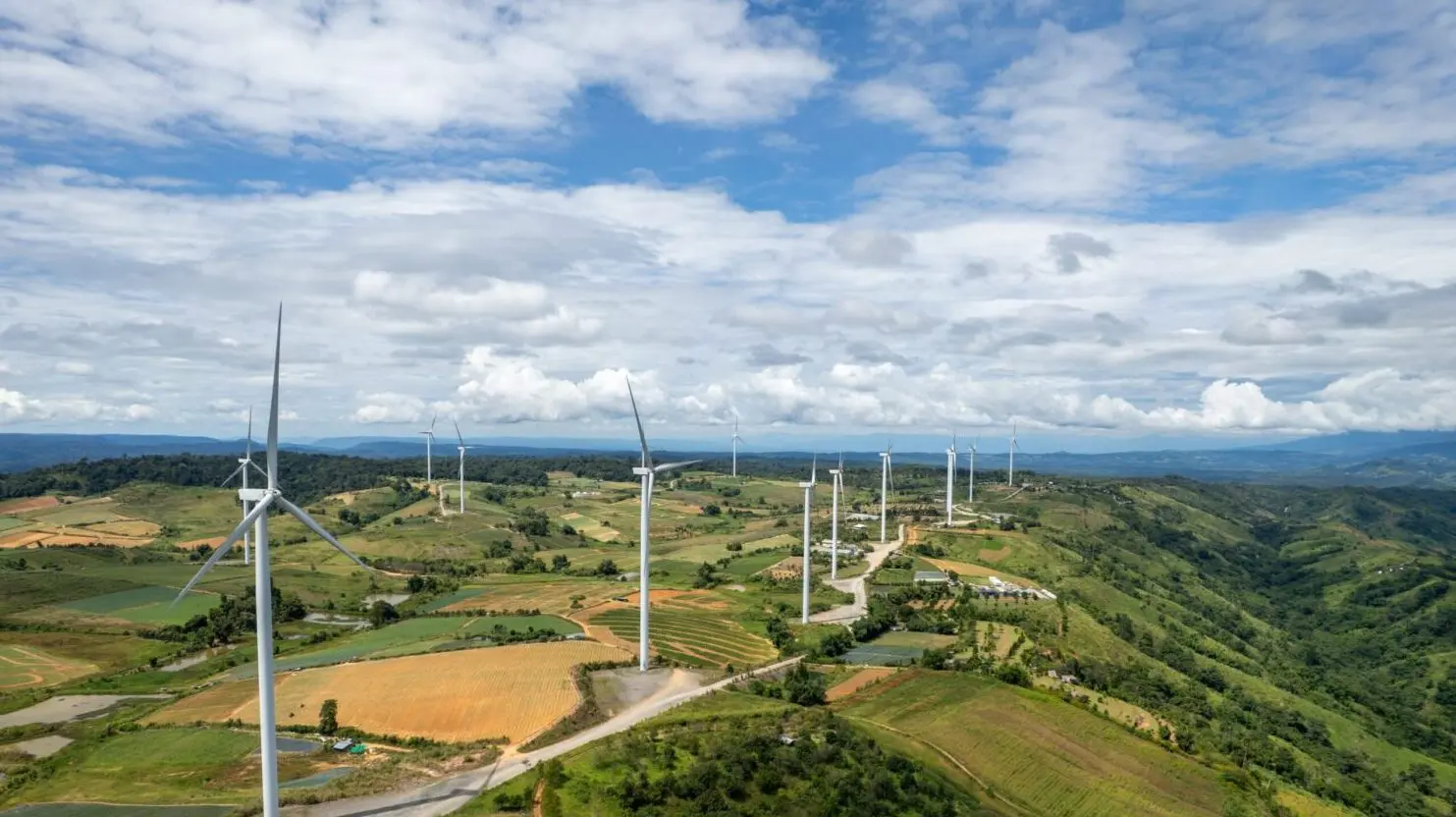
Saudi Arabia’s progress is tied to the National Renewable Energy Program. The Ministry of Energy says the program supports a target for renewables to make up around 50 percent of the electricity production mix by 2030 through the renewable energy program. The WEF-linked reporting also notes that Saudi renewable investment rose from $6.6 billion in 2024 to $11.9 billion in 2025, while tenders for more than 20 gigawatts of renewable capacity had been issued by 2025.
This makes the Kingdom one of the clearest examples of how energy security and transition goals can align. By expanding solar, wind and storage capacity, Saudi Arabia is not only diversifying away from liquid fuels in domestic power generation, but also positioning itself for a more competitive energy system.
Leaders, laggards and the next phase
Advanced economies still dominate the top rankings. Sweden leads the 2026 index, while the Nordic economies remain among the strongest performers because of diversified energy systems, clean energy adoption, policy stability and infrastructure readiness. China ranks 14th and continues scaling clean energy investment at record levels, while the United States ranks 19th despite policy uncertainty weighing on readiness.
The WEF’s message is that the next phase will reward countries that treat security, affordability and sustainability as connected goals. Its three recommended priorities are to build resilience into energy systems from the start, unblock delivery through faster grid and system integration, and restore investability through stable policies and targeted capital flows.
For policymakers and investors, the warning is practical: investment alone is not enough. Countries that build reliable grids, credible regulations and diversified supply chains will be better positioned to turn today’s shocks into long-term competitive advantage.
Sources used: World Economic Forum / Arab News / Saudi Ministry of Energy
Your financial future isn’t something you wait for—it’s something you build.
The real question is: when do you begin?
Move beyond simply staying informed.
Navigate the markets with clarity—track trends through the Serrari Group Market Index, uncover opportunities in the Serrari Marketplace, and build practical knowledge with our Curated Wealth Builder Platform.
Stay connected to what truly matters.
Get daily insights on macro trends and financial movements across Kenya, Africa, and global markets—delivered through the Serrari Newsletter.
Growth opens doors.
Advance your career through professional programs including ACCA, HESI A2, ATI TEAS 7 , HESI EXIT , NCLEX – RN and NCLEX – PN, Financial Literacy!🌟—designed to move you forward with confidence.
See where money is flowing—clearly and in real time.
Track Money Market Funds, Treasury Bills, Treasury Bonds, Green Bonds, and Fixed Deposits, alongside global and African indexes, key economic indicators, and the evolving Crypto and stablecoin landscape—all within Serrari’s Market Index.