The African Development Bank Group has approved a $100 million financing facility for the ECOWAS Bank for Investment and Development, known in French as BIDC and in English as EBID. The deal, approved in Abidjan on 17 June 2026, combines a $30 million equity investment with a $70 million long-term credit facility focused on clean energy projects across West Africa.
According to the official AfDB announcement, the operation is designed to strengthen BIDC’s capital base, improve its ability to mobilise long-term resources and support renewable energy generation in underserved communities. It also makes the African Development Bank Group the first development finance institution to acquire a stake in BIDC and secure a board seat.
Key Overview
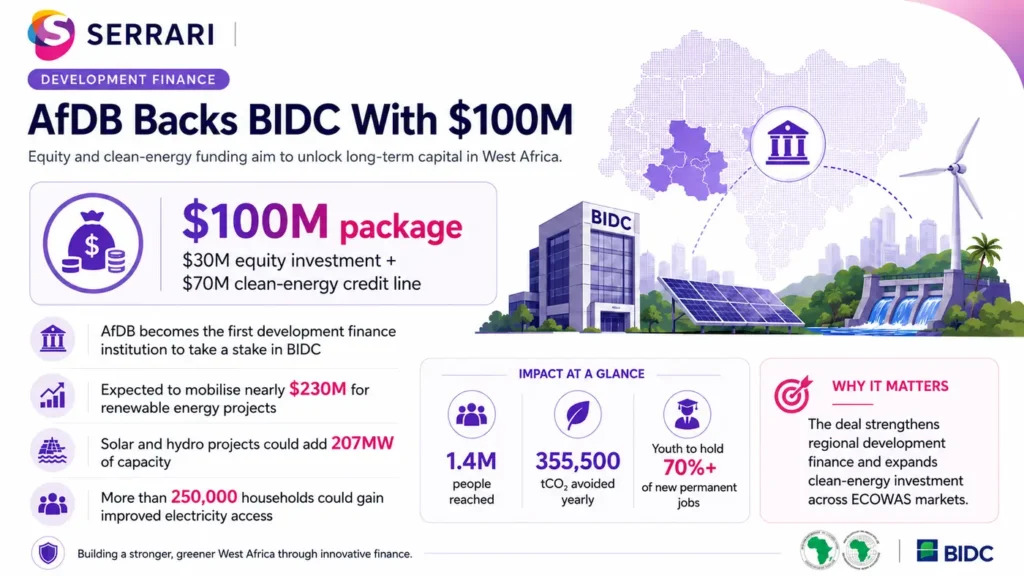
- AfDB approved a $100 million package for BIDC on 17 June 2026.
- The package includes a $30 million equity investment and a $70 million clean-energy credit line.
- AfDB becomes the first development finance institution to take an equity stake in BIDC.
- The credit facility is expected to help mobilise nearly $230 million for renewable energy generation.
- Target projects include solar and hydropower, with expected additional capacity of 207 megawatts.
- The operation is expected to improve electricity access for more than 250,000 households, reaching nearly 1.4 million people.
- AfDB says supported projects could mitigate 355,500 tonnes of annual CO₂ emissions.
AfDB takes a strategic stake in BIDC
The equity component is a major institutional signal. By taking a $30 million stake, AfDB is not only injecting capital into BIDC but also strengthening the regional bank’s credibility with international investors. BIDC is the financial arm of ECOWAS and belongs to the region’s 15 member states, according to this institutional profile.
The investment gives AfDB a board seat, which could support stronger governance, improved investor confidence and closer alignment between regional development finance and continental priorities. This matters because West Africa faces a long-term need for patient capital in infrastructure, energy, industry and private sector development.
BIDC’s own platform describes the bank as a regional development finance institution focused on supporting ECOWAS member states through private and public sector financing. In recent activity, EBID said it had approved financing operations to support private sector development and energy security following its 98th Ordinary Session, showing that the AfDB facility comes at a time when the institution is actively expanding its regional role.
Clean energy credit line targets underserved communities
The second component of the package is a $70 million long-term credit facility for new clean energy projects. AfDB says BIDC will use the facility to expand clean energy production for underserved communities and businesses across West Africa.
The expected leverage is significant. AfDB estimates that the credit line could mobilise nearly $230 million in financing for renewable energy generation, particularly solar and hydropower projects. These projects are expected to represent 207 megawatts of additional capacity.
Beyond generation capacity, the social impact is central to the transaction. The funded projects are expected to improve electricity access for more than 250,000 households, affecting nearly 1.4 million people. AfDB also expects the projects to cut 355,500 tonnes of annual CO₂ emissions, making the facility both an energy access and climate finance intervention.
The youth employment angle is also important. The AfDB announcement says young people are expected to account for more than 70 percent of all newly created permanent jobs under the funded initiatives. That positions the package as more than an energy transaction: it is also a development finance tool for jobs, skills and local economic participation.
Context is everything. Stay ahead of shifting trends with today’s market updates, and uncover emerging opportunities using the Serrari Group Market Index and Marketplace. Then, take control of your own financial future by exploring our Money & Life Reset Transformation Blueprint ™ to build stronger habits, create better systems, and design a path toward lasting wealth.
Deal supports Africa’s financing architecture
The operation aligns with AfDB’s New African Financial Architecture for Development, a framework designed to strengthen Africa’s ability to mobilise large-scale development capital. AfDB has described NAFAD as a response to structural barriers that limit resource mobilisation and contribute to Africa’s estimated annual development financing gap, as outlined in its April 2026 update.
By investing directly in BIDC, AfDB is supporting a regional development bank that already understands local markets, policy environments and project pipelines. This could help crowd in additional investors who may be more comfortable participating alongside a triple-A-rated multilateral development bank.
The package also supports broader electricity access goals. AfDB and its partners are working through Mission 300, which aims to connect 300 million Africans to electricity by 2030. While the BIDC facility is a separate transaction, its focus on clean power, underserved communities and regional capital mobilisation fits within the same development challenge.
Why the transaction matters for West Africa
West Africa’s energy gap remains one of the region’s biggest constraints on growth. Reliable electricity is essential for industry, healthcare, education, agriculture processing, digital services and small businesses. Yet many communities still face limited access, weak grid coverage or costly power supply.
The AfDB-BIDC deal addresses this problem from two sides. First, it strengthens a regional lender that can finance development projects across ECOWAS countries. Second, it creates a long-term funding channel for renewable energy projects that can expand access and reduce emissions.
If successfully deployed, the facility could help BIDC become a stronger platform for regional energy finance. It could also show how development finance institutions can use equity, governance support and credit lines together to unlock more capital for Africa’s infrastructure needs.
Sources used: African Development Bank Group / ECOWAS Bank for Investment and Development / West African Development Bank / African Development Bank Mission 300
Your financial future isn’t something you wait for—it’s something you build.
The real question is: when do you begin?
Move beyond simply staying informed.
Navigate the markets with clarity—track trends through the Serrari Group Market Index, uncover opportunities in the Serrari Marketplace, and build practical knowledge with our Curated Wealth Builder Platform.
Stay connected to what truly matters.
Get daily insights on macro trends and financial movements across Kenya, Africa, and global markets—delivered through the Serrari Newsletter.
Growth opens doors.
Advance your career through professional programs including ACCA, HESI A2, ATI TEAS 7 , HESI EXIT , NCLEX – RN and NCLEX – PN, Financial Literacy!🌟—designed to move you forward with confidence.
See where money is flowing—clearly and in real time.
Track Money Market Funds, Treasury Bills, Treasury Bonds, Green Bonds, and Fixed Deposits, alongside global and African indexes, key economic indicators, and the evolving Crypto and stablecoin landscape—all within Serrari’s Market Index.