
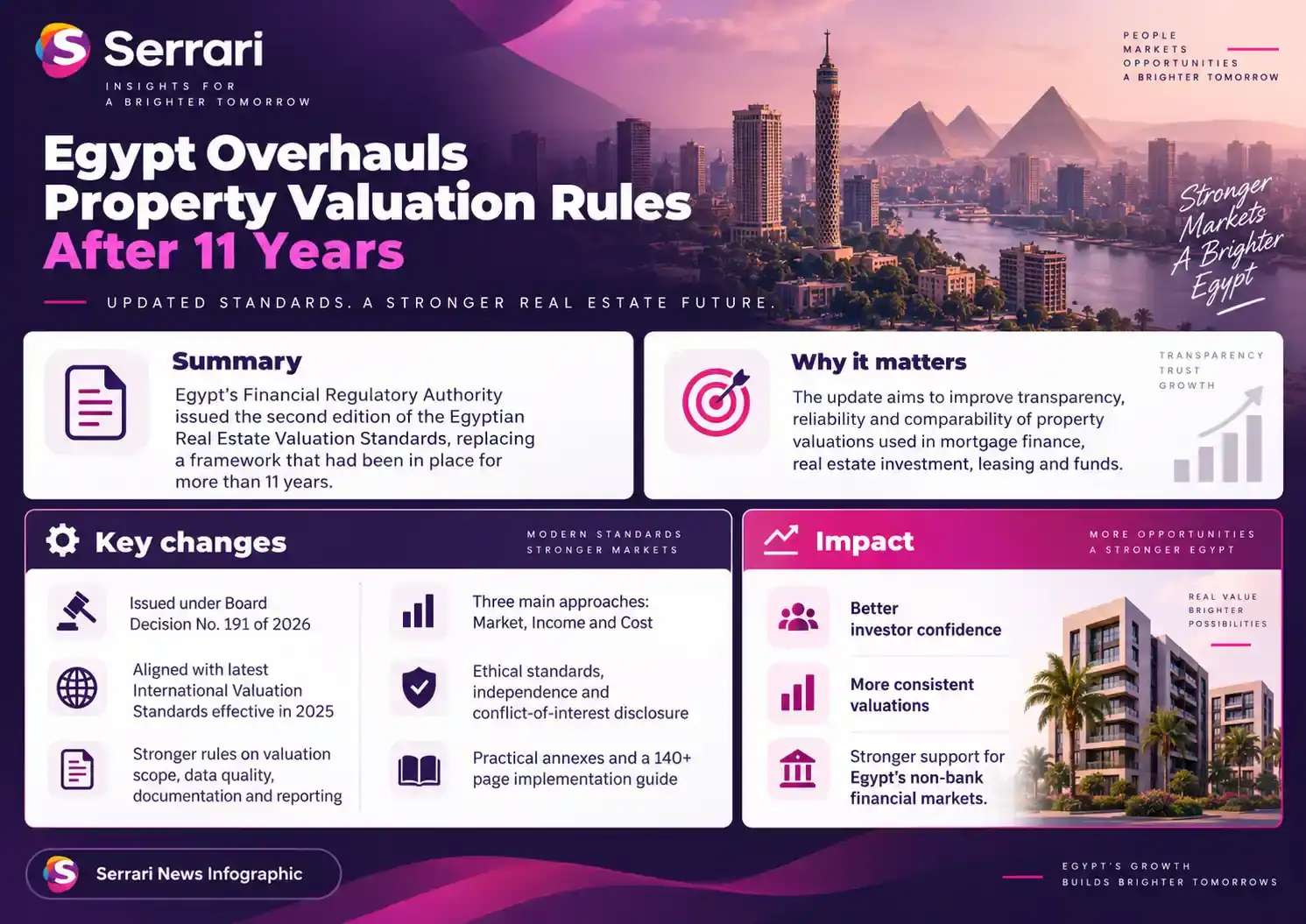
Egypt’s Financial Regulatory Authority (FRA) has introduced the second edition of the country’s real estate valuation standards, replacing a framework that had remained largely unchanged for more than 11 years. The overhaul, issued under Board Decision No. 191 of 2026, is designed to improve the reliability, transparency and comparability of valuations used across mortgage finance, property investment, financial leasing, investment funds and other activities linked to real estate assets.
The new framework also brings Egyptian practice closer to the latest international valuation principles while adapting those rules to the country’s regulatory and economic environment.
Key Overview
The standards establish clearer requirements for valuation scope, data quality, professional independence, conflicts of interest, documentation and reporting. They retain three principal valuation approaches — market, income and cost — while encouraging valuers to use more than one method when available evidence is insufficient for a dependable conclusion.
The reform also introduces detailed guidance for valuing property rights, development projects and assets under construction, supported by practical applications and an indicative reporting template. The accompanying guide runs to more than 140 pages across nine main chapters.
An 11-Year Overhaul of Egypt’s Valuation Framework
The second edition follows the first standards introduced under FRA Board Decision No. 39 of 2015. The regulator consulted market participants before finalising the new framework, allowing changes in property markets, financing structures and valuation practice to be reflected in the updated rules.
The standards were issued within the FRA’s broader mandate under Law No. 10 of 2009, which gives the authority responsibility for supervising and regulating Egypt’s non-bank financial markets.
The revised framework is particularly significant because property valuations can influence lending decisions, investment fund calculations, leasing arrangements and the reported value of real estate assets. Greater consistency in how those valuations are prepared should make it easier for lenders, investors and other market participants to assess assets on a more comparable basis.
Alignment With International Valuation Standards
A central objective of the reform is alignment with the latest International Valuation Standards. The current IVS edition was published in January 2024 and became effective on 31 January 2025, introducing strengthened requirements around data and inputs, valuation models, documentation and reporting.
Egypt’s updated framework incorporates similar priorities while retaining compatibility with domestic legislation. This is intended to improve transparency, consistency and objectivity while making Egyptian valuation reports easier to compare with work produced under internationally recognised valuation frameworks.
For foreign investors, lenders and institutional property owners, stronger comparability can be important when assessing risk, collateral quality and expected returns across different markets.
Context is everything. Stay ahead of shifting trends with today’s market updates, and uncover emerging opportunities using the Serrari Group Market Index and Marketplace. Then, take control of your own financial future by exploring our Money & Life Reset Transformation Blueprint ™ to build stronger habits, create better systems, and design a path toward lasting wealth.
Three Core Approaches and Stronger Data Rules
The standards continue to recognise the market, income and cost approaches as the three principal ways of determining property value. A valuer must select the approach — or combination of approaches — that best fits the asset, the purpose of the valuation and the definition of value being sought.
The market approach relies heavily on comparable transactions or observable market evidence. The income approach focuses on the income-generating capacity of an asset, while the cost approach considers the cost of replacing or reproducing an asset after relevant adjustments.
Under the revised rules, data should be based on factual information such as measurements and published prices. Valuers must assess whether inputs are accurate, complete, clear and timely, while also considering environmental, social and governance factors where they can influence asset value. The new standards also encourage multiple methods where a single approach does not provide enough evidence for a reliable conclusion.
Ethics, Independence and Documentation Take Greater Weight
Professional conduct is another major focus. Valuers and supporting teams must demonstrate competence, independence and objectivity, while disclosing potential conflicts of interest and avoiding dishonest, fraudulent or deceptive conduct.
The rules also strengthen record-keeping. Information associated with a valuation must generally be retained for at least five years from the date of the report, or for two years after the latest legal proceedings connected with the relevant property.
Reports must clearly explain the valuation approach, methods, inputs, data and risk-management considerations used to reach the final conclusion. These requirements are intended to make valuations easier to review, challenge and reproduce where necessary.
Development Property and Real Estate Rights Covered
The framework goes beyond completed buildings. It includes ownership interests, leasehold and possession rights, rights of use, market rent assessments and properties under development.
Rules for development property cover new buildings, undeveloped land after infrastructure installation, redevelopment projects and improvements or modifications to existing structures. This wider coverage is important for developers, financiers and investors dealing with projects whose value changes substantially during construction.
Practical annexes provide guidance for general property valuation, financial-statement purposes, mortgage finance, financial leasing and projects under construction. The regulator has also included an indicative valuation report template to support more consistent application.
What the New Standards Mean for the Market
The overhaul gives Egypt a more detailed and internationally aligned framework for determining real estate value. For mortgage providers, investment funds and property investors, the biggest potential benefit is greater confidence in how underlying asset values are calculated and documented.
The 140-page-plus implementation guide is divided into nine chapters covering the valuation framework, scope of work, bases of value, approaches, data and inputs, valuation models, documentation and reporting, among other areas.
Implementation will therefore depend not only on the written standards but also on how consistently valuers, financial institutions and other market participants apply the new requirements in practice.
Sources: Financial Regulatory Authority / International Valuation Standards Council / Daily News Egypt / Ahram Business / El Muashir
Your financial future isn’t something you wait for—it’s something you build.
The real question is: when do you begin?
Move beyond simply staying informed.
Navigate the markets with clarity—track trends through the Serrari Group Market Index, uncover opportunities in the Serrari Marketplace, and build practical knowledge with our Curated Wealth Builder Platform.
Stay connected to what truly matters.
Get daily insights on macro trends and financial movements across Kenya, Africa, and global markets—delivered through the Serrari Newsletter.
Growth opens doors.
Advance your career through professional programs including ACCA, HESI A2, ATI TEAS 7 , HESI EXIT , NCLEX – RN and NCLEX – PN, Financial Literacy!🌟—designed to move you forward with confidence.
See where money is flowing—clearly and in real time.
Track Money Market Funds, Treasury Bills, Treasury Bonds, Green Bonds, and Fixed Deposits, alongside global and African indexes, key economic indicators, and the evolving Crypto and stablecoin landscape—all within Serrari’s Market Index.