
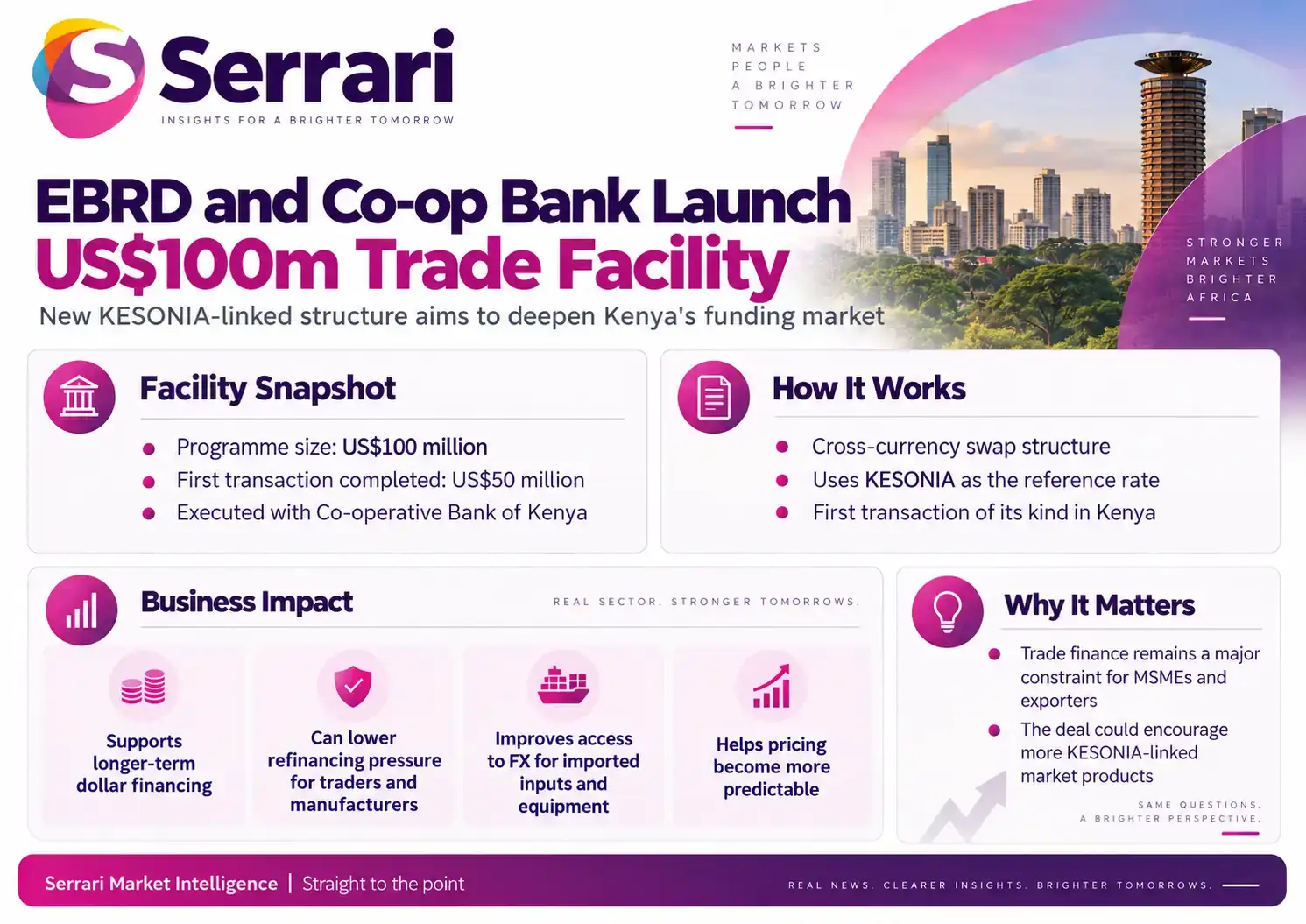
The European Bank for Reconstruction and Development and Co-operative Bank of Kenya have launched a $100 million cross-currency swap programme, opening a new channel for longer-term financing while marking a milestone in the development of Kenya’s financial markets.
The first $50 million transaction has already been completed under the programme. It is the first cross-currency swap in Kenya to use the Kenya Shilling Overnight Interbank Average, or KESONIA, as its reference rate.
The structure gives the two institutions access to funding in the currencies they require while reducing reliance on repeated transactions in the spot foreign-exchange market.
Key Overview
The deal has two important dimensions. Co-op Bank says the first $50 million tranche strengthens its ability to provide longer-term, competitively priced foreign-currency financing to Kenyan businesses, while the EBRD says the transaction enhances its ability to raise and manage Kenyan-shilling funding.
At the same time, using KESONIA in a live cross-currency transaction gives Kenya’s relatively new reference rate an important real-world test and could encourage its adoption in more sophisticated financial products.
How the $100 Million Currency Swap Works
A cross-currency swap allows two counterparties to exchange funding denominated in different currencies and agree on the terms for reversing those exchanges over an agreed period.
Under the new arrangement, dollar and shilling funding can be exchanged between the institutions, allowing each side to better match the currency of its financing with its own requirements.
The EBRD says the swap will strengthen its ability to manage Kenyan-shilling funding, supporting more local-currency financing for businesses whose revenues are largely earned in shillings.
For Co-op Bank, the programme also provides a more stable framework for accessing foreign-currency funding. The bank says the initial $50 million transaction improves its capacity to provide longer-term foreign-currency loans to businesses.
That can be especially relevant to firms that genuinely earn dollars or require foreign currency to pay for imported machinery, equipment, industrial inputs and other goods that cannot easily be sourced locally.
KESONIA Reaches an Important Milestone
The transaction is significant because it is the first cross-currency swap to use KESONIA, helping move the benchmark from regulatory reform into practical market use.
KESONIA is a transaction-based overnight benchmark calculated from actual unsecured lending between Kenyan banks. It is published every business day and is intended to provide a transparent reference point for financial contracts.
The benchmark began being published together with the KESONIA Compounded Index in September 2025 as part of Kenya’s efforts to modernise its interest-rate framework.
Unlike a benchmark based largely on submissions or estimates, KESONIA is calculated as a volume-weighted average of actual overnight interbank transactions.
Its adoption in a major cross-currency swap shows that the benchmark can also support more complex products involving international financial institutions.
Context is everything. Stay ahead of shifting trends with today’s market updates, and uncover emerging opportunities using the Serrari Group Market Index and Marketplace. Then, take control of your own financial future by exploring our Money & Life Reset Transformation Blueprint ™ to build stronger habits, create better systems, and design a path toward lasting wealth.
Why the Deal Matters for Kenyan Businesses
Access to suitable financing remains a major constraint for many African businesses participating in international trade.
Research on the region has found that shortfalls in trade finance can limit SMEs’ participation in international markets, particularly when businesses cannot obtain affordable funding for working capital, imports or export transactions.
For Kenyan companies, the challenge can be particularly acute when financing requirements are denominated in foreign currency.
A manufacturer importing specialised machinery, industrial chemicals or components may need dollar financing even when much of its revenue is generated locally. Exporters may also require working capital while waiting for foreign-currency receipts.
Longer-term and more predictable access to funding can therefore help businesses plan capital expenditure, manage cash flows and avoid repeatedly refinancing short-term facilities.
Swap Could Deepen Kenya’s Financial Markets
The deal extends beyond the immediate financing available through Co-op Bank.
The KESONIA benchmark framework was introduced to improve transparency, strengthen monetary-policy transmission and provide a reference point aligned with international benchmark reforms.
Demonstrating that the rate can support an international cross-currency swap could encourage additional banks, institutional investors and development financiers to use KESONIA-linked instruments.
Greater adoption could eventually support improved price discovery, deeper derivative markets and more sophisticated risk-management products for Kenyan institutions.
The central bank has also indicated that developing KESONIA lays the foundation for instruments such as term reference rates, KESONIA-linked products and a domestic derivatives market.
First $50 Million Could Set a Wider Precedent
The completed $50 million deal is only the first use of the broader $100 million programme, leaving scope for additional transactions between the two institutions.
The EBRD only began investing in Kenya in 2025, with its activities focused on areas including private-sector development, financial inclusion, sustainable infrastructure and the green transition.
For Co-op Bank, the arrangement adds another international funding channel at a time when businesses continue to require longer-term capital for trade, manufacturing and investment.
More broadly, the transaction provides an early demonstration of how Kenya’s benchmark-rate reforms can be incorporated into institutional transactions. If similar structures are adopted by other banks, KESONIA could become increasingly important in pricing loans, swaps and other financial products across the domestic market.
Sources
European Bank for Reconstruction and Development / Central Bank of Kenya / Co-operative Bank of Kenya / African Development Bank / The Standard
Your financial future isn’t something you wait for—it’s something you build.
The real question is: when do you begin?
Move beyond simply staying informed.
Navigate the markets with clarity—track trends through the Serrari Group Market Index, uncover opportunities in the Serrari Marketplace, and build practical knowledge with our Curated Wealth Builder Platform.
Stay connected to what truly matters.
Get daily insights on macro trends and financial movements across Kenya, Africa, and global markets—delivered through the Serrari Newsletter.
Growth opens doors.
Advance your career through professional programs including ACCA, HESI A2, ATI TEAS 7 , HESI EXIT , NCLEX – RN and NCLEX – PN, Financial Literacy!🌟—designed to move you forward with confidence.
See where money is flowing—clearly and in real time.
Track Money Market Funds, Treasury Bills, Treasury Bonds, Green Bonds, and Fixed Deposits, alongside global and African indexes, key economic indicators, and the evolving Crypto and stablecoin landscape—all within Serrari’s Market Index.